Ministry of Home Affairs Unveils Prahaar Counter Terrorism Policy
Source:Indian Express ↗
Why It Matters
Counter-terrorism is a core aspect of the GS3 Internal Security syllabus. The introduction of 'Prahaar' provides aspirants with an official, structured government framework to cite when discussing India's defense against cross-border terrorism, cyber threats, and the misuse of advanced technologies like drones and the dark web by extremist entities.
Summary
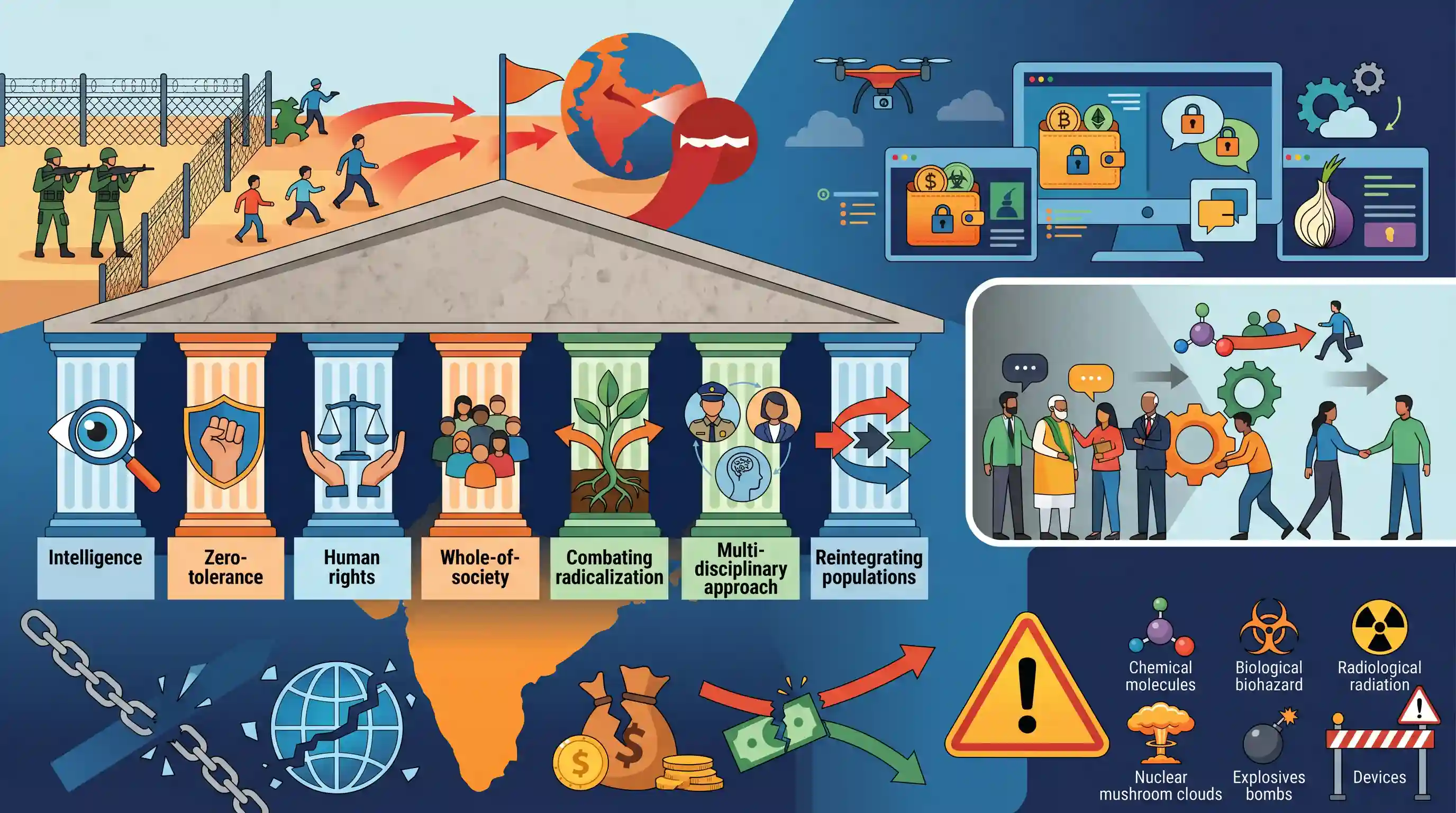
The Centre has announced 'Prahaar', India's first dedicated counter-terrorism policy designed to comprehensively dismantle terror networks, their financing, and logistics. Structured around a seven-pillar framework, it balances intelligence-led, zero-tolerance responses with human rights and a whole-of-society effort to combat radicalization. The policy specifically identifies state-sponsored cross-border terrorism and the evolving threat landscape driven by modern technologies—such as drones, crypto wallets, encrypted messaging, and the dark web—as pressing internal security challenges. Furthermore, it outlines a multi-disciplinary approach for de-radicalization, utilizing community leaders and experts to reintegrate affected populations while enhancing vigilance against CBRNED material misuse.
Key Points
- The Ministry of Home Affairs has unveiled 'Prahaar', India's first comprehensive counter-terrorism policy based on a zero-tolerance approach.
- The policy features a seven-pillar strategy that includes intelligence-led prevention, human rights and rule-of-law adherence, global alignment, and whole-of-society resilience.
- It emphasizes denying terrorists access to funds, weapons, and safe havens while addressing the threat of cross-border, state-sponsored terrorism and global outfits like Al Qaeda and ISIS.
- The document highlights severe challenges from the misuse of emerging technologies such as drones, the dark web, encryption, and crypto wallets by extremist groups for logistics, funding, and propaganda.
- It calls attention to the critical threat posed by CBRNED (chemical, biological, radiological, nuclear, explosive, digital) materials falling into terrorist hands.
- A multi-disciplinary approach involving civil society, doctors, and religious leaders will be utilized to tackle radicalization and reintegrate affected communities.
Important Terms
Prahaar (National Counter-Terrorism Policy)

India's first comprehensive counter-terrorism doctrine (2026), institutionalizing a 'zero-tolerance' stance through a seven-pillar framework integrating intelligence, law enforcement, and social interventions to dismantle terror ecosystems.
UPSC context
GS Paper III (Internal Security); tests knowledge of national security architecture and policy shifts.
Zero-Tolerance Policy
India's firm governance stance rejecting any justification for terrorism. It mandates swift, proportionate responses and the total dismantling of financing and logistics networks without compromise.
UPSC context
GS Paper III (Internal Security); represents the core principle of India’s security doctrine.
Whole-of-Society Approach
A collaborative strategy involving government, private sectors, and civil society to build national resilience, manage post-attack recovery, and prevent radicalization through community-level engagement.
UPSC context
GS Paper III (Security/Governance); tests multi-stakeholder participation in maintaining internal stability.
CBRNED
An acronym for Chemical, Biological, Radiological, Nuclear, Explosive, and Digital threats. These are high-consequence non-traditional vectors identified as pressing modern security challenges.
UPSC context
GS Paper III (Internal Security/Science & Tech); tests awareness of evolving technology-enabled threats.
De-radicalization
A multi-disciplinary effort to reverse extremist indoctrination using community leaders, psychologists, and experts to reintegrate affected populations into the mainstream society.
UPSC context
GS Paper III (Internal Security); crucial for questions on preventing home-grown extremism.
Cross-border Terrorism
Terrorist activity originating in one country and targeting another, typically involving state-sponsored infrastructure, training, and financing to achieve geopolitical objectives.
UPSC context
GS Paper III (Internal Security); fundamental for analyzing state-sponsored threats and border management.
Prelims Trap
"Prahaar is a joint military operation led by the Ministry of Defence to execute cross-border kinetic strikes."
Prahaar is a comprehensive policy launched by the Ministry of Home Affairs, not a military strike. Also, an earlier 'Operation Prahaar' was an anti-Naxal operation, causing potential naming confusion.
Static Concepts Connected
What is the institutional framework against Terror Financing in India?
- UAPA 1967: The primary legislation criminalizing the raising of funds, from legitimate or illegitimate sources, for terrorist acts.
- FIU-IND: The central, independent agency responsible for receiving, processing, and analyzing reports of suspicious financial transactions (STRs).
- FATF Alignment: India's domestic laws and RBI mandates align with FATF guidelines, specifically regarding strict KYC norms and the recent inclusion of crypto-asset monitoring.
What does the CBRN(E) threat encompass in internal security?
- Definition: Stands for Chemical, Biological, Radiological, Nuclear, and Explosive emergencies. The new 'Prahaar' policy notably adds 'D' for Digital.
- WMD Act 2005: Prohibits unlawful activities regarding Weapons of Mass Destruction and their delivery systems by non-state actors.
- NDMA Guidelines: The nodal agency that provides specific Standard Operating Procedures (SOPs) for state and district administrations to manage CBRN disasters.
Cross-Topic Patterns
Terror financing + Crypto/Dark Web
The intersection of virtual digital assets (crypto) and the dark web bridges GS3 Cyber Security with conventional Internal Security, mirroring the FATF's recent regulatory focus on decentralized finance.
Whole-of-Society De-radicalization
Shifting from purely kinetic (military) action to involving civil society and religious leaders bridges GS3 security management with GS4 concepts of emotional intelligence, attitude change, and social persuasion.

Expect a 2026 GS3 mains question evaluating 'Prahaar's shift from kinetic military operations to a 'whole-of-society' model.
Linked PYQs · 4
Linked PYQs · 4
- 2025MainsGS3
Terrorism is a global scourge. How has it manifested in India? Elaborate with contemporary examples. What are the counter measures adopted by the State? Explain.
- 2023MainsGS3
The use of unmanned aerial vehicles (UAVs) by our adversaries across the borders to ferry arms/ammunitions, drugs, etc., is a serious threat to the internal security. Comment on the measures being taken to tackle this threat.
- 2024MainsGS3
Social media and encrypting messaging services pose a serious security challenge. What measures have been adopted at various levels to address the security implications of social media? Also suggest any other remedies to address the problem.
- 2016MainsGS3
Use of Internet and social media by non-state actors for subversive activities is a major security concern. How have these been misused in the recent past? Suggest effective guidelines to curb the above threat.
