Uttarakhand Sanskrit Commission Setup and Preservation Goals
Source:garhwal-post ↗
Why It Matters
In UKPSC PCS Prelims, State-Specific GK is highly prioritized. Uttarakhand being the first state to adopt Sanskrit as its second official language makes any new institutional development related to it—like the Sanskrit Commission—a highly probable question for Prelims.
Summary
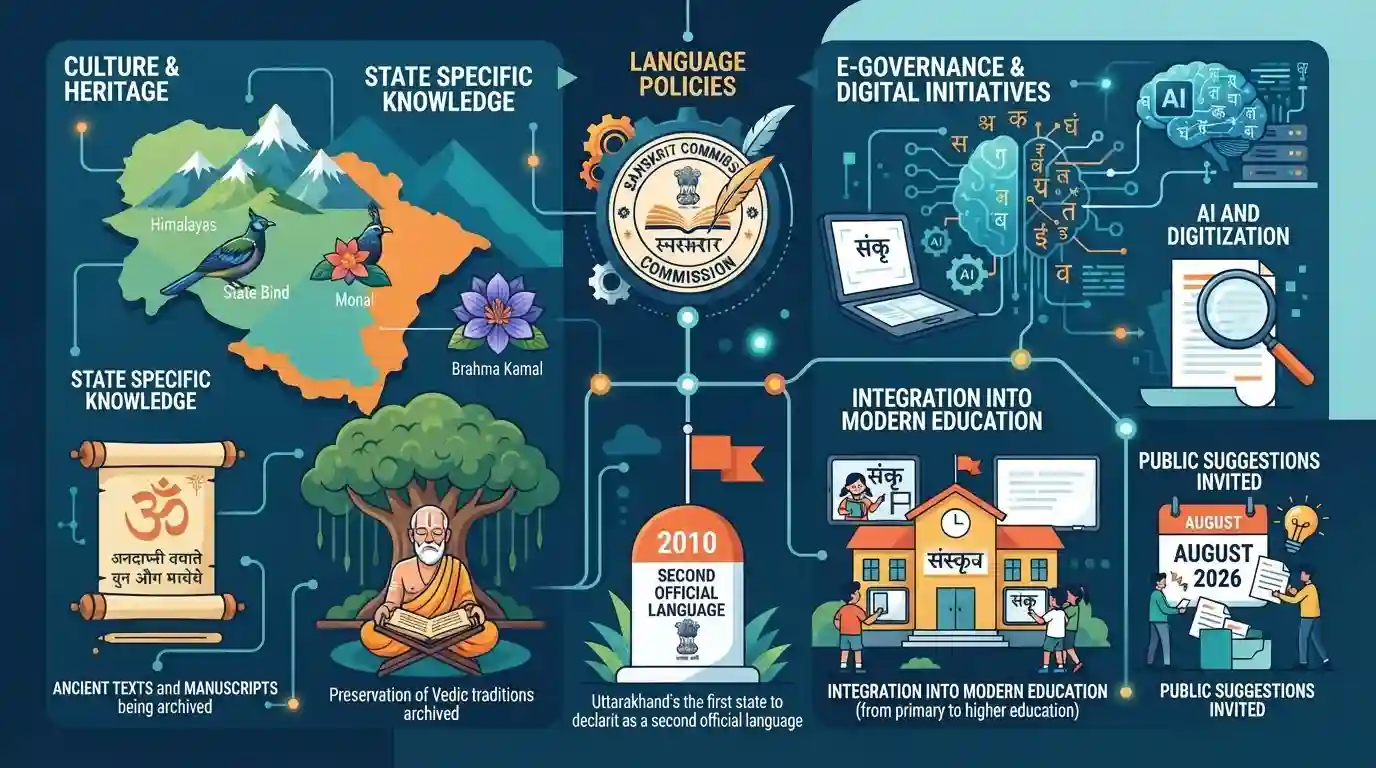
The Uttarakhand government is preparing to establish a Sanskrit Commission aimed at preserving, promoting, and integrating the Sanskrit language into modern education and digital platforms. The government has invited public suggestions until August 10, 2026, to shape the Commission’s objectives. Focus areas include integrating Sanskrit into the syllabus from primary to higher education, preserving Vedic traditions and manuscripts, and exploring the language's use in artificial intelligence and digitization. Notably, Uttarakhand was the first state in India to declare Sanskrit as its second official language in 2010.
Key Points
- The Uttarakhand government is in the process of setting up a Sanskrit Commission to preserve, promote, and research the Sanskrit language.
- Uttarakhand was the first state in India to adopt Sanskrit as its second official language (in 2010).
- Public suggestions for the Commission’s structure and objectives have been invited through the portal sanskrit.uk.gov.in until 10 August 2026.
- Key focus areas of the proposed Commission include integrating Sanskrit from primary to higher education, preserving Vedic traditions, manuscripts, and scriptures, and promoting Sanskrit journalism and literature.
- The Commission will also explore the intersection of Sanskrit with Artificial Intelligence (AI), digitization, and digital platforms.
Important Terms
Sanskrit Commission

A high-level advisory body constituted to review, preserve, and promote Sanskrit education, research, and its integration into modern digital and academic systems.
UPSC context
GS Paper I (Art & Culture) and II (Education). Tests understanding of linguistic heritage preservation policies.
Article 345 of the Indian Constitution
A constitutional provision that empowers state legislatures to officially adopt one or more languages in use within the state, or Hindi, for administrative purposes.
UPSC context
GS Paper II (Polity & Governance). Tests knowledge of linguistic federalism and state legislative powers.
Second Official Language
An additional administrative language adopted by a state government under constitutional provisions to promote regional identity and linguistic heritage.
UPSC context
GS Paper II (Polity). Tests understanding of state-level official language policies and regional administrative choices.
Eighth Schedule
A schedule of the Indian Constitution that lists the 22 officially recognized languages of India, including Sanskrit, aimed at promoting and enriching them.
UPSC context
GS Paper II (Polity). Tests familiarity with constitutional schedules and safeguards for linguistic diversity.
Prelims Trap
Parliament determines a state's second official language based on the Eighth Schedule.
Under Article 345, the State Legislature, not Parliament, has the exclusive power to adopt any language in use in the state as its official language.
Static Concepts Connected
How are official languages of Indian states determined constitutionally?
- Article 345: Empowers state legislatures to adopt any language(s) in use in the state, or Hindi, as the official language.
- Eighth Schedule Independence: A language does not need to be listed in the Eighth Schedule to be adopted as a state's official language.
- Article 347: The President may recognize a language state-wide if a substantial proportion of the population demands it.
What are the criteria for a language to be declared 'Classical' in India?
- High Antiquity: Must possess a recorded history or early texts spanning 1500 to 2000 years.
- Valuable Heritage: Must have a body of ancient literature considered a valuable heritage by generations of speakers.
- Originality: The literary tradition must be original and not borrowed from another speech community.
Cross-Topic Patterns
Sanskrit Grammar & NLP (AI)
Panini’s 'Ashtadhyayi' features an algorithmic rule system. UPSC frequently links ancient heritage with modern science, highlighting Sanskrit's structural compatibility with Natural Language Processing (NLP).
NEP 2020 & Classical Languages
Integrating Sanskrit into primary and higher education fulfills NEP 2020's mandate to mainstream ancient Indian languages, shifting them from ritualistic domains into practical, modern pedagogy.

Expect a 2026 Prelims statement mixing Article 345 (State language powers), classical language criteria, and Panini's grammar structure in AI.
Linked PYQs · 2
Linked PYQs · 2
- 2025UKPSC_PRELIMSGS1
Consider the following statements about Uttarakhand Human Rights Commission and choose the correct option from the options given below: 1. Uttarakhand Human Rights Commission came into existence on May 13, 2013. 2. The objectives of UHRC was to bring about greater accountability and transparency in governance.
- 2024UKPSC_PRELIMSGS1
UTDB is established in Uttarakhand to promote:
