Government Announces Cochin Shipyard Stake Sale via OFS
Source:The Hindu ↗
Why It Matters
This article represents a practical application of India's disinvestment policy and public finance management. Understanding how minority stake sales (like OFS) generate capital receipts without sacrificing management control is crucial for GS-3 (Government Budgeting/Resource Mobilization) and GS-1/Prelims (basic conceptual understanding of capital vs. revenue receipts).
Summary
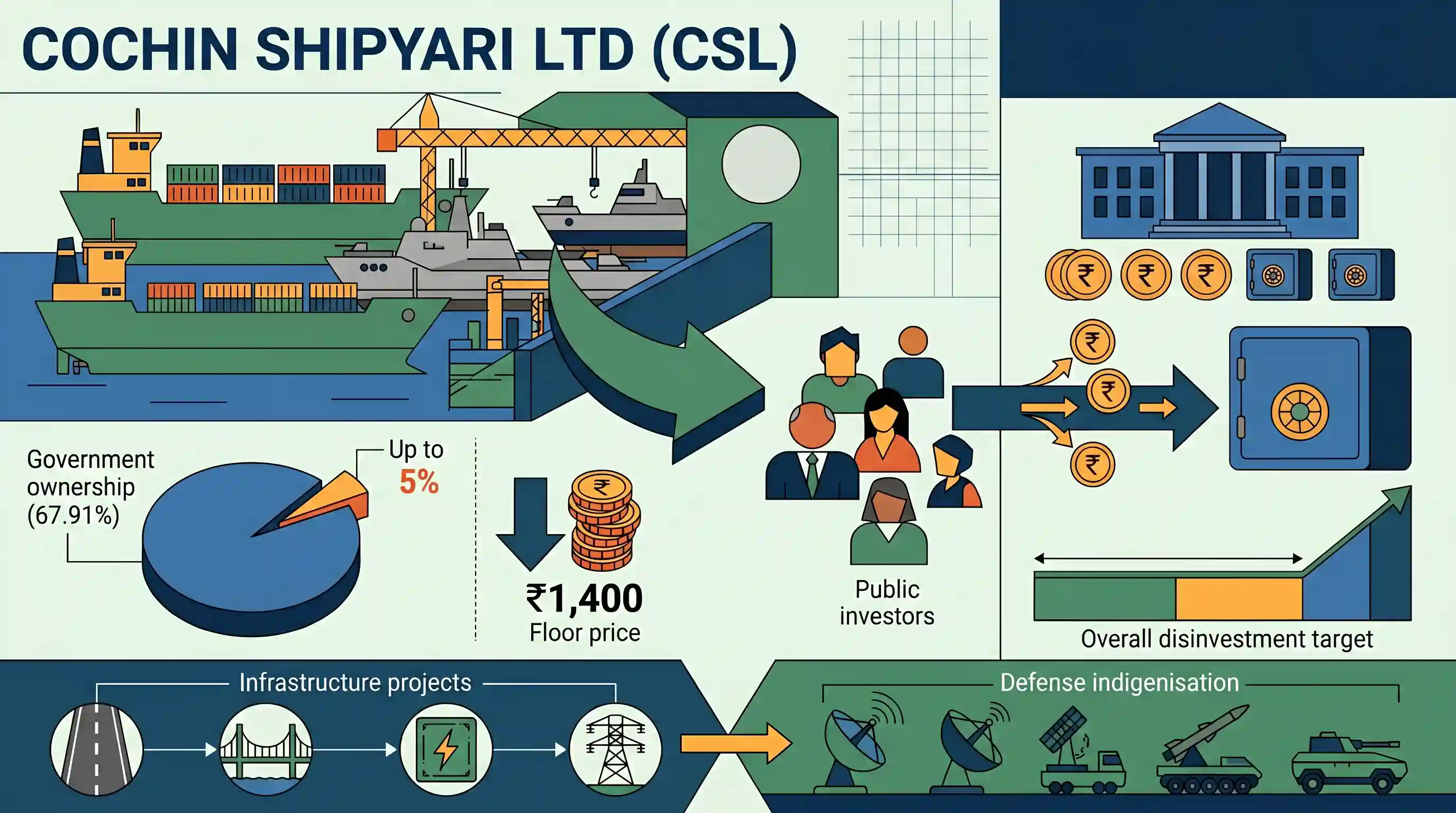
The Government of India is divesting up to a 5% stake in Cochin Shipyard Ltd (CSL) through an Offer for Sale (OFS) at a floor price of ₹1,400 per share. Managed by the Department of Investment and Public Asset Management (DIPAM), the sale includes a 2.52% base offer and a 2.52% green-shoe option. The government holds 67.91% in CSL, meaning it will retain majority ownership and management control post-sale. This disinvestment forms part of the government's ₹80,000 crore annual disinvestment and asset monetisation target.
Key Points
- The Government of India is selling up to a 5% stake in Cochin Shipyard Ltd (CSL) via an Offer for Sale (OFS) with a floor price of ₹1,400 per share.
- The OFS consists of a base offer of 2.52% of paid-up equity and an additional 2.52% as a 'green-shoe option' in case of oversubscription. The government currently holds a 67.91% stake in CSL.
- This transaction is part of the government's broader ₹80,000 crore disinvestment and asset monetisation target for the full fiscal year.
- Prior to this, the government raised ₹18,561 crore in the current fiscal by selling minority stakes in six other public sector enterprises: Central Bank of India, Coal India, NHPC, NLC India, GIC, and IRFC.
- Cochin Shipyard Ltd is India's largest shipbuilding and maintenance facility, holding high strategic significance for maritime security and the indigenous defense manufacturing sector (e.g., building INS Vikrant).
Important Terms
Offer for Sale (OFS)

A simplified mechanism regulated by SEBI that allows promoters or major shareholders of listed companies to sell their existing shares directly to the public through stock exchange bidding, without issuing fresh capital.
UPSC context
GS Paper III (Indian Economy); tests knowledge of capital market instruments, SEBI regulatory frameworks, and public disinvestment.
Department of Investment and Public Asset Management (DIPAM)
A nodal department under the Ministry of Finance, Government of India, responsible for managing central government investments in equity, including disinvestment, strategic sales, and capital restructuring of CPSEs.
UPSC context
GS Paper III (Government Budgeting & Indian Economy); tests understanding of institutional mechanisms for resource mobilization and asset management.
Union Budget (Disinvestment Targets)
Annual revenue-generation targets set by the central government in the Union Budget, achieved by selling equity stakes in public sector enterprises to finance social-sector programs and manage fiscal deficits.
UPSC context
GS Paper III (Government Budgeting); tests understanding of capital receipts, fiscal consolidation, and policies governing public sector undertakings.
Cochin Shipyard Ltd (CSL)
A premier Schedule A Miniratna public sector undertaking under the Ministry of Ports, Shipping, and Waterways, recognized as India's largest shipbuilding and maintenance facility, heavily involved in naval indigenisation.
UPSC context
GS Paper III (Infrastructure & Security); tests knowledge of domestic defense manufacturing, technology indigenisation, and maritime strategic infrastructure.
Prelims Trap
Disinvestment proceeds are classified as debt-creating capital receipts because they dilute state ownership.
Disinvestment proceeds are non-debt capital receipts; they liquidate an asset without creating any repayment liability for the sovereign.
Static Concepts Connected
What is the difference between debt-creating and non-debt-creating capital receipts?
- Debt Capital Receipts: Increase future liabilities (e.g., market borrowings, external loans) that the government must repay with interest.
- Non-Debt Receipts: Do not create future liabilities (e.g., disinvestment proceeds, recovery of loans) but do reduce the government's financial assets.
How do Offer for Sale (OFS) and Strategic Disinvestment differ?
- Offer for Sale (OFS): A simplified exchange-based mechanism for promoters/majority holders to dilute their stake to the public without issuing fresh capital.
- Strategic Disinvestment: Involves selling a block of shares (often >= 51%) along with the transfer of management control to a private entity.
Cross-Topic Patterns
Blue Economy + Fiscal Space
Linking strategic shipbuilding PSU disinvestment receipts directly to capital expenditure allocations for naval indigenisation under the Union Budget.
PSU Governance + Capital Markets
Analyzing how SEBI-regulated market mechanisms like OFS transition traditional PSUs into corporatized entities, balancing state control with market discipline.

Expect a multi-statement question on the classification of disinvestment proceeds vs debt receipts, combined with SEBI's OFS rules in 2026.
Linked PYQs · 2
Linked PYQs · 2
- 2011PrelimsGS1
Why is the Government of India disinvesting its equity in the Central Public Sector Enterprises (CPSEs)? 1. The Government intends to use the revenue earned from the disinvestment mainly to pay back the external debt. 2. The Government no longer intends to retain the management control of the CPSEs. Which of the statements given above is/are correct?
- 2025PrelimsGS1
Consider the following statements : I. Capital receipts create a liability or cause a reduction in the assets of the Government. II. Borrowings and disinvestment are capital receipts. III. Interest received on loans creates a liability of the Government. Which of the statements given above are correct?
