Government to Replace Wholesale Price Index with Producer Price Index
Source:The Hindu ↗
Why It Matters
The shift from WPI to PPI marks a fundamental change in how India measures macroeconomic inflation. It is highly relevant for UPSC Prelims (conceptual differences between CPI, WPI, and PPI, base year changes, and index components) and Mains GS3 (evaluating inflation metrics, monetary policy constraints, and statistical reforms).
Summary
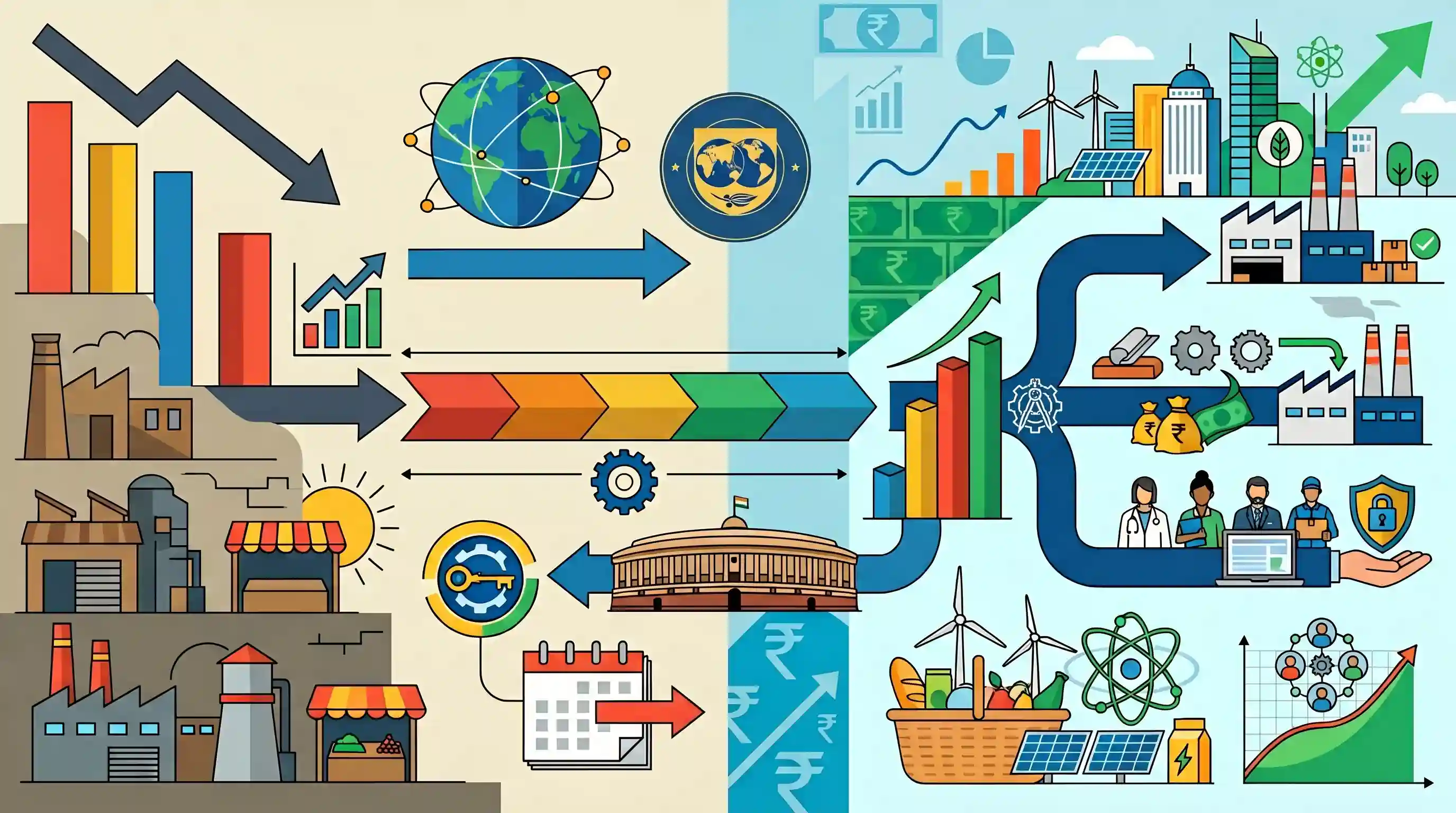
India is set to replace the Wholesale Price Index (WPI) with the Producer Price Index (PPI) over a five-year transition period to better reflect realistic inflation trends, aligning with global standards and IMF recommendations. Starting June 15, the Department for Promotion of Industry and Internal Trade (DPIIT) will launch a revised WPI and three new PPI series (Output, Input, and Services) with a base year of 2022-23. The revised indices involve significant structural changes, such as incorporating services, tracking input costs at purchaser prices, and updating energy baskets with renewables.
Key Points
- The government will phase out the Wholesale Price Index (WPI) over the next five years, replacing it with the Producer Price Index (PPI) to better capture inflationary trends.
- The DPIIT will release a revised WPI series and new PPI indices on June 15 with 2022-23 as the base year, replacing the 2011-12 base year for WPI.
- The new PPI will consist of three indices: Output PPI, Trial Input PPI, and Services PPI. Services PPI will initially cover seven sectors, including banking and telecom.
- In the revised WPI series, total items have increased from 697 to 957; renewables and nuclear have been added to electricity, while crude petroleum and natural gas have shifted to fuel and power.
- WPI, Output PPI, and Service PPI are calculated at basic prices (excluding taxes and margins), whereas Input PPI is calculated using purchaser\'s prices.
- The transition aligns with IMF recommendations and matches practices in advanced economies.
Important Terms
Producer Price Index (PPI)

An index measuring the average change in selling prices received by domestic producers for their output. Unlike WPI, it excludes indirect taxes and includes the services sector.
UPSC context
GS Paper III: Indian Economy; critical for understanding supply-side inflation and as a GDP deflator.
Wholesale Price Index (WPI)
India's legacy inflation index capturing price changes at the first point of bulk sale. It is being phased out in favor of the PPI over five years.
UPSC context
GS Paper III: Inflation and Price Indices; tested in Prelims for its composition and weighting.
Department for Promotion of Industry and Internal Trade (DPIIT)
A department under the Ministry of Commerce and Industry responsible for formulating industrial policy and administering price indices like WPI and the new PPI.
UPSC context
GS Paper II & III: Government Departments/Industrial Growth; nodal agency for FDI and ease of doing business.
International Monetary Fund (IMF)
A global organization that promotes economic stability. Its recommendations and Special Data Dissemination Standard (SDDS) drive India's transition from WPI to the internationally-aligned PPI.
UPSC context
GS Paper II: International Institutions; sets global standards for economic data and fiscal health.
Base Year
The benchmark year (shifted to 2022-23) used for comparing current prices. It is updated periodically to reflect contemporary production and consumption patterns in the economy.
UPSC context
GS Paper III: Economic Growth; relevant for calculating Real GDP and maintaining index accuracy.
Prelims Trap
"Like the WPI, the new Producer Price Index (PPI) exclusively measures price changes in goods, excluding the services sector."
The new PPI framework explicitly introduces a 'Services PPI' (covering banking, telecom, etc.), a major structural departure from the goods-only WPI.
Static Concepts Connected
What are the fundamental differences between WPI and CPI?
- Coverage: WPI covers only goods, whereas CPI captures price changes for both goods and services consumed by households.
- Weightage: Manufactured goods dominate the WPI basket, while food and beverages hold the highest weight in CPI.
- Publishing Agency: WPI is published by the Office of Economic Adviser (DPIIT), while CPI is published by the National Statistical Office (MoSPI).
How do Basic Prices differ from Purchaser's Prices in national accounting?
- Basic Price: The amount receivable by the producer, excluding taxes on products and transport margins, but including subsidies on products.
- Purchaser's Price: The amount actually paid by the buyer, which includes trade margins, transport charges, and non-deductible product taxes.
Cross-Topic Patterns
Monetary Policy & Anchor Metrics
RBI uses CPI for inflation targeting, but WPI-CPI divergence complicates policy. PPI’s accurate input-cost tracking will give the Monetary Policy Committee better leading indicators for core retail inflation trends.
Energy Transition in Macro Data
The inclusion of solar and wind power in the new electricity index mirrors India's structural shift toward its Panchamrit climate commitments, embedding green energy into baseline economic metrics.

Expect a 2026 Prelims multi-statement question testing the exact differences in coverage (goods vs. services) between CPI, WPI, and PPI.
Linked PYQs · 4
Linked PYQs · 4
- 2020PrelimsGS1
Consider the following statements: 1. The weightage of food in Consumer Price Index (CPI) is higher than that in Wholesale Price Index (WPI). 2. The WPI does not capture changes in the prices of services, which CPI does. 3. Reserve Bank of India has now adopted WPI as its key measure of inflation and to decide on changing the key policy rates. Which of the statements given above is/are correct?
- 2010PrelimsGS1
With reference to India, consider the following statements : 1. The Wholesale Price Index (WPI) in India is available on a monthly basis only. 2. As compared to Consumer Price Index for Industrial Workers (CPI(IW)), the WPI gives less weight to food articles. Which of the statements given above is/are correct ?
- 1997PrelimsGS1
In India, inflation is measured by the
- 2001PrelimsGS1
The new series of Wholesale Price Index (WPI) released by the Government of India is with reference to the base prices of
