Telangana Local Body Polls Deferred Amid BC Reservation Debate
Source:The Hindu ↗
Why It Matters
The article illustrates practical applications of constitutional concepts vital for UPSC aspirants, including the legislative powers of the Governor (ordinances), the ongoing legal debates around exceeding the 50% reservation cap for Backward Classes in local bodies, and the implementation/relaxation of demographic policies (two-child norm) in political representation.
Summary
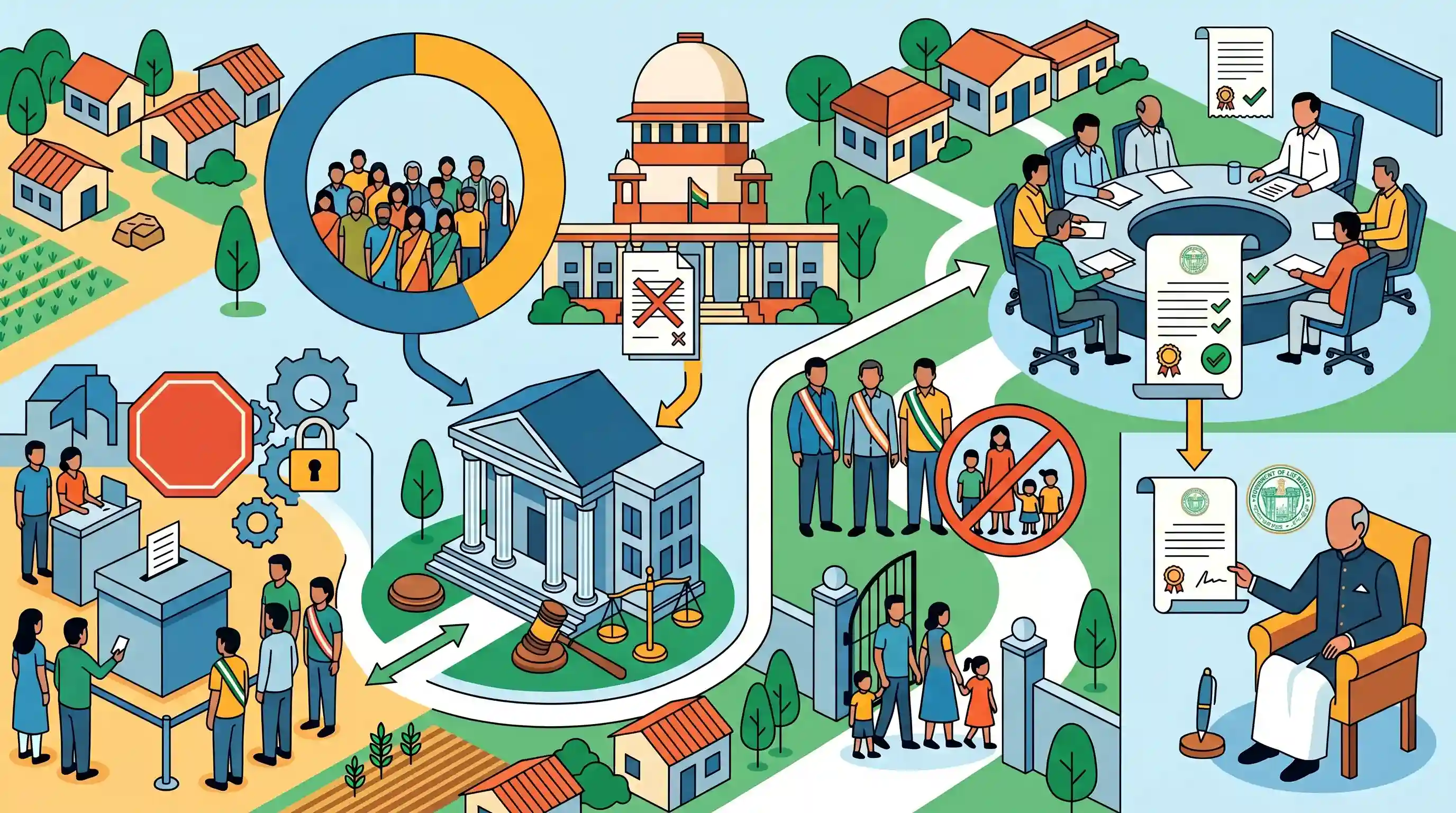
The Telangana government has decided to delay its local body elections until the High Court rules on its proposal to provide 42% reservation for Backward Classes (BCs). This decision follows the Supreme Court's dismissal of the State's special leave petition on the matter. Additionally, the State Cabinet, headed by Chief Minister A. Revanth Reddy, resolved to promulgate an ordinance to relax the existing two-child norm for candidates participating in local elections. The ordinance will be sent to Governor Jishnu Dev Varma for his assent.
Key Points
- The Telangana government has deferred local body elections pending the High Court’s decision on increasing Backward Class (BC) reservations to 42%.
- The Supreme Court dismissed the State government's special leave petition on the reservation hike, directing them to resolve it in the High Court.
- The State Cabinet passed a resolution to relax the two-child norm for candidates contesting local body polls.
- An ordinance will be promulgated and sent to the Governor to enact the relaxation of the two-child policy, demonstrating the use of executive ordinance-making powers.
Important Terms
Triple Test Formula

A three-step legal mandate (Commission, empirical inquiry, and 50% reservation cap) required by the Supreme Court to justify Backward Class reservations in local body elections.
UPSC context
GS-II: Governance and Reservation Policy; essential for understanding legal hurdles in political representation of OBCs.
Article 213
Empowers the Governor of a state to promulgate ordinances when the State Legislature is not in session, provided they are satisfied immediate action is necessary.
UPSC context
GS-II: Indian Constitution; tests executive-legislative relations and the temporary nature of ordinance-based lawmaking.
Two-child norm
A legal provision disqualifying individuals with more than two children from contesting local body elections, often introduced to control population growth.
UPSC context
GS-I: Population and Associated Issues; GS-II: Social Justice; explores the intersection of demographic policy and democratic rights.
Articles 243D and 243T
Constitutional provisions mandating seat reservations for SCs and STs, and enabling reservations for Backward Classes in Panchayats and Municipalities respectively.
UPSC context
GS-II: Local Self Government; fundamental for questions on the 73rd and 74th Constitutional Amendment Acts.
Indra Sawhney Ceiling
The 50% upper limit for total vertical reservations in public employment and education, extended by the Supreme Court to local body seat reservations.
UPSC context
GS-II: Judiciary and Social Justice; critical for analyzing the constitutional validity of enhanced reservation quotas.
Governor's Assent
The constitutional requirement (Article 200) for a Governor to sign a bill or ordinance passed by the State Cabinet for it to become law.
UPSC context
GS-II: State Executive; involves the Governor's discretionary powers and legislative role.
Prelims Trap
"The 73rd Constitutional Amendment mandates reservation for Backward Classes in Panchayats."
The 73rd and 74th Amendments make SC, ST, and Women quotas mandatory. However, reservations for Backward Classes are entirely discretionary and left to the respective State Legislatures.
Static Concepts Connected
What is the Supreme Court's "Triple Test" for OBC reservation in local bodies?
- Dedicated Commission: States must establish a dedicated, independent commission to collect rigorous empirical data on the nature and implications of local backwardness.
- Proportionate Quota: The commission's recommendations must be used to specify the proportion of reservation required local body-wise.
- 50% Ceiling: The total reservation for SCs, STs, and OBCs combined must not exceed the 50% constitutional ceiling in any local body.
What are the key limitations on the Governor's Ordinance-making power (Article 213)?
- Legislature Not in Session: An ordinance can only be promulgated when the state legislature (or either house in a bicameral legislature) is not in session.
- Six-Week Lifespan: An ordinance ceases to operate six weeks from the reassembly of the State Legislature, unless approved earlier.
- Presidential Control: The Governor requires prior instructions from the President if a similar Bill would have required the President's prior sanction or consideration.
Cross-Topic Patterns
TFR Decline vs. Electoral Two-Child Norms
As states like Telangana achieve Total Fertility Rates (TFR) below the 2.1 replacement level, statutory population control measures like the two-child norm for local elections are being repealed to mitigate demographic aging.
Breaching the 50% Cap in Local Polls
State attempts to push combined quotas past the 50% ceiling (like Telangana's 42% BC quota) are repeatedly checked by the Judiciary applying the Indra Sawhney limit to local polls via the Triple Test.

Expect a multi-statement question contrasting mandatory SC/ST quotas with discretionary OBC quotas and the SC's Triple Test in local polls.
Linked PYQs · 5
Linked PYQs · 5
- 2022MainsGS2
Discuss the essential conditions for exercise of the legislative powers by the Governor. Discuss the legality of re-promulgation of ordinances by the Governor without placing them before the Legislature.
- 2025PrelimsGS1
With reference to the Indian polity, consider the following statements : I. An Ordinance can amend any Central Act. II. An Ordinance can abridge a Fundamental Right. III. An Ordinance can come into effect from a back date. Which of the statements given above are correct?
- 2021MainsGS1
Discuss the main objectives of Population Education and point out the measures to achieve them in India in detail.
- 2022MainsGS2
Discuss the role of the National Commission for Backward Classes in the wake of its transformation from a statutory body to a constitutional body.
- 2023PrelimsGS1
Consider the following organizations/bodies in India: 1. The National Commission for Backward Classes 2. The National Human Rights Commission 3. The National Law Commission 4. The National Consumer Disputes Redressal Commission How many of the above are constitutional bodies?
