Himachal Utilizes Medical Corporation to Modernize State Healthcare
Source:theprint ↗
Why It Matters
HPAS Prelims frequently asks questions about state budgetary allocations and key institutions (like HPMSCL) managing public services. Recognizing the health budget commitments and the specific role of state corporations is crucial for the Himachal Pradesh GK section.
Summary
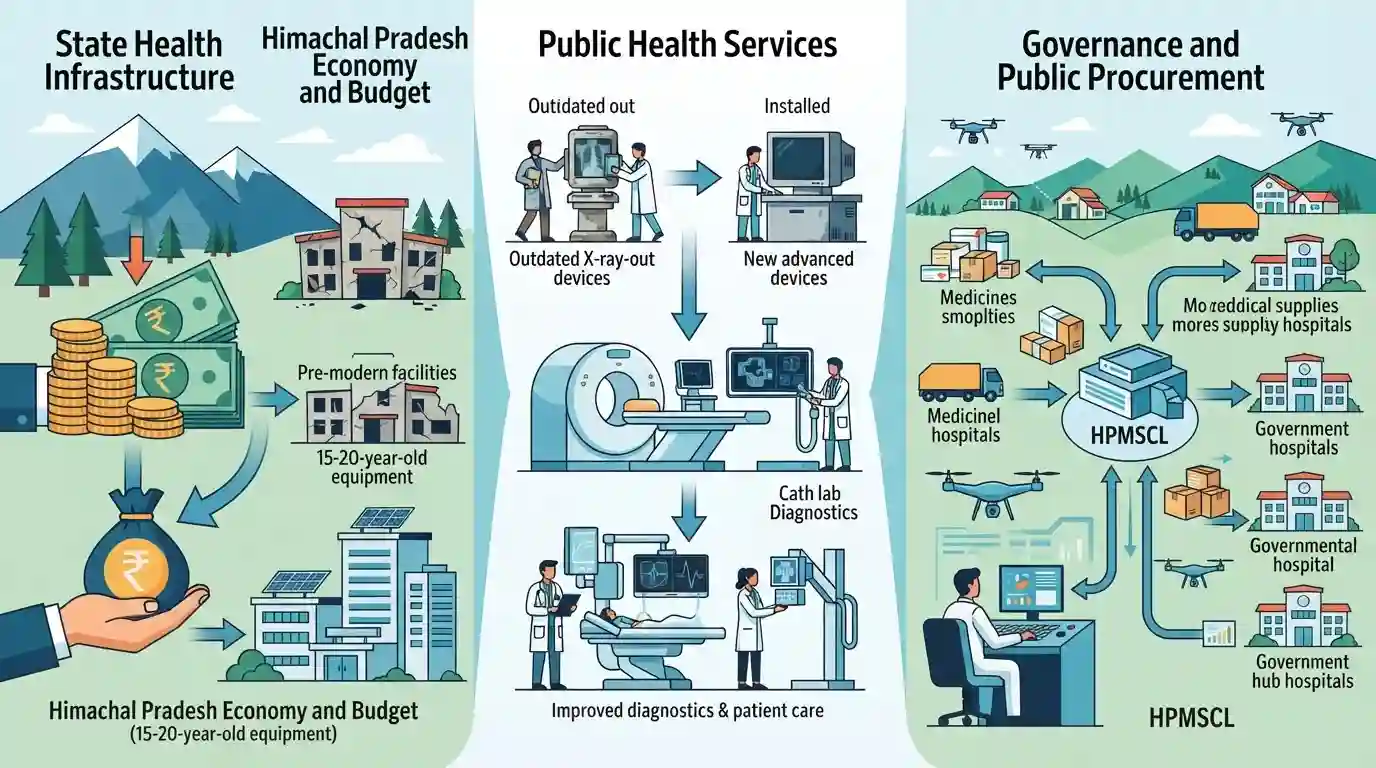
The Himachal Pradesh government has allocated Rs 3,000 crore to modernize state healthcare facilities and replace 15-20-year-old medical equipment. Health and Family Welfare Minister Dhani Ram Shandil highlighted the critical role of the Himachal Pradesh Medical Services Corporation Limited (HPMSCL) in expediting the centralized procurement and distribution of medicines and advanced equipment, such as PET scanners, cath labs, and digital X-ray machines, across government hospitals and medical colleges.
Key Points
- The Himachal Pradesh government is spending Rs 3,000 crore to upgrade healthcare facilities and replace outdated medical machinery across the state.
- The Himachal Pradesh Medical Services Corporation Limited (HPMSCL) plays a pivotal role in streamlining the procurement and distribution of medicines, surgical items, and medical equipment for government hospitals and colleges.
- The upgrade includes purchasing advanced diagnostic and surgical equipment such as PET scanners, DSA machines, cath labs, and digital X-ray machines to modernize public health infrastructure.
Important Terms
Himachal Pradesh Medical Services Corporation Limited (HPMSCL)

A state-owned enterprise incorporated in 2023 to handle centralized, transparent procurement and distribution of medicines, surgical consumables, and advanced medical equipment for public healthcare institutions in Himachal Pradesh.
UPSC context
GS Paper II (Governance/Health). Tests understanding of decentralization, procurement reforms, and state-level public health service delivery mechanisms.
Centralized Procurement
A supply chain strategy (also known as pooled procurement) where a central entity purchases goods for multiple facilities, leveraging economies of scale to lower costs, ensure quality, and prevent stockouts.
UPSC context
GS Paper II (Governance) & GS Paper III (Economy). Tests concepts of fiscal efficiency, public procurement policies, and supply chain management.
Public Health Infrastructure
The foundational physical, technological, and human resources—including clinics, medical equipment, laboratories, and specialized hospitals—requisite for delivering comprehensive preventive and curative healthcare services to the public.
UPSC context
GS Paper II (Social Justice - Issues relating to development of Health). Tests analytical ability regarding health governance and public health spending.
Government of Himachal Pradesh
The subnational governing authority of the Indian state of Himachal Pradesh, established under the Constitution of India, executing state laws and policies, and managing regional developmental domains like public health.
UPSC context
GS Paper II (Polity & Governance). Tests understanding of Indian federalism, Seventh Schedule division of powers (State List), and subnational administration.
Prelims Trap
"The 'pooled procurement' model for public health supplies was pioneered by the Himachal Pradesh Medical Services Corporation."
The pooled procurement model was actually pioneered by the Tamil Nadu Medical Services Corporation (TNMSC). Himachal Pradesh is merely adopting this established best practice.
Static Concepts Connected
What is the 'pooled procurement' model in public health administration?
- Demand Aggregation: A centralized nodal agency collects and aggregates the requirements of medicines and equipment from all state medical facilities.
- Bulk Purchasing: Leverages aggregated volume to negotiate significantly lower prices directly from manufacturers, bypassing middlemen and achieving economies of scale.
- Supply-Chain Efficiency: Reduces drug stock-outs and administrative delays that often plague decentralized, facility-level purchasing systems in public hospitals.
What are the Constitutional provisions governing public health in India?
- Seventh Schedule: Public health, sanitation, hospitals, and dispensaries are exclusively placed under the State List (Entry 6) of the Constitution.
- Article 47 (DPSP): Directs the State to consider raising the level of nutrition, the standard of living, and the improvement of public health as its primary duties.
Cross-Topic Patterns
Centralized Procurement & Healthcare OOPE
Centralized bulk procurement models efficiently reduce out-of-pocket expenditure (OOPE) for citizens by ensuring consistent availability of free medicines, while simultaneously optimizing state health budgets.
Federalism & Health Infrastructure
Even though health is a State subject, state-level nodal agencies are critical to absorb and implement Central scheme funds (like NHM) effectively, highlighting cooperative federalism in healthcare.

The 'pooled procurement' model (TNMSC) is highly likely to feature in GS-2 Mains as a best practice for healthcare governance.
Linked PYQs · 1
Linked PYQs · 1
- 2025HPAS_PRELIMSGS1
Consider the following statements regarding public finance of Himachal Pradesh : (1) According to Budget Estimate for the year 2024-25, share of revenue expenditure out of total expenditure is around 80 percent. (2) Debt as a percentage of GSDP reached 75.33 during the year 2022-23. (3) State's own tax revenue as a percentage of total revenue for the year 2024-25 (BE) increased to 27.4. (4) During FY 2024-25 (BE) education and health sector were allocated Rs. 9995 and Rs. 8575 crores respectively. Choose the correct answer from the options given below :
