Uttarakhand Emphasizes Inclusive Welfare Schemes and UCC Reforms
Source:aninews ↗
Why It Matters
This article highlights important state-level policy shifts in Uttarakhand, specifically the implementation of the Uniform Civil Code (UCC) under Article 44 and educational reforms for minorities, making it highly relevant for UKPSC State Specific topics and GS Polity/Governance sections.
Summary
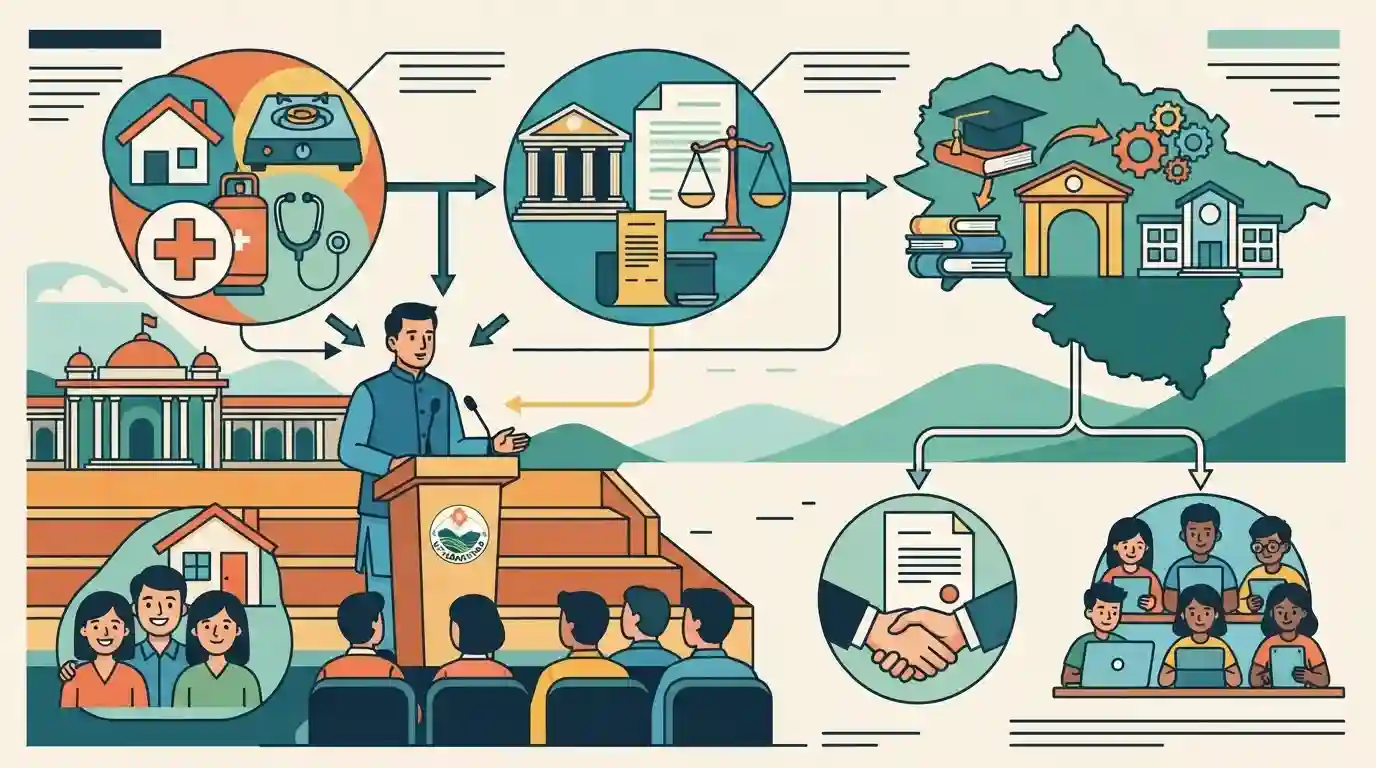
Uttarakhand Chief Minister Pushkar Singh Dhami addressed a 'Beneficiary Conference' in Dehradun, highlighting the 'double-engine' government's commitment to inclusive development and empowerment. He emphasized the successful reach of welfare schemes such as the Pradhan Mantri Awas Yojana, PM Ujjwala Yojana, and Ayushman Bharat directly to eligible citizens. Additionally, Dhami underscored significant state policy decisions, including being the first state to implement the Uniform Civil Code (UCC) and replacing the Uttarakhand Madrasa Board with the new Uttarakhand State Minority Education Authority to modernize minority education.
Key Points
- Uttarakhand CM Pushkar Singh Dhami interacted with beneficiaries of various central and state government schemes at a conference in Dehradun.
- Key welfare schemes highlighted include Pradhan Mantri Awas Yojana (providing pucca houses to over 1.5 lakh people in the state), PM Ujjwala Yojana, and Ayushman Bharat.
- The state has abolished the Uttarakhand Madrasa Board and announced the formation of the Uttarakhand State Minority Education Authority to provide modern, employment-oriented education to minority students.
- Uttarakhand was highlighted as the first state in the country to implement the Uniform Civil Code (UCC), ensuring equal rights across communities.
Important Terms
Pradhan Mantri Awas Yojana (PMAY)

A flagship central scheme providing affordable housing with basic amenities to the urban and rural poor, aiming for "Housing for All." It includes financial assistance and convergence with other schemes like MGNREGA for wage employment.
UPSC context
Covers GS Paper 2 (Welfare Schemes) and GS Paper 3 (Infrastructure). Tests knowledge of target beneficiaries, socio-economic impact, and funding ratios.
Pradhan Mantri Ujjwala Yojana (PMUY)
A welfare scheme providing deposit-free LPG connections to women in Below Poverty Line (BPL) households. It aims to reduce indoor air pollution, replace traditional cooking fuels, and safeguard the health of women and children.
UPSC context
Relevant for GS Paper 2 (Welfare Schemes) and GS Paper 3 (Environment). Focuses on energy transition, women's empowerment, and reducing indoor pollution.
Ayushman Bharat
India's flagship universal healthcare program featuring Health and Wellness Centres for primary care and the PM-JAY scheme, which provides ₹5 lakh per family per year in cashless health insurance for secondary and tertiary hospitalization.
UPSC context
Crucial for GS Paper 2 (Health, Social Justice). Examines public healthcare access, out-of-pocket expenditure reduction, and digital health initiatives.
Uniform Civil Code (UCC)
A proposal under Article 44 of the Constitution to replace religious-based personal laws with a common set of civil laws governing marriage, divorce, inheritance, and adoption for all citizens, aiming to ensure equality.
UPSC context
Highly relevant for GS Paper 2 (Polity, Constitution). Tests understanding of Directive Principles of State Policy, secularism, gender justice, and center-state legislative dynamics.
Uttarakhand State Minority Education Authority
A statutory body established in Uttarakhand to regulate and modernize educational institutions across minority communities. It replaces the Madrasa Board, mandating subjects like Science and Math alongside religious studies under a unified framework.
UPSC context
Important for GS Paper 2 (Governance, Minority Affairs). Highlights state-level educational reforms, integration of the National Education Policy (NEP), and minority welfare.
Prelims Trap
The Uttarakhand Uniform Civil Code is applicable to all citizens residing within the state without exception.
The Uttarakhand UCC Act explicitly exempts all Scheduled Tribes (STs) in the state from its purview to protect their customary laws and practices.
Static Concepts Connected
How can a State legally enact its own Uniform Civil Code?
- Concurrent List: Personal laws involving marriage, divorce, and succession are listed under Entry 5 of the Concurrent List (List III), allowing state legislatures to pass their own laws.
- Presidential Assent: Under Article 254(2), a state law on a concurrent subject that overrides or contradicts central laws requires the President's assent to be legally valid, which Uttarakhand received.
- Legislative Competence: Though Article 44 directs the State to secure a UCC throughout India's territory, courts have affirmed states have legislative competence to enact piecemeal state-level personal laws.
What are the constitutional boundaries for regulating Minority Educational Institutions?
- Article 30 Rights: Article 30(1) grants religious and linguistic minorities the fundamental right to establish and administer educational institutions of their choice.
- Permissible State Regulation: The Supreme Court has ruled that the right to administer is not an absolute right to maladminister. States can impose reasonable regulations for academic excellence and syllabus standardization.
- Notified Communities: There are exactly six notified religious minority communities at the national level in India: Muslims, Christians, Sikhs, Buddhists, Parsis, and Jains.
Cross-Topic Patterns
UCC vs. Right to Privacy
Mandatory live-in relationship registration under Uttarakhand's UCC creates a direct constitutional conflict with individual autonomy and privacy rights established in the Puttaswamy judgment (Article 21).
Minority Institutions & State Regulation
Replacing the Madrasa board with a unified, NEP-aligned Minority Education Authority touches on the classic Article 30 debate: balancing minority institutional autonomy with state regulation for academic excellence.
Border Strategy via Welfare Saturation
Welfare scheme saturation (PMAY, Ayushman) in Uttarakhand merges with strategic border security via the Vibrant Villages Programme, aimed at reversing outmigration in frontier districts.

State-level UCC frameworks, specifically ST exemptions and privacy concerns regarding live-in registrations, will likely anchor a 2026 Mains Polity question.
Linked PYQs · 2
Linked PYQs · 2
- 2025UKPSC_PRELIMSGS1
Arrange the following social welfare schemes in chronological order: i. Integrated Rural Development Programme (IRDP) ii. Rural Employment Generation Programme (REGP) iii. Prime Minister Rojgar Yojana (PMRY) iv. Rural Landless Employment Guarantee Programme (RLEGP)
- 2025UKPSC_PRELIMSGS1
Which programme was approved by the Union Cabinet in April, 2025 to develop border villages ?
