Pahalgam Attack Triggers Retaliatory Options And Bihar Election Focus
Source:Indian Express ↗
Why It Matters
The article provides a real-world case study of India's strategic options against cross-border terrorism, while also highlighting the enduring demographic and economic challenges of migration and unemployment that shape governance and electoral politics in developing regions like Bihar.
Summary
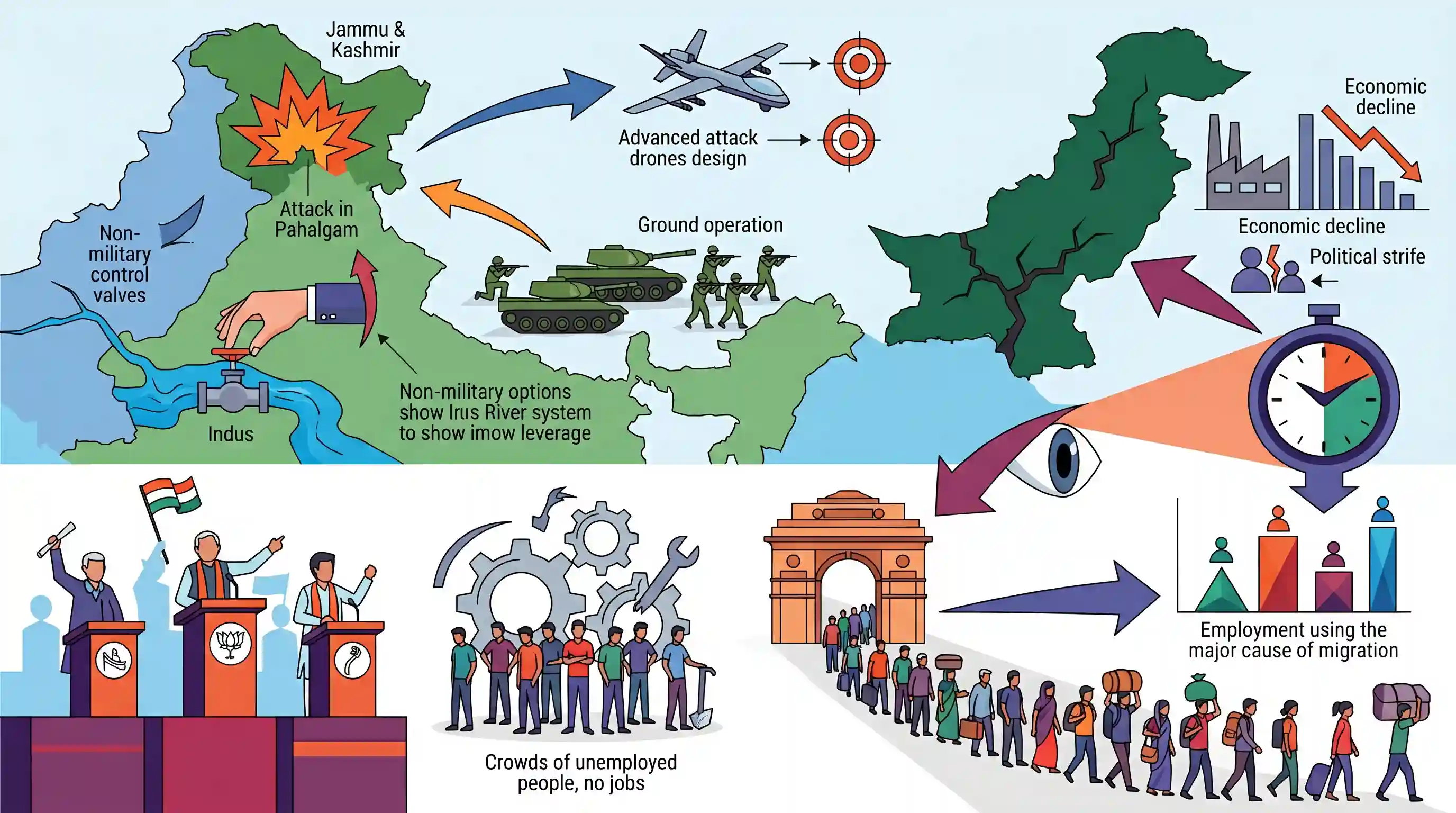
Following the Pahalgam attack, India is contemplating diverse retaliatory military options against Pakistan, including the use of advanced attack drones from within Indian territory and potential ground operations. These options build on non-military responses like leveraging the Indus Water Treaty. Security assessments indicate the attack was orchestrated by Pakistan to divert attention from its domestic economic and political crises. Domestically, ahead of the Bihar assembly elections, political focus has sharply shifted towards the state's persistent issues of unemployment and out-migration, backed by Census data showing employment as the leading cause of migration from the state.
Key Points
- The Indian government is exploring a spectrum of retaliatory options against Pakistan following the Pahalgam attack, including precision strikes from within its borders using attack drones and potential ground operations.
- Security agencies assess that the Pahalgam attack is a tactic by Pakistan Army Chief General Asim Munir to deflect attention from Pakistan's ongoing economic crisis and internal discord.
- As Bihar approaches assembly elections, chronic issues of unemployment, poverty, and out-migration have dominated political discourse and sparked credit wars between the ruling NDA and opposition parties.
- Data from the 2011 Census highlights that Bihar has the second-highest out-migration rate in India, with 30% of its migrants citing employment as their primary reason for leaving the state.
Important Terms
Indus Water Treaty

A 1960 World Bank-brokered pact governing the distribution of the Indus River system between India and Pakistan; India recently placed it in abeyance post-Pahalgam attack.
UPSC context
GS Paper II (International Relations). Tests knowledge of transboundary water diplomacy as a tool for strategic leverage against state-sponsored terrorism.
Mahagathbandhan
A Bihar-based grand alliance primarily including the RJD, Congress, and Left parties, formed to challenge the NDA on issues like unemployment and migration.
UPSC context
GS Paper II (Indian Polity). Relevant for understanding coalition politics, regional alliances, and electoral strategies in state assembly elections.
NDA (National Democratic Alliance)
A center-right coalition led by the BJP; in Bihar, it includes JD(U) and LJP, focusing on governance and infrastructure while facing opposition on migration issues.
UPSC context
GS Paper II (Polity and Governance). Tests understanding of the executive structure and the dynamics of multi-party governance at state and union levels.
JD(U) (Janata Dal (United))
A socialist-leaning regional party in Bihar led by Nitish Kumar; its shifting alliances between the NDA and Mahagathbandhan significantly influence the state's political stability.
UPSC context
GS Paper II (Political Parties). Important for analyzing regionalism and the role of "swing parties" in Indian federalism.
Rashtriya Janata Dal (RJD)
A Bihar-based party led by the Yadav family, emphasizing social justice; in the 2025-26 elections, it centered its campaign on job creation and rural distress.
UPSC context
GS Paper II (Polity). Tests awareness of regional opposition dynamics and the impact of socio-economic manifestos on voter behavior.
Indian Air Force (IAF)
The aerial branch of India's military, tasked with air defense and potential retaliatory strikes (e.g., Operation Sindoor) in response to cross-border terror attacks.
UPSC context
GS Paper III (Internal Security). Relevant for understanding India’s military doctrine, deterrence strategies, and the role of specialized security forces.
Prelims Trap
"Bihar is the largest source state for inter-state out-migration in India."
Uttar Pradesh actually ranks first in absolute numbers of inter-state out-migrants according to the 2011 Census. Bihar ranks second, despite being the focal point of current political debates.
Static Concepts Connected
What are the key provisions of the Indus Water Treaty (1960)?
- Eastern Rivers: The waters of the Ravi, Beas, and Sutlej are allocated to India for unrestricted use.
- Western Rivers: The Indus, Jhelum, and Chenab are allocated to Pakistan, but India retains rights for run-of-the-river hydroelectric projects, domestic, and agricultural use.
- Dispute Resolution: It establishes a graded mechanism: Permanent Indus Commission, followed by a Neutral Expert, and finally a Court of Arbitration.
What are the primary trends of internal migration in India (Census 2011)?
- Top Source States: Uttar Pradesh and Bihar account for the largest share of out-migrants, moving largely to industrially developed regions.
- Top Destinations: Maharashtra and Delhi are the largest recipient states for inter-state migrants seeking better economic opportunities.
- Primary Reasons: Marriage is the leading cause overall (primarily female), while employment is the overwhelmingly dominant cause for male migration.
Cross-Topic Patterns
Water diplomacy as asymmetric retaliation
India's move to leverage the Indus Water Treaty bridges conventional military strategy with geo-economic coercion, effectively weaponizing Pakistan's agrarian vulnerabilities against its asymmetric warfare tactics.
Demography dictating regional electoral politics
The dominance of out-migration in Bihar's political discourse illustrates how demographic distress (push factors) dictates regional party manifestos and fuels demands for state-level welfare and industrial policy shifts.

Expect a mixed Prelims question testing 2011 Census migration push-factors alongside the exact river allocations of the Indus Water Treaty.
Linked PYQs · 5
Linked PYQs · 5
- 2016MainsGS3
The terms 'Hot Pursuit' and 'Surgical Strikes' are often used in connection with armed action against terrorist attacks. Discuss the strategic impact of such actions.
- 2020MainsGS3
Analyze internal security threats and transborder crimes along Myanmar, Bangladesh and Pakistan borders including Line of Control (LoC). Also discuss the role played by various security forces in this regard.
- 2012MainsGS2
The situation today is far different to that prevalent fifty years back when the Indus Water Treaty was signed." Highlight the complexity of the current challenges on both sides of the border in this regard. Do you think that a review of the Treaty is in India's best interests?
- 2015MainsGS2
Terrorist activities and mutual distrust have clouded India-Pakistan relations. To what extent the use of soft power like sports and cultural exchanges could help generate goodwill between the two countries? Discuss with suitable examples.
- 2024MainsGS1
Why do large cities tend to attract more migrants than smaller towns? Discuss in the light of conditions in developing countries.
