Generative AI Regulation and Intermediary Liability for Deepfakes
Source:Indian Express ↗
Why It Matters
Demonstrates the governance challenges posed by Generative AI and deepfakes, touching on intermediary liability (safe harbour) and cyber crimes against women, directly mapping to GS3 (S&T, Internal Security) and GS2 (Governance) syllabus components.
Summary
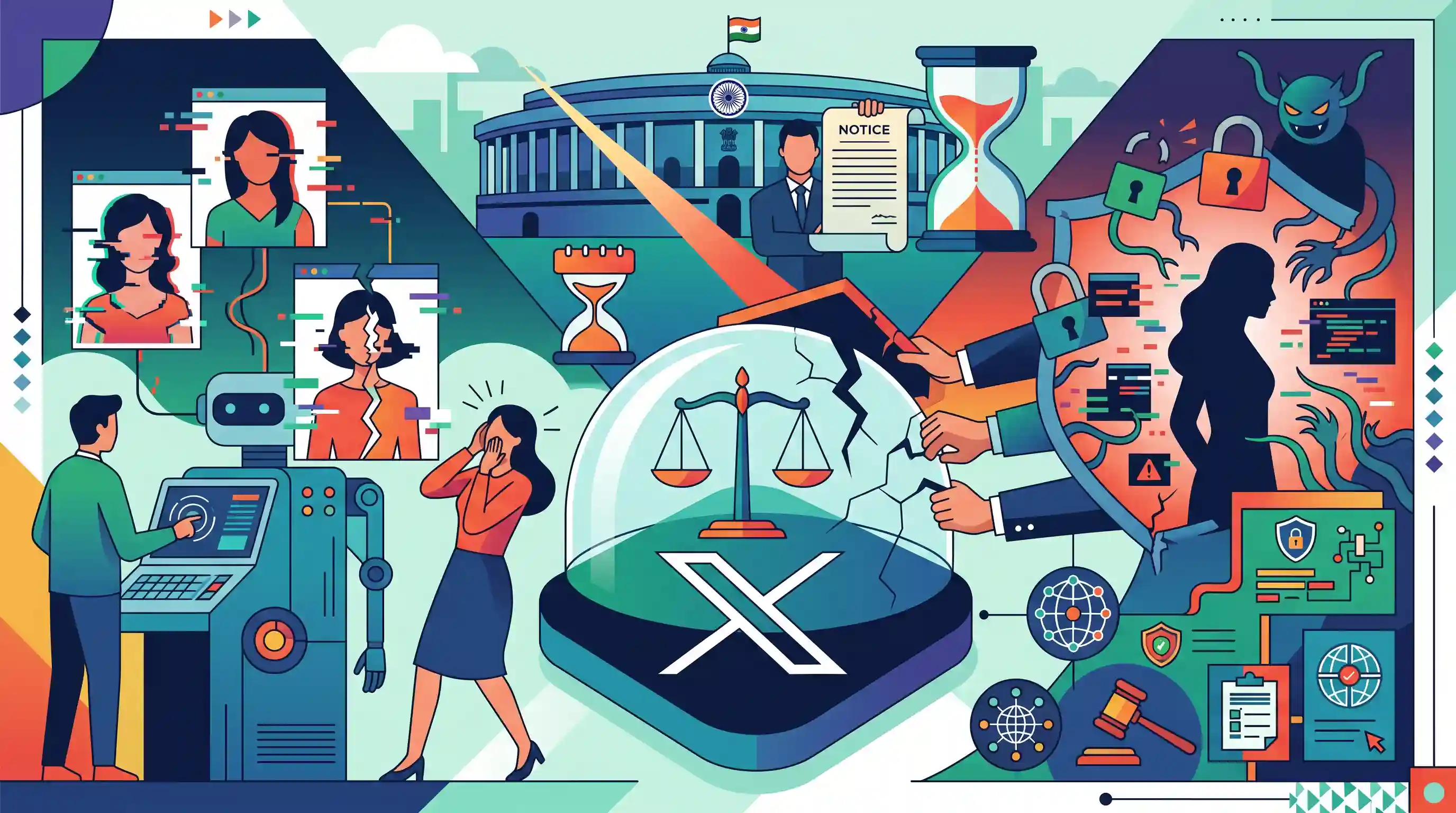
The Government of India has issued a stern notice to social media platform X, giving it 72 hours to explain why its generative AI tool, Grok, has been generating objectionable and non-consensual images of women. The government warned that failure to comply could result in the revocation of X's "safe harbour" protection under Section 79 of the Information Technology Act. This incident highlights the critical intersection of generative AI, social media intermediary liability, and cybersecurity, emphasizing the urgent need to protect vulnerable groups from AI-generated deepfakes and cyber abuse under the IT Rules 2021.
Key Points
- The Indian Government has reprimanded social media platform X over its AI chatbot 'Grok' generating non-consensual and objectionable images of women.
- X has been given 72 hours to submit a response explaining how it intends to curb this misuse of its generative AI tools.
- The government warned that non-compliance could lead to the revocation of X's safe harbour immunity under Section 79 of the IT Act, making the platform legally liable for third-party content.
- The incident underscores the emerging regulatory challenges posed by deepfakes and generative AI, highlighting the need for stricter enforcement of the IT Rules 2021 to ensure women's safety in cyberspace.
Important Terms
Information Technology Act 2000

India's primary legislation governing cyber activities, e-commerce, and digital signatures. It provides the legal framework for addressing cybercrimes and regulating electronic records through key provisions like Section 69A and Section 79.
UPSC context
GS Paper 3: Cyber Security. Essential for understanding India's legal architecture against cyber offenses and digital governance.
Information Technology (Intermediary Guidelines and Digital Media Ethics Code) Rules 2021
A regulatory framework mandating social media, OTT, and digital news platforms to establish grievance redressal mechanisms and comply with strict content removal timelines, especially for non-consensual explicit imagery.
UPSC context
GS Paper 2: Governance/Regulatory Bodies. Tests knowledge of digital ethics and social media accountability.
Safe Harbour Protection (Section 79)
A legal immunity under Section 79 of the IT Act that shields intermediaries from liability for third-party content, provided they follow due diligence and remove illegal material upon official notice.
UPSC context
GS Paper 2/3: IT and Law. Crucial for discussions on intermediary liability and freedom of speech.
Ministry of Electronics and Information Technology (MeitY)
The nodal central government department responsible for formulating policies related to IT, electronics, and the internet, including the oversight of AI regulation and digital safety advisories.
UPSC context
GS Paper 2: Government Policies. Key executive body implementing digital India initiatives and AI governance.
Generative AI
A subset of artificial intelligence capable of creating new content like text, images, or video. In India, its regulation focuses on preventing bias, misinformation, and the creation of deepfakes.
UPSC context
GS Paper 3: Science and Technology. Important for emerging tech ethics and regulatory challenges.
Significant Social Media Intermediary (SSMI)
A classification under the IT Rules 2021 for social media platforms with over 5 million users, requiring them to appoint dedicated compliance and grievance officers based in India.
UPSC context
GS Paper 2: Governance. Relevant for platform-specific regulatory compliance and user safety.
Prelims Trap
Section 79 of the IT Act grants absolute legal immunity to social media platforms for any third-party content.
Safe harbour is highly conditional. It vanishes immediately if the intermediary fails to observe 'due diligence' or ignores government takedown orders for unlawful content.
Static Concepts Connected
What is 'Safe Harbour' under Section 79 of the IT Act, 2000?
- Legal Immunity: It provides legal immunity to intermediaries (like social media platforms) from liability for third-party data or user-generated content hosted on their network.
- Conditional Protection: Immunity is contingent on observing 'due diligence' guidelines and removing unlawful content promptly upon receiving actual knowledge or court orders.
- Exceptions: Safe harbour does not apply if the platform initiated the transmission, selected the receiver, or modified the content being transmitted.
How do the IT Rules 2021 define a 'Significant Social Media Intermediary' (SSMI)?
- User Threshold: Platforms with registered Indian users exceeding a threshold notified by the Central Government (currently set at 50 lakhs/5 million).
- Mandatory Appointments: SSMIs must appoint a Chief Compliance Officer, a Nodal Contact Person, and a Resident Grievance Officer, all of whom must be Indian residents.
- Originator Tracing: Messaging SSMIs are required to enable the identification of the 'first originator' of information to aid law enforcement.
Cross-Topic Patterns
Generative AI & Fundamental Rights
Deepfakes explicitly violate the Right to Privacy (Puttaswamy judgment). UPSC frequently pairs tech regulation mechanisms (like IT Rules) with their underlying Constitutional Article 21 implications in Prelims.
Transition to the Digital India Act
The repeated failure of the legacy 2000 IT Act to manage modern Generative AI accelerates the policy shift toward the Digital India Act, which focuses heavily on algorithmic accountability.

Expect a 2026 Prelims question linking the conditional nature of 'Safe Harbour' (Sec 79) with AI-deepfakes and the Right to Privacy.
Linked PYQs · 3
Linked PYQs · 3
- 2023MainsGS3
Introduce the concept of Artificial Intelligence (AI). How does Al help clinical diagnosis? Do you perceive any threat to privacy of the individual in the use of Al in healthcare?
- 2020MainsGS3
Discuss different types of cyber crimes and measures required to be taken to fight the menace.
- 2025PrelimsGS1
Consider the following statements: I. It is expected that Majorana 1 chip will enable quantum computing. II. Majorana 1 chip has been introduced by Amazon Web Services (AWS). III. Deep learning is a subset of machine learning. Which of the statements given above are correct?
