Introduction of Producer Price Index to replace WPI in India
Source:The Hindu ↗
Why It Matters
The shift from WPI to PPI is a fundamental change in how India measures inflation. UPSC frequently tests the conceptual differences between inflation indices (CPI vs. WPI). Candidates must now understand PPI, its base year (2022-23), its weightages (higher manufacturing weight), and critically, its inclusion of services (unlike WPI) as it will dictate future macroeconomic analysis and RBI policy formulation.
Summary
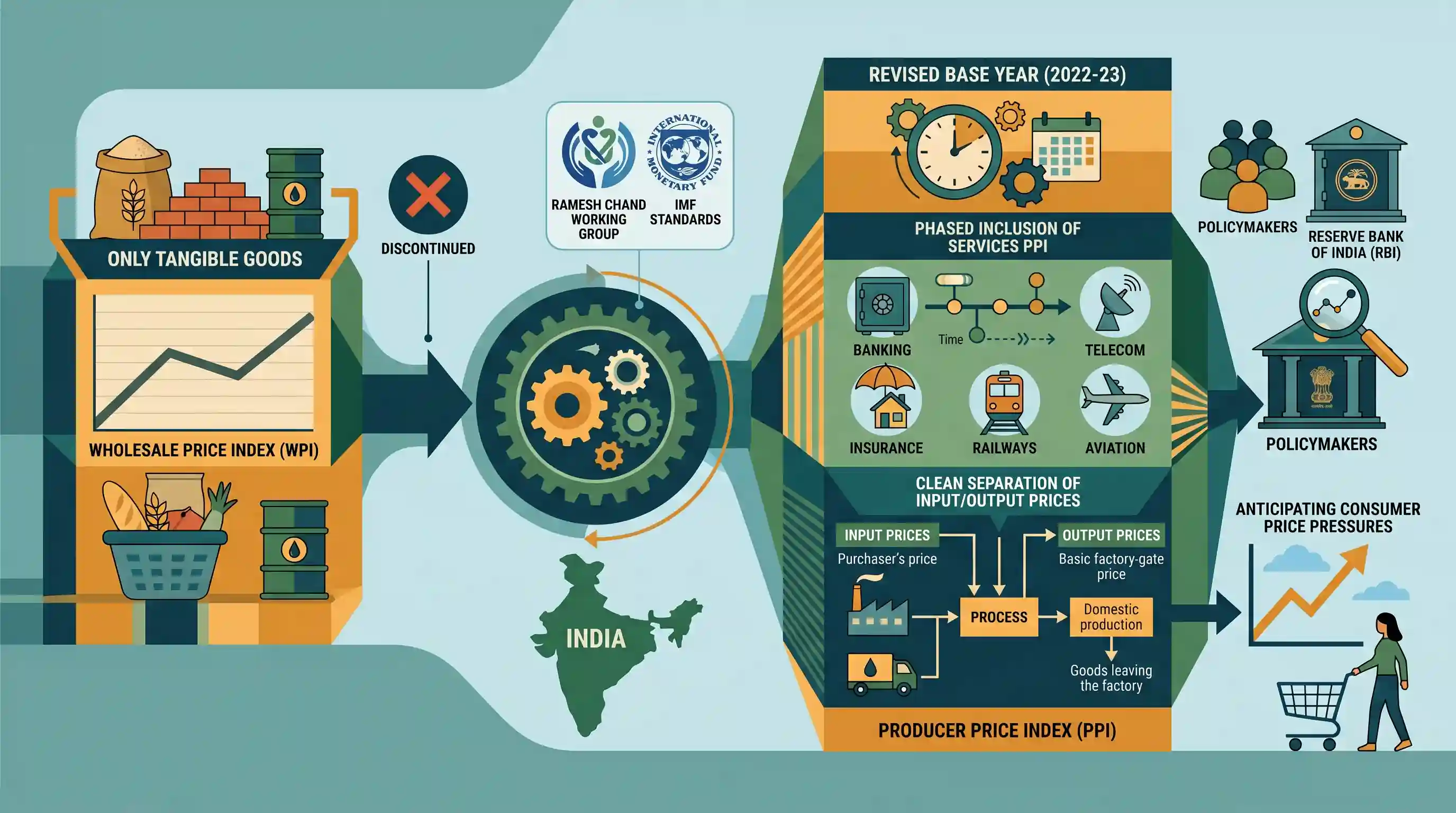
India is undergoing a major macroeconomic data overhaul by introducing the Producer Price Index (PPI) to eventually replace the Wholesale Price Index (WPI) for tracking wholesale inflation. Based on the Ramesh Chand working group's recommendations and aligned with IMF standards, the PPI brings two major changes: a revised base year of 2022-23 and the phased inclusion of a Services PPI (covering banking, telecom, etc.), which the WPI historically lacked. By cleanly separating input and output prices, the PPI will give policymakers and the RBI a more precise tool for measuring producer-side inflation and anticipating consumer price pressures.
Key Points
- The Indian government has released its first-ever Producer Price Index (PPI) data for goods and services, with plans to completely phase out the Wholesale Price Index (WPI) in the next five years.
- The transition to PPI aligns India's inflation measurement with advanced economies and international standards recommended by the IMF, providing better insights into producer-level input costs before they are passed on to consumers.
- The base year for the new indices (both the updated WPI and the new PPI) has been revised to 2022-23 from the previous 2011-12, expanding the basket to 957 items to reflect current economic structures.
- A major limitation of the WPI—its exclusion of services—is addressed by introducing a Services PPI in phases, initially covering seven key sectors like banking, telecom, railways, and insurance.
- The weightages in the new Output PPI differ from the old WPI; manufactured items now account for 69.93% (up from 63.12%), while primary agriculture and allied sectors account for 22.16%.
Important Terms
Producer Price Index (PPI)

Measures the average change over time in the selling prices received by domestic producers for their output, excluding indirect taxes and trade margins.
UPSC context
GS Paper 3: Indian Economy (Inflation). Critical for understanding the shift to producer-centric inflation tracking and international data alignment.
Wholesale Price Index (WPI)
Measures the price of a representative basket of wholesale goods. Unlike PPI, it excludes the services sector and includes some taxes and transport costs.
UPSC context
GS Paper 3: Indian Economy. Historically India's primary wholesale inflation measure; understanding its limitations is essential for mains analysis.
Ramesh Chand Working Group
An 18-member panel chaired by NITI Aayog member Ramesh Chand, tasked with revising the WPI base year and suggesting a roadmap for transitioning to PPI.
UPSC context
GS Paper 3: Committees and Commissions. Relevant for questions on institutional reforms in economic data and statistical transparency.
Services PPI
A specific component of the PPI that tracks price changes in sectors like banking and telecom, addressing a major gap in the traditional WPI.
UPSC context
GS Paper 3: Economy. Significant as India's economy is service-led; tests knowledge of sectoral data coverage and accuracy.
Base Year Revision
The reference point (set to 2022-23 for the new series) used for comparing economic indices over time to measure real price changes.
UPSC context
GS Paper 3: Economics. Fundamental for understanding how inflation and GDP are calculated to reflect current economic realities.
System of National Accounts (SNA)
The internationally agreed standard set of recommendations on how to compile measures of economic activity, which India's PPI aims to satisfy.
UPSC context
GS Paper 3: Economy. Important for understanding global economic standards and India's compliance with IMF data dissemination requirements.
Prelims Trap
The new Producer Price Index (PPI), like the WPI, measures wholesale inflation exclusively for goods and excludes the services sector.
This is a trap. A key feature of the new PPI framework is the phased inclusion of a Services PPI, addressing WPI's historical exclusion of services.
Static Concepts Connected
How does the Wholesale Price Index (WPI) differ from the Consumer Price Index (CPI)?
- Coverage: WPI tracks only goods, whereas CPI tracks both goods and services (e.g., housing, education).
- Publishing Agency: WPI is published by the Office of Economic Adviser (MoCI); CPI is released by the National Statistical Office (MoSPI).
- Transaction Level: WPI tracks bulk wholesale transactions between businesses, while CPI measures retail prices directly paid by the end consumers.
How does the Producer Price Index (PPI) technically improve upon the WPI?
- Double Counting: PPI cleanly separates Input PPI (raw materials) from Output PPI (factory gate prices), eliminating the double counting of intermediate goods that flawed the WPI.
- Tax Treatment: PPI measures basic prices received by producers, explicitly excluding indirect taxes like GST. This reveals actual production inflation without distortion from tax policy changes.
Cross-Topic Patterns
Monetary Policy & Lead Indicators
While RBI's MPC legally targets CPI, the new Output PPI serves as a critical early-warning radar for inflation, tracking factory-gate costs before they pass through to consumer retail prices.
Base Year Revisions & GDP Calculation
The shift to a 2022-23 base year for PPI signals an impending broader macroeconomic statistical overhaul, including expected revisions to the GDP and IIP base years to match IMF standards.
Ramesh Chand & Index Weightages
The Ramesh Chand committee sets manufactured items at roughly 70% and primary agriculture at 22%, reflecting structural shifts in India's industrial output profile.

Expect a 2026 Prelims question contrasting PPI and WPI, specifically targeting the inclusion of services and the 2022-23 base year.
Linked PYQs · 3
Linked PYQs · 3
- 2020PrelimsGS1
Consider the following statements: 1. The weightage of food in Consumer Price Index (CPI) is higher than that in Wholesale Price Index (WPI). 2. The WPI does not capture changes in the prices of services, which CPI does. 3. Reserve Bank of India has now adopted WPI as its key measure of inflation and to decide on changing the key policy rates. Which of the statements given above is/are correct?
- 1997PrelimsGS1
In India, inflation is measured by the
- 2024MainsGS3
What are the causes of persistent high food inflation in India? Comment on the effectiveness of the monetary policy of the RBI to control this type of inflation.
