US Tariffs Impact on India and Government Response
Source:The Hindu ↗
Why It Matters
Rising global protectionism, specifically US tariffs, poses direct challenges to India's export-led growth ambitions. Understanding the discourse between global financial institutions like the IMF and the Indian government helps students frame balanced answers on macroeconomic resilience, trade policy, and the strategic importance of FTAs in countering external shocks.
Summary
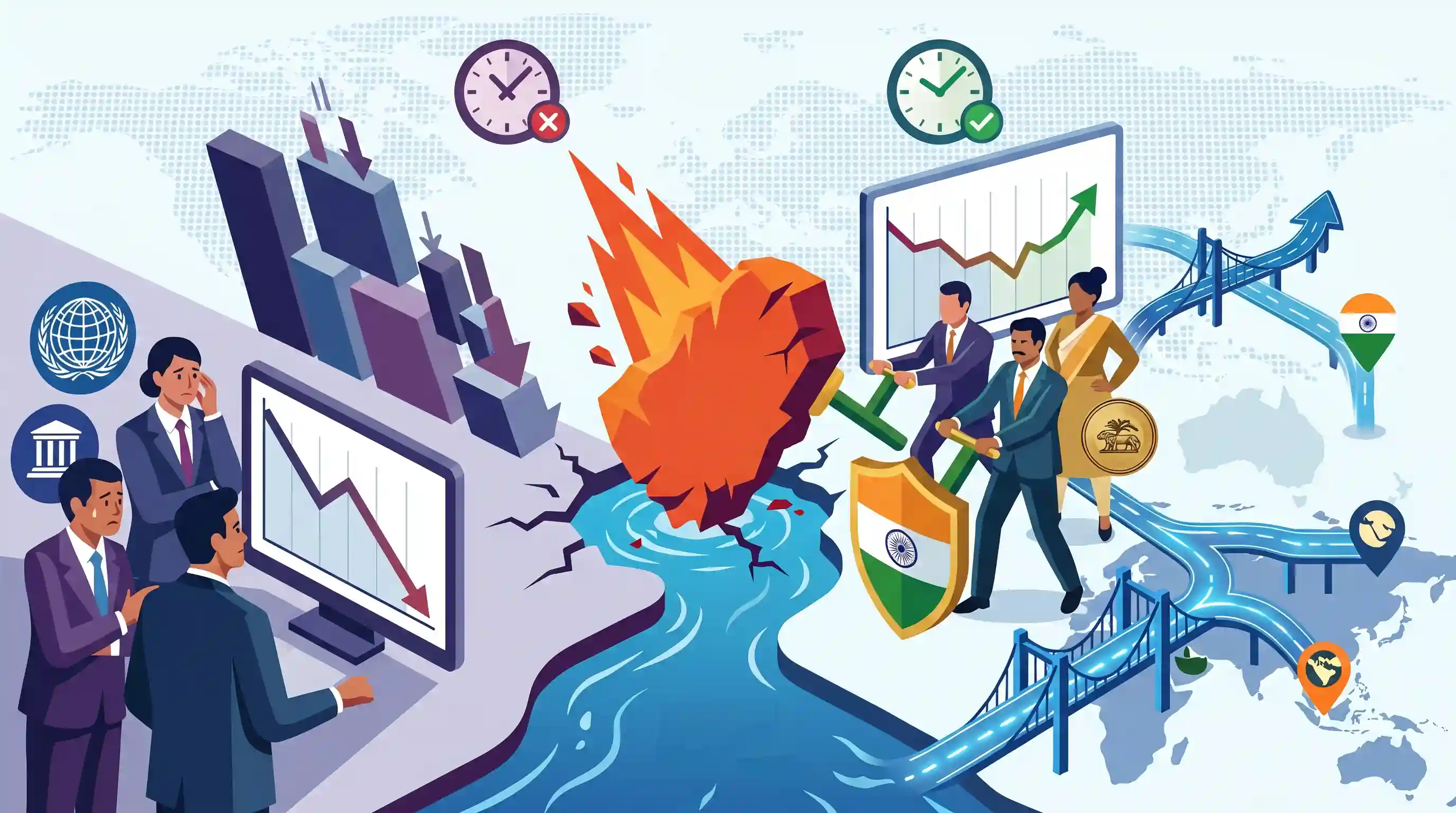
The Indian government has officially pushed back against the International Monetary Fund's (IMF) assessment regarding the impact of a 50% US tariff hike on the Indian economy. Featured in the latest Article IV consultation report, the IMF estimated the tariffs would slash India's GDP growth by 0.4% in FY26. The Finance Ministry and RBI argued that these tariffs are unlikely to remain indefinitely and that the growth reduction estimate is overstated. Although certain sectors will face concentrated disruptions, the government asserted that the broader economic shock is manageable, pointing to the cushioning effect of new Free Trade Agreements (FTAs) and the diversification of export markets.
Key Points
- The Indian government contested the IMF's baseline assumption that the 50% US tariffs will be permanent, terming the consequent growth impact as overstated.
- In its latest Article IV consultation report, the IMF projected that US tariffs would drag down India's GDP growth rate by 0.4% in 2025-26 and 0.3% in the subsequent year.
- While Indian authorities acknowledged that some specific industries would be heavily affected, they maintained that the overall macroeconomic impact would be manageable in the near term.
- The government highlighted mitigation strategies, including the frontloading of exports and the expansion into alternative markets through recently concluded and upcoming Free Trade Agreements (FTAs).
Important Terms
Article IV Consultation Report

An annual economic review by the IMF where experts visit member countries to evaluate financial health and provide policy advice; it is a critical tool for global economic surveillance.
UPSC context
GS Paper III/Economy; tests understanding of international economic surveillance and its influence on domestic fiscal and monetary policy.
International Monetary Fund (IMF)
A global organization of 190 countries working to foster monetary cooperation, secure financial stability, facilitate international trade, and promote sustainable economic growth and poverty reduction.
UPSC context
GS Paper II/International Institutions; essential for understanding global financial architecture, balance of payments, and international economic governance.
Free Trade Agreements (FTAs)
Pacts between two or more nations to reduce or eliminate trade barriers, such as tariffs and quotas, facilitating easier cross-border exchange of goods and services.
UPSC context
GS Paper II/IR and GS III/Economy; critical for studying India’s trade diplomacy, export growth, and global value chain integration.
Ministry of Finance
The nodal agency of the Government of India responsible for the national economy, overseeing taxation, financial legislation, the Union Budget, and fiscal policy.
UPSC context
GS Paper III/Economy; fundamental for questions on fiscal administration, budget preparation (Article 112), and macroeconomic management.
Reserve Bank of India (RBI)
India's central bank and primary monetary authority, responsible for regulating the banking system, managing foreign exchange reserves, issuing currency, and controlling inflation.
UPSC context
GS Paper III/Economy; central to topics on monetary policy, inflation targeting (MPC), and financial sector stability.
Prelims Trap
"IMF Article IV consultations result in binding macroeconomic directives for member nations."
Article IV consultations are bilateral surveillance exercises for assessing economic health and offering non-binding policy advice. They are not conditional bailout programs or mandatory directives.
Static Concepts Connected
What is the mandate of IMF Article IV consultations?
- Surveillance Mandate: Annual bilateral meetings between the IMF and member countries to review economic policies.
- Assessment Scope: Evaluates macroeconomic stability, exchange rate policies, and structural reforms to flag potential risks to global stability.
- Non-binding Nature: Results in a staff report with policy recommendations, which are advisory and not tied to IMF lending conditions.
How does 'Export Frontloading' help mitigate trade shocks?
- Pre-emptive Strategy: A tactical maneuver where businesses artificially accelerate export shipments before anticipated trade barriers or tariff hikes take effect.
- Cushioning Effect: It minimizes immediate financial losses from higher duties, buying time for exporters to negotiate prices or find alternate markets.
- Data Distortion: It causes a temporary spike in trade volumes, often followed by a steep contraction once the tariffs actually kick in.
Cross-Topic Patterns
Global Protectionism & India's FTA Push
As Western nations adopt protectionist tariffs, India's counter-strategy heavily pivots toward bilateral FTAs (like CEPA with UAE, ECTA with Australia) to diversify markets and bypass a paralyzed WTO.
Institutional Bias in Macro Assessments
The Finance Ministry frequently rebuts IMF and rating agency baseline assumptions (e.g., debt trajectories, tariff shocks), reflecting India's broader pushback against perceived institutional bias toward emerging markets.

A combined Prelims question linking IMF's Article IV mandate, WTO tariff exceptions, and India's macroeconomic resilience is highly likely.
Linked PYQs · 3
Linked PYQs · 3
- 2018MainsGS3
How would the recent phenomena of protectionism and currency manipulations in world trade affect macroeconomic stability of India?
- 2025MainsGS3
What are the challenges before the Indian economy when the world is moving away from free trade and multilateralism to protectionism and bilateralism? How can these challenges be met?
- 2016PrelimsGS1
'Global Financial Stability Report' is prepared by the
