Monitoring Tigers Outside Protected Reserves Across States
Source:Indian Express ↗
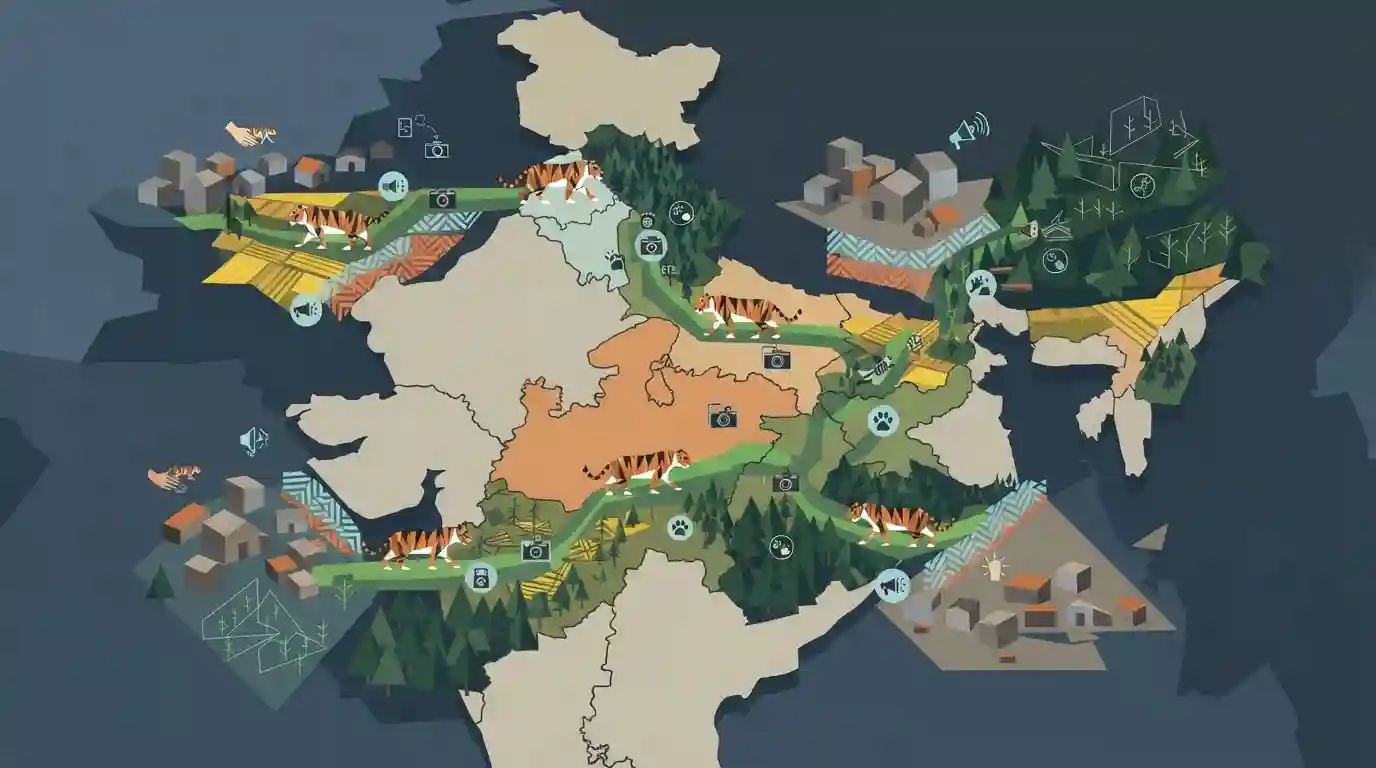
Why It Matters
Monitoring wildlife populations outside protected reserves is crucial for managing human-wildlife conflict, protecting ecological corridors, and formulating landscape-level conservation strategies under Project Tiger.
Summary
The Indian government is initiating a specialized project to monitor tiger populations residing outside traditional tiger reserves across ten states. Designed to mitigate human-wildlife conflict and manage wildlife corridors, the monitoring framework will assess big cat dispersal and habitat health in multiple-use and production forests.
Key Points
- The government is launching a new project to monitor tigers outside formal tiger reserves across 10 states in its first phase.
- The initiative aims to address human-tiger conflict, habitat fragmentation, and secure wildlife corridors beyond protected areas.
- It relies on standardized monitoring protocols to track big cat dispersal, population dynamics, and straying incidents in production or multiple-use forests.
Important Terms
Wild Life Protection Act 1972

India's umbrella legislation providing legal frameworks for the protection of wild animals, birds, and plants, and establishing protected area categories like national parks, sanctuaries, and tiger reserves.
UPSC context
UPSC Prelims/Mains GS Paper III (Environment & Biodiversity). Frequently tested for statutory provisions, schedules, and conservation mechanisms.
National Tiger Conservation Authority
A statutory body under the Ministry of Environment, Forest and Climate Change established under the Wildlife Protection Act to oversee tiger conservation and manage tiger reserves across India.
UPSC context
UPSC Prelims/Mains GS Paper III. Evaluates institutional mechanisms for endangered species protection and corridor management.
Wildlife Institute of India
An autonomous institution under the Ministry of Environment, Forest and Climate Change that conducts research in biodiversity, wildlife management, and nationwide tiger population estimations.
UPSC context
UPSC Prelims/Mains GS Paper III. Important for scientific research bodies backing environmental policy and wildlife monitoring in India.
Static Concepts Connected
What are the statutory powers and composition of the National Tiger Conservation Authority (NTCA)?
- Statutory Basis: Established under the Wildlife (Protection) Amendment Act, 2006, following recommendations of the Tiger Task Force.
- Composition: Chaired by the Minister for Environment, Forest and Climate Change, with a Vice-Chairperson (Minister of State) and experts.
- Core Mandate: Approves the tiger conservation plan prepared by state governments and evaluates management effectiveness.
Cross-Topic Patterns
Tiger Corridors + Production Forests + WLPA 1972
As tigers disperse through multiple-use forests, revenue and production forestry intersect directly with Schedule I wildlife protection mandates under the WLPA.
Federal Wildlife Governance + NTCA Jurisdiction
Monitoring straying tigers across 10 states bridges the gap between state forest department jurisdiction and central NTCA conservation strategy.

NTCA-led monitoring of tigers outside reserves in production forests will likely feature in a multi-statement prelims question on WLPA.
Linked PYQs · 3
Linked PYQs · 3
- 2020PrelimsGS1
Among the following Tiger Reserves, which one has the largest area under "Critical Tiger Habitat"?
- 2026PrelimsGS1
With reference to Madhav National Park, which of the following statements is/are correct ? 1. It was declared a Tiger Reserve in India in 2025. 2. Sakhya Sagar, which is designated as a Ramsar Site, is situated within this National Park. 3. Its area is shared between Madhya Pradesh and Rajasthan. Select the answer using the code given below :
- 2023PrelimsGS1
Consider the following statements: Once the Central Government notifies an area as a 'Community Reserve' 1. the Chief Wildlife Warden of the State becomes the governing authority of such forest 2. hunting is not allowed in such area 3. people of such area are allowed to collect non-timber forest produce 4. people of such area are allowed traditional agricultural practices How many of the above statements are correct?
