Government Proposes BS-VII Norms and Non-Exhaust Emission Rules
Source:The Hindu ↗
ఇది ఎందుకు ముఖ్యం
This development is significant for UPSC GS-3 as it illustrates India's evolving regulatory framework to tackle multi-source urban pollution—addressing not just tailpipe emissions but also non-exhaust particulate matter from tyres and brakes, alongside green mobility transitions like EV battery durability.
సారాంశం
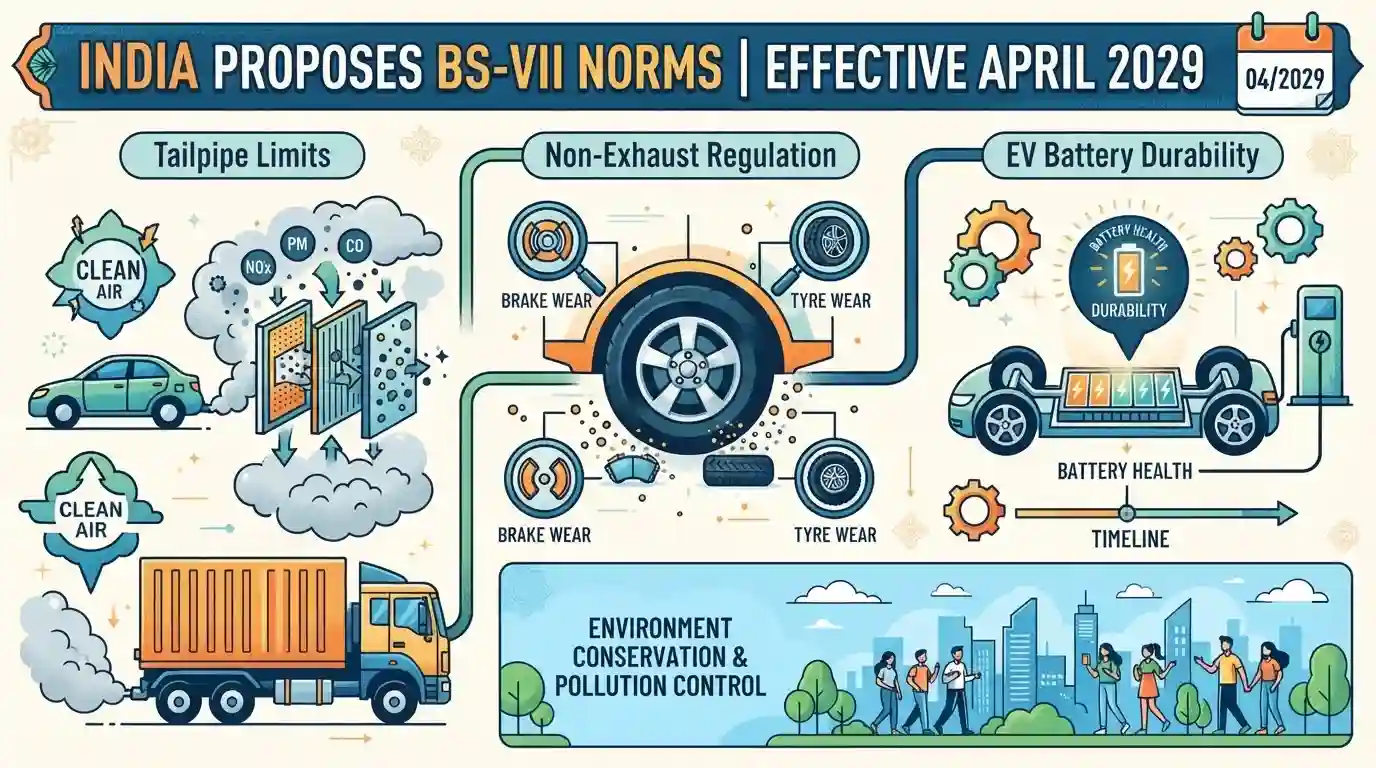
The Indian government has proposed the implementation of Bharat Stage-VII (BS-VII) emission norms effective April 2029. Beyond traditional tailpipe exhaust limits, the proposed framework expands into non-exhaust pollution sources by regulating brake and tyre wear, alongside setting durability requirements for electric vehicle batteries.
ముఖ్య అంశాలు
- The government has proposed the introduction of Bharat Stage-VII (BS-VII) emission norms starting April 2029.
- For the first time, regulatory standards will cover non-exhaust emissions, including brake and tyre wear.
- New durability regulations for electric vehicle (EV) batteries are also introduced to ensure long-term performance and consumer protection.
- These steps mark a paradigm shift from traditional tailpipe-only emission regulation to comprehensive lifecycle and particulate pollution management.
ముఖ్యమైన పదాలు
Bharat Stage-VII (BS-VII) emission norms

Stricter vehicular pollution standards proposed for implementation in India starting April 2029. They extend beyond traditional tailpipe exhaust limits to regulate non-exhaust pollution sources such as brake and tyre wear, alongside electric vehicle battery durability.
UPSC context
UPSC CSE Prelims and Mains (GS Paper III - Environment Conservation and Pollution Control), testing knowledge of regulatory frameworks for reducing vehicular emissions and urban air pollution.
Ministry of Road Transport and Highways
The apex central government ministry in India responsible for formulating and administering policies, rules, and regulations relating to road transport, national highways, and vehicular emission standards.
UPSC context
UPSC CSE Prelims and Mains (GS Paper II / III - Governance and Infrastructure), testing institutional frameworks and policy implementation for transport and environmental regulations.
ప్రిలిమ్స్ ఉచ్చు
Bharat Stage emission norms exclusively regulate internal combustion engine tailpipe exhausts such as NOx and particulate matter.
Aspirants assume BS norms apply only to internal combustion engine tailpipe emissions; BS-VII explicitly regulates non-exhaust sources like brake and tyre wear.
అనుసంధానమైన స్థిర భావనలు
What is the legal framework and evolution of Bharat Stage (BS) emission standards in India?
- Statutory Backing: Nodal authority notified under the Central Motor Vehicles Rules, framed under the Motor Vehicles Act, 1988 by MoRTH.
- Leapfrogging BS-V: Shifted directly from BS-IV to BS-VI in April 2020, skipping BS-V to curb spiraling urban air pollution rapidly.
- Fuel Quality Linkage: Mandates ultra-low sulphur fuel (10 ppm) nationwide to enable advanced catalytic converters and particulate filters.
అంతర-అంశ నమూనాలు
BS-VII Non-Exhaust Norms vs National Clean Air Programme
Non-exhaust particulate emissions from brakes and tyres affect urban air quality independently of fuel type, linking transport policy directly with NCAP particulate reduction targets.
EV Battery Durability meets Circular Economy mandates
EV battery durability rules introduced under vehicular emission norms directly intersect with upcoming circular economy and battery waste management regulations.

Expect a statement-based question pairing BS-VII inclusion of non-exhaust sources (brakes/tyres) with EV battery lifecycle standards.
అనుసంధాన PYQలు · 1
అనుసంధాన PYQలు · 1
- 2023MainsGS3
The adoption of electric vehicles is rapidly growing worldwide. How do electric vehicles contribute to reducing carbon emissions and what are the key benefits they offer compared to traditional combustion engine vehicles?
