India pitches indigenous PHWR scale up to US nuclear mission
Source:Indian Express ↗
Why It Matters
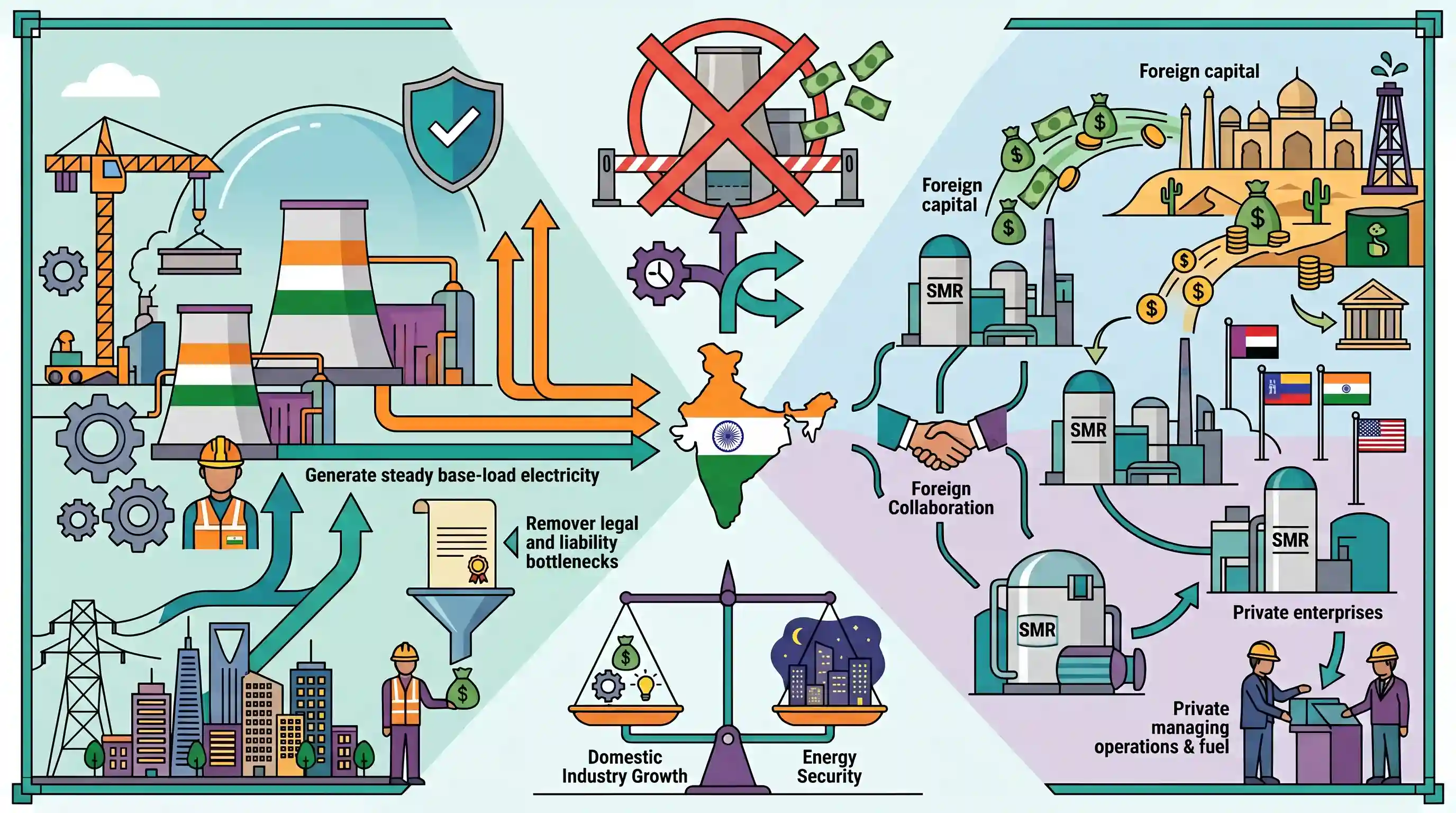
This highlights India's evolving civil nuclear strategy, showcasing the balance between indigenous reactor deployment (PHWRs) and the integration of private/foreign investment for new technologies (SMRs). The SHANTI Act 2025 is a critical legislative milestone for UPSC aspirants tracking energy sector reforms.
Summary
India is signaling a strategic evolution in its civil nuclear policy by pitching the scale-up of indigenous Pressurised Heavy Water Reactors (PHWRs) for base-load capacity to a visiting US nuclear mission, while actively seeking foreign collaboration and capital for Small Modular Reactors (SMRs). To facilitate private sector integration, the recently enacted SHANTI Act, 2025 opens nuclear operations and fuel management to private players, effectively addressing bottlenecks in the previous civil liability regime. India aims to attract foreign capital, particularly from West Asian sovereign funds, rather than importing expensive Light Water Reactors (LWRs) from the US, balancing domestic industry protection with energy security goals.
Key Points
- India prioritizes its indigenous Pressurised Heavy Water Reactors (PHWRs) to build base-load nuclear capacity, aiming to avoid over-reliance on costly imported Light Water Reactors (LWRs).
- The government is highly receptive to international partnerships and technology transfers for Small Modular Reactors (SMRs), which are seen as crucial for scalable, decentralized energy generation.
- The newly enacted SHANTI Act, 2025 enables private sector participation in nuclear operations and fuel management by addressing long-standing hurdles created by India's strict civil nuclear liability laws.
- India seeks foreign financial investment—especially from West Asian sovereign funds—to fund its nuclear expansion, leveraging US technology authorizations (10CFR810) while keeping tariff structures manageable.
Important Terms
SHANTI Act, 2025

2025 legislation opening India's civil nuclear sector to private/foreign participation, overhauling liability norms, and repealing the Atomic Energy Act, 1962.
UPSC context
GS2 (Government Policies) and GS3 (Energy); marks a shift from state monopoly to private participation in strategic sectors.
Small Modular Reactors (SMRs)
Advanced nuclear reactors with power capacity up to 300 MWe, characterized by modular factory-based construction, enhanced safety features, and lower upfront capital costs.
UPSC context
GS3 (Science and Technology); focus on decarbonization, energy security, and indigenization of advanced power technologies.
Civil Liability for Nuclear Damage Act, 2010
2010 law establishing 'no-fault' operator liability for accidents; its 'right of recourse' against equipment suppliers historically deterred foreign investments until the 2025 reforms.
UPSC context
GS2 (International Relations) and GS3 (Legislation); central to the operationalization of the Indo-US Civil Nuclear Deal.
10CFR810 Authorisations
A US federal regulation (Atomic Energy Act, 1954) controlling the export of unclassified nuclear technology and assistance, requiring specific licenses for transfers to India.
UPSC context
GS2 (International Relations/Bilateral Agreements); tests knowledge of technology transfer regimes and regulatory barriers in strategic partnerships.
Pressurised Heavy Water Reactors (PHWRs)
Nuclear reactors using natural uranium as fuel and heavy water as moderator/coolant; the indigenous mainstay of India's three-stage nuclear power program.
UPSC context
GS3 (Indigenization of Technology); core component of India's nuclear energy infrastructure and domestic R&D success.
Department of Atomic Energy (DAE)
The nodal department under the Prime Minister’s Office responsible for India’s nuclear energy policy, research (BARC), and strategic atomic development.
UPSC context
GS2 (Institutions/Governance); essential for understanding India's administrative framework for high-technology and strategic sectors.
Prelims Trap
"Private sector companies are legally prohibited from owning and operating nuclear power plants in India."
The SHANTI Act 2025 ended the state monopoly established by the Atomic Energy Act 1962, legally permitting private sector entities to build, own, and operate nuclear power plants.
Static Concepts Connected
How does India's Three-Stage Nuclear Programme function?
- Stage 1 (PHWRs): Pressurised Heavy Water Reactors (PHWRs) use natural uranium and heavy water to generate power, producing Plutonium-239 as a byproduct.
- Stage 2 (FBRs): Fast Breeder Reactors (FBRs) use Plutonium-239 mixed with uranium, generating more fissile material than they consume and converting Thorium-232 to fissile Uranium-233.
- Stage 3 (AHWRs): Advanced Heavy Water Reactors (AHWRs) will use Uranium-233 and abundant domestic Thorium, establishing a fully self-sustaining fuel cycle.
What distinguishes PHWRs, LWRs, and Small Modular Reactors (SMRs)?
- PHWRs: Utilize unenriched natural uranium as fuel and heavy water as both coolant and moderator. Highly indigenized in India.
- LWRs: Require costly enriched uranium and ordinary light water. Historically imported by India (e.g., Kudankulam plant from Russia).
- SMRs: Advanced reactors with up to 300 MWe capacity. They are factory-assembled, decentralized, and rely on passive safety systems.
Cross-Topic Patterns
West Asian SWFs in Strategic Sectors
India is shifting from purely Western technological dependence to integrating West Asian sovereign capital for critical infrastructure, mirroring recent foreign direct investment trends in green hydrogen and renewable grids.
Overcoming the 'Right of Recourse' hurdle
The SHANTI Act 2025 resolves the long-standing international friction over Section 17(b) of CLNDA, 2010, which previously deterred foreign suppliers by holding them liable for equipment defects.

Expect a multi-statement 2026 Prelims question testing the SHANTI Act's privatization of nuclear operations alongside SMR characteristics.
Linked PYQs · 3
Linked PYQs · 3
- 2024PrelimsGS1
With reference to radioisotope thermoelectric generators (RTGs), consider the following statements: 1. RTGs are miniature fission reactors. 2. RTGs are used for powering the onboard systems of spacecrafts. 3. RTGs can use Plutonium-238, which is a by-product of weapons development. Which of the statements given above are correct?
- 2025MainsGS3
The fusion energy programme in India has steadily evolved over the past few decades. Mention India's contributions to the international fusion energy project International Thermonuclear Experimental Reactor (ITER). What will be the implications of the success of this project for the future of global energy?
- 2017MainsGS3
Give an account of the growth and development of nuclear science and technology in India. What is the advantage of fast breeder reactor programme in India?
