Maharashtra Probe into Below Estimate Building Repair Tenders
Source:Indian Express ↗
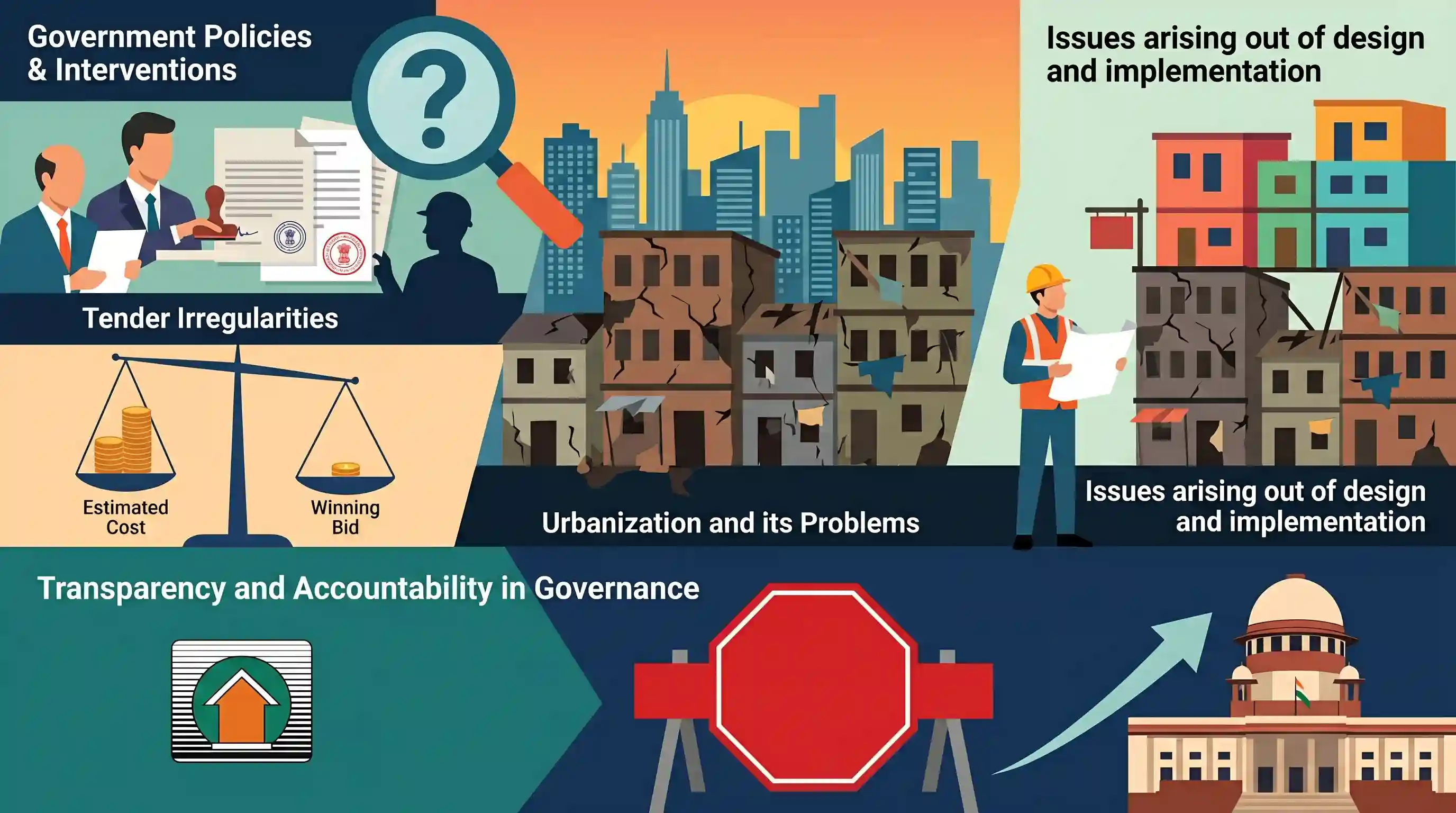
Why It Matters
Highlights the persistent challenges in urban redevelopment and public procurement in India's mega-cities. It underscores the intersection of legal bottlenecks (High Court stays on housing acts), bureaucratic functioning (public tendering), and unauthorized constructions (urban planning violations), which are key themes in GS2 and GS3 urbanization and governance topics.
Summary
The Maharashtra government has ordered an investigation into suspected irregularities in MHADA tenders for repairing dilapidated, cessed buildings in Mumbai. Contractors are allegedly winning bids by quoting prices drastically below the estimated costs—sometimes 100 to 140 percent lower—and subsequently engaging in unauthorized construction to sell extra space for profit. In parallel, the government is moving to challenge a Bombay High Court stay on the amended Section 79A of the MHADA Act in the Supreme Court. This amendment was designed to empower MHADA to take over and redevelop old and unsafe cessed buildings, addressing critical urban housing and safety issues in the metropolis.
Key Points
- The Maharashtra government has initiated a probe into suspected irregularities in MHADA's repair tenders for cessed dilapidated buildings in Mumbai.
- Contractors allegedly secured tenders by quoting prices 100 to 140 percent below the estimated project costs.
- These contractors are suspected of carrying out illegal construction, such as adding extra floors, to sell for profit and compensate for their low bids.
- The state government plans to appeal to the Supreme Court to lift the Bombay High Court's stay on Section 79A of the MHADA Act, which empowers MHADA to acquire and redevelop unsafe cessed buildings.
Important Terms
MHADA (Maharashtra Housing and Area Development Authority)

Statutory body established in 1977 to provide affordable housing and oversee urban development in Maharashtra, coordinating regional housing boards and redevelopment projects.
UPSC context
GS Paper 2: Statutory bodies and government policies; GS Paper 1: Problems of urbanization and remedies.
Section 79A of the MHADA Act
A legal provision empowering the state to fast-track redevelopment of dilapidated 'cessed buildings' if owners or 51% of tenants fail to initiate repairs/reconstruction within specified timelines.
UPSC context
GS Paper 2: Issues arising out of design and implementation of policies; tests understanding of legal-administrative frameworks for urban safety.
Cessed Buildings
Old Mumbai properties (mostly pre-1969) that pay a special 'repair cess' (tax) to MHADA to fund their structural maintenance, repair, and potential reconstruction.
UPSC context
GS Paper 3: Infrastructure and disaster management (safety of aging structures); GS Paper 1: Urbanization challenges.
Mumbai Buildings Repairs and Reconstruction Board (MBRRB)
A specialized wing of MHADA responsible for the structural audit, repair, and reconstruction of nearly 16,000 cessed buildings in Mumbai's island city.
UPSC context
GS Paper 2: Transparency and accountability in governance and specialized government agencies.
Urban Redevelopment
A strategy to revitalize dilapidated urban areas by replacing unsafe structures with modern housing, often involving incentive Floor Space Index (FSI) for private developers.
UPSC context
GS Paper 1: Urbanization; GS Paper 3: Sustainable infrastructure and economic development.
Prelims Trap
"The L1 (lowest bidder) criteria is legally mandated for all public procurement without exception."
The General Financial Rules (GFR) 2017 allow for Quality and Cost Based Selection (QCBS) in specific procurements to avoid poor quality from Abnormally Low Bids.
Static Concepts Connected
How do the General Financial Rules (GFR) address 'Abnormally Low Bids' (ALB)?
- Definition: An ALB is a bid so unrealistically low that it raises substantive concerns about the contractor's capability to execute the project.
- Performance Security: Guidelines allow procuring entities to seek clarification and, if risk remains high, demand Additional Performance Security to protect public interests.
- QCBS Alternative: To counter ALB issues, the government increasingly allows Quality and Cost Based Selection (QCBS) where technical competence is weighted alongside price.
What is the State's power of Eminent Domain in urban redevelopment?
- Article 300A: Under Article 300A, the state can acquire private property (e.g., dilapidated buildings) but only through the authority of law.
- Public Purpose: Acquisition must satisfy a legitimate "public purpose," such as public safety, slum rehabilitation, or preventing urban hazards.
- Judicial Scrutiny: Courts can stay such acquisitions if they violate natural justice, procedural fairness, or become mechanisms for state overreach.
Cross-Topic Patterns
L1 Tendering + Urban Disasters
Links GS2 Governance (flaws in Lowest Bidder tendering) with GS1 Urbanization. Abnormally Low Bids often drive illegal construction, creating prime case studies for GS4 ethics on corporate governance.
Eminent Domain + Judicial Stays
Highlights the tension between executive policies aimed at rapid urban renewal (GS2 Policies) and constitutional safeguards for property rights, often triggering Article 136 appeals by the State.

Expect a Mains GS2 or GS4 question critiquing the L1 (Lowest Bidder) public procurement system, citing urban infrastructure collapses.
Linked PYQs · 3
Linked PYQs · 3
- 2023MainsGS1
Does urbanization lead to more segregation and/or marginalization of the poor in Indian metropolises?
- 2024MainsGS2
Analyse the role of local bodies in providing good governance at local level and bring out the pros and cons merging the rural local bodies with the urban local bodies.
- 2017MainsGS4
Examine the relevance of the following in the context of civil service: Transparency, Accountability, Fairness and justice, Courage of conviction, Spirit of service.
