Government Open to Structured Dialogue on Reservation Policies
Source:Indian Express ↗
हे का महत्त्वाचे आहे
The article highlights the ongoing debate between caste-based and economic-based affirmative action, which is a core topic in GS Paper 2 (Social Justice). It also touches upon the right to protest and the role of political opposition, providing practical examples of how democratic dissent is negotiated between citizens, opposition parties, and the ruling government.
सारांश
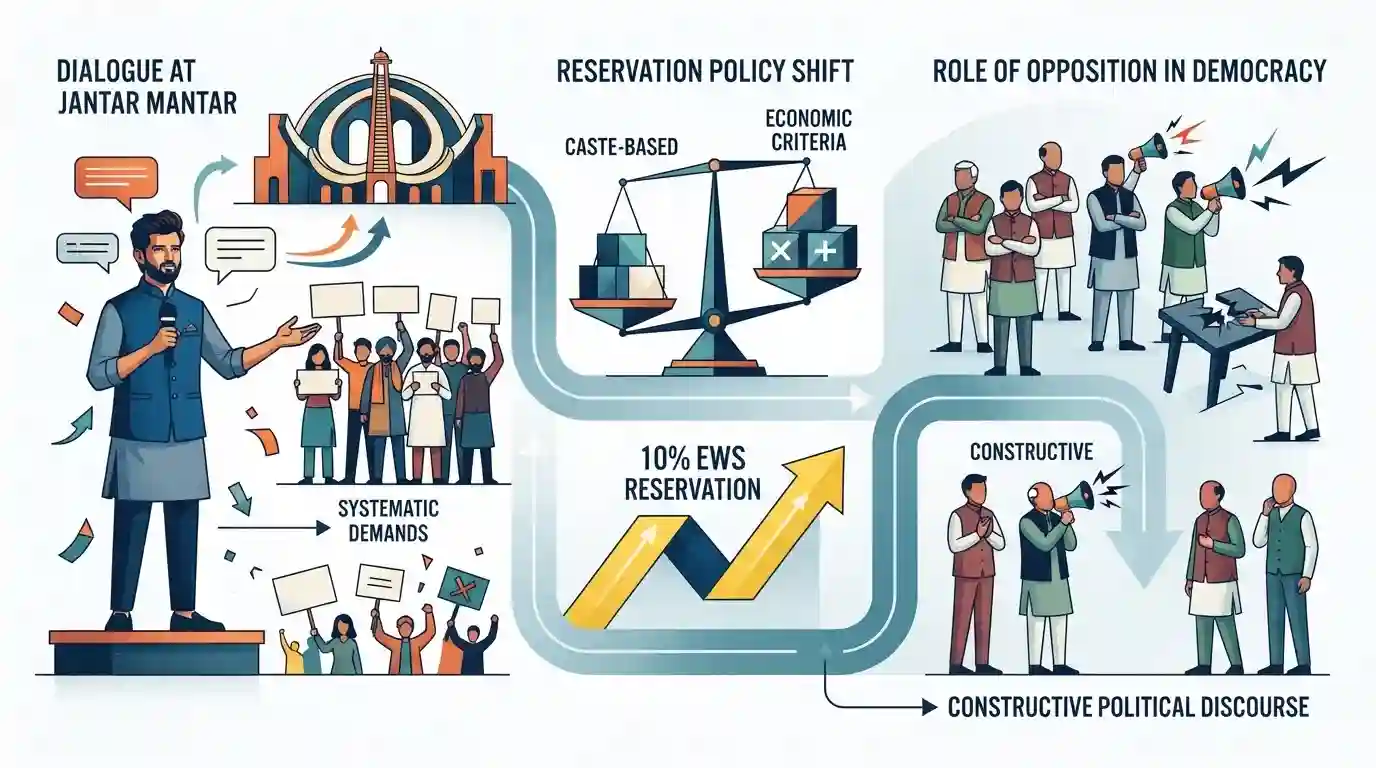
Union Minister Chirag Paswan has expressed the government's willingness to engage in dialogue with anti-reservation protesters at Delhi's Jantar Mantar, provided their demands are structured systematically. The protesters are advocating for economic criteria to replace caste-based affirmative action. Paswan highlighted the NDA government's existing 10% reservation for Economically Weaker Sections (EWS) to address economic disparities. Additionally, he criticized opposition parties, including the Congress and RJD, for staging disruptive protests rather than facilitating constructive political discourse.
मुख्य मुद्दे
- Union Minister Chirag Paswan offered government dialogue to anti-reservation protesters at Jantar Mantar if demands are organized systematically.
- The protesters are demanding that reservations be based on economic criteria rather than caste.
- Paswan pointed out that the NDA government has already implemented a 10% quota for Economically Weaker Sections (EWS).
- He criticized the Congress and RJD for using protests as political tools rather than engaging constructively.
महत्त्वाच्या संज्ञा
10% EWS Reservation

A policy introduced by the 103rd Constitutional Amendment Act, 2019, reserving 10% of seats in government jobs and educational admissions for Economically Weaker Sections among those not covered by existing caste-based quotas.
UPSC context
GS Paper II (Polity & Governance); tests constitutional amendments, reservation policy, and affirmative action.
National Democratic Alliance
A center-right political coalition in India founded in 1998, led by the Bharatiya Janata Party (BJP), representing coalition politics and federal power-sharing at the national level.
UPSC context
GS Paper II (Polity & Governance); tests coalition government dynamics, political parties, and federal structures.
Role of Opposition in Democracy
The democratic function of non-governing parties to hold the executive accountable, critique policies, debate laws, protect minority rights, and offer a viable alternative government.
UPSC context
GS Paper II (Polity); tests the functioning, challenges, and constitutional significance of parliamentary opposition.
Indian National Congress
One of India's oldest political parties, founded in 1885, which spearheaded the national freedom movement and subsequently dominated post-independence politics.
UPSC context
GS Paper I (Modern History) & GS Paper II (Polity); tests national freedom struggle and party system evolution.
Rashtriya Janata Dal
A prominent regional political party in India, active primarily in Bihar, advocating for social justice, secularism, and the political representation of backward classes.
UPSC context
GS Paper II (Polity); tests regionalism, state-level political parties, and coalition dynamics.
पूर्वपरीक्षा सापळा
The Constitution of India explicitly defines 'efficiency of administration' under Article 335 to limit reservation policies.
While Article 335 mandates considering the claims of SCs/STs consistent with 'efficiency of administration', the Constitution does not define this phrase, leaving its interpretation to judicial precedents like B.K. Pavitra.
संबंधित स्थिर संकल्पना
What is the constitutional and judicial basis of the 10% EWS Reservation?
- 103rd Amendment: Inserted Articles 15(6) and 16(6) to enable reservation for economically weaker sections in educational institutions and public employment.
- Sinho Commission: Formulated based on the S.R. Sinho Commission (2010) which identified economically backward classes among the general category.
- Janhit Abhiyan (2022): A 5-judge bench upheld the amendment (3:2), ruling economic-only criteria does not violate basic structure and the 50% cap applies only to SC/ST/OBCs.
How does Article 335 balance reservation with administrative standards?
- Article 335: Mandates that claims of SCs/STs shall be taken into consideration, consistently with the maintenance of efficiency of administration.
- No Definition: The term 'efficiency of administration' is not defined anywhere in the Constitution of India.
- Judicial Clarification: The SC in B.K. Pavitra (II) held that efficiency must be defined inclusively, as representation itself enhances administrative efficiency rather than degrading it.
आंतर-विषय नमुने
Economic Criteria vs. Caste Mobilization
The transition toward income-based affirmative action (EWS) complicates traditional caste-based electoral politics and federal welfare demands.
Judicial Review and the 50% Cap
The shift from Indra Sawhney's absolute 50% cap to Janhit Abhiyan's exclusion of EWS demonstrates the Court's evolving doctrine on basic structure.

Expect questions testing the legal status of the 50% reservation cap post-Janhit Abhiyan alongside constitutional provisions of Article 335.
संबंधित PYQ · 3
संबंधित PYQ · 3
- 2023PrelimsGS1
Consider the following statements: Statement-I: The Supreme Court of India has held in some judgements that the reservation policies made under Article 16(4) of the Constitution of India would be limited by Article 335 for maintenance of efficiency of administration. Statement-II: Article 335 of the Constitution of India defines the term 'efficiency of administration'. Which one of the following is correct in respect of the above statements?
- 2023MainsGS2
“Development and welfare schemes for the vulnerable, by its nature, are discriminatory in approach.” Do you agree? Give reasons for your answer.
- 2023MainsGS2
“The Constitution of India is a living instrument with capabilities of enormous dynamism. It is a constitution made for a progressive society.” Illustrate with special reference to the expanding horizons of the right to life and personal liberty.
