Termination of GST Compensation Cess and Tobacco Tax Revision
Source:The Hindu ↗
Why It Matters
The end of the GST compensation cess fundamentally alters state revenue calculations and fiscal federalism dynamics. Furthermore, employing a dedicated cess to fund national security introduces a critical debate on resource allocation, non-lapsable funds, and the balancing of off-budget financing against the divisible tax pool.
Summary
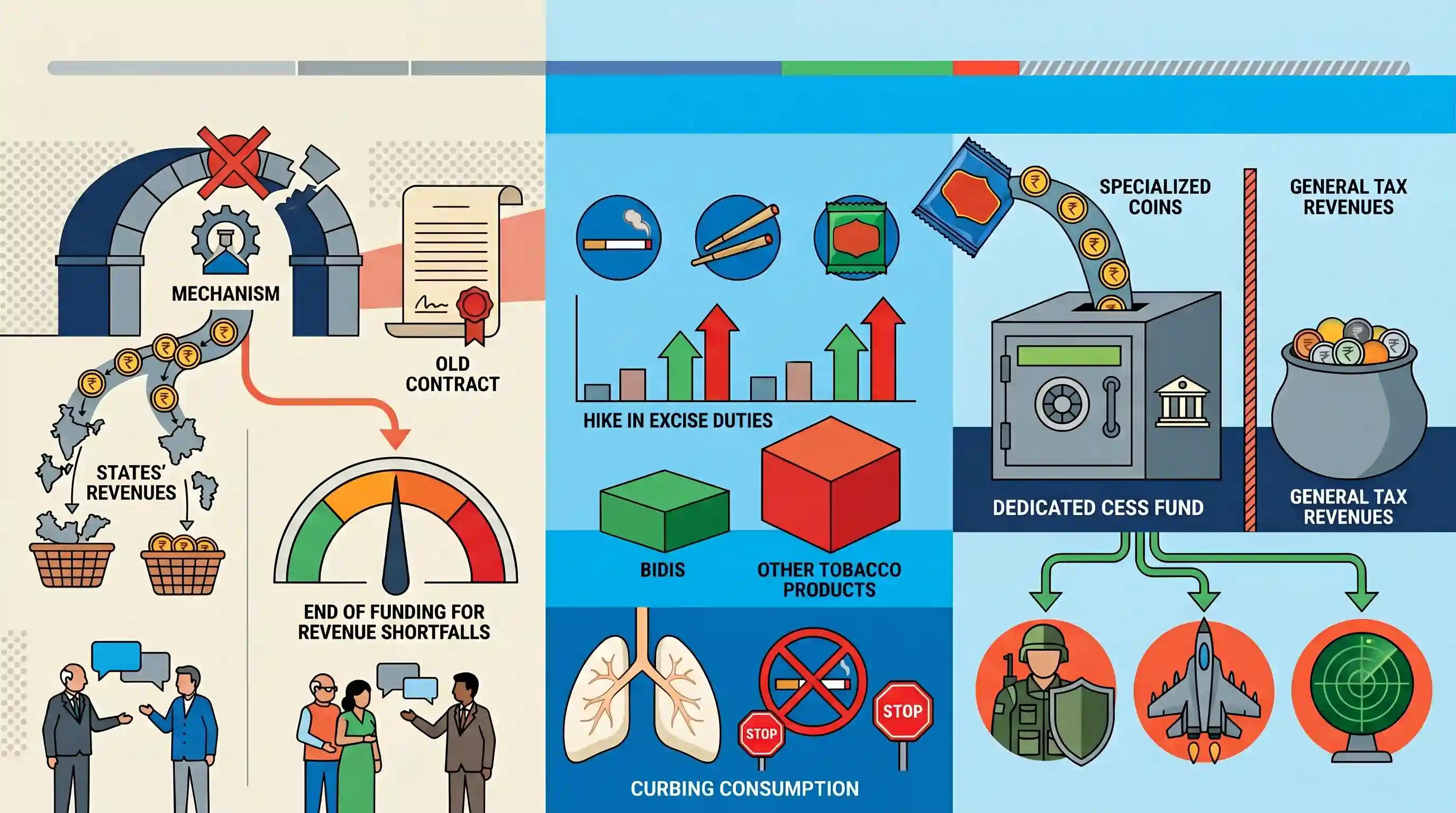
The Union Finance Ministry has notified the end of the GST compensation cess effective February 1, 2026, marking the closure of the mechanism created to offset States' revenue shortfalls from the GST rollout. Simultaneously, a new tobacco taxation framework under the Central Excise (Amendment) Act, 2025 will hike excise duties to curb consumption, while restructuring GST slabs (18% for bidis, 40% for other tobacco products). The government is also enacting the Health Security se National Security Act, 2025, which levies a dedicated cess on pan masala to create a non-lapsable fund for financing multi-year national security and defence upgrades independently of general tax revenues.
Key Points
- The GST compensation cess, initially introduced for five years to offset state revenue losses and later extended to repay COVID-19 related borrowing, will be terminated on February 1, 2026.
- The Central Excise (Amendment) Act, 2025 enforces new excise duties on tobacco products to ensure their prices rise faster than income, aligning with global public health recommendations.
- GST rates on tobacco are revised: bidis drop from the now-defunct 28% slab to 18%, while other tobacco products are moved to a new 40% slab.
- A new valuation mechanism for chewing tobacco and related products determines GST value based on the declared retail sale price.
- The Health Security se National Security Act, 2025 establishes a dedicated, non-lapsable cess on pan masala to fund multi-year national security preparedness and technological upgradation.
Important Terms
GST Compensation Cess

A levy introduced in 2017 to compensate States for revenue shortfalls during the GST transition; ending February 1, 2026, after serving to repay pandemic-era loans.
UPSC context
GS-III Economy; tested under Fiscal Federalism, GST Council decisions, and resource mobilization between Centre and States.
Health Security se National Security Act, 2025
A 2025 law levying a capacity-based cess on pan masala to create a dedicated, non-lapsable fund for public health and national security upgrades.
UPSC context
GS-III Economy & Security; relevant for innovative defence financing and earmarked taxation (cess) mechanisms.
Central Excise (Amendment) Act, 2025
Legislation amending the 1944 Act to hike excise duties on tobacco products, maintaining high tax incidence after the GST compensation cess expires.
UPSC context
GS-III Economy; concerns indirect taxation, demerit goods (sin taxes), and legislative measures for revenue stability.
Capacity-based Cess
A taxation method where the levy is based on manufacturing capacity (e.g., machine speed) rather than actual production volume, used to prevent evasion.
UPSC context
GS-III Economy; tests understanding of tax administration and innovative anti-evasion techniques in the tobacco sector.
Non-lapsable Fund
A financial pool where unspent balances do not revert to the Consolidated Fund at year-end but carry forward for specific multi-year projects.
UPSC context
GS-III Budgeting; critical for defense modernization (AMDF) and long-term infrastructure funding discussions.
Prelims Trap
"Tobacco products in India are excluded from the GST framework and only attract Central Excise Duty."
Tobacco is subjected to BOTH GST and Central Excise Duty. Unlike alcohol for human consumption or crude oil, it is not kept outside the GST framework.
Static Concepts Connected
How did the 15th Finance Commission address defence funding?
- Non-lapsable fund: Recommended the creation of a dedicated non-lapsable fund called the Modernisation of Defence and Internal Security (MFMODIS).
- Funding sources: Suggested funding via the Consolidated Fund of India, disinvestment of defence PSEs, and monetization of surplus defence land.
- Rationale: Aimed to ensure multi-year capital acquisition projects aren't hindered by annual budget lapses at the end of the financial year.
What is the constitutional difference between a Cess and a Surcharge?
- Constitutional basis: Cess is levied for a specific purpose (Article 270); Surcharge is an additional tax for general purposes (Article 271).
- Divisible Pool: Neither forms part of the central divisible pool of taxes that is mandatorily shared with states.
- End use: Cess collections must be transferred to a dedicated reserve fund and do not lapse at the end of the financial year.
Cross-Topic Patterns
Public health and taxation (WHO MPOWER)
Linking excise hikes to outpace per capita income directly maps to WHO's MPOWER framework, blending macroeconomic policy with national health goals.
Tackling under-invoicing via RSP valuation
Shifting chewing tobacco's GST calculation from transaction value to Retail Sale Price (RSP) addresses rampant supply-chain under-invoicing, a systemic tax evasion tactic.

Expect a multi-statement question on tobacco taxation (GST + Excise) and the constitutional validity of non-lapsable cesses in 2026.
Linked PYQs · 3
Linked PYQs · 3
- 2020MainsGS3
Explain the rationale behind the Goods and Services Tax (Compensation to States) Act of 2017. How has COVID-19 impacted the GST compensation fund and created new federal tensions?
- 2019MainsGS3
Enumerate the indirect taxes which have been subsumed in the Goods and Services Tax (GST) in India. Also, comment on the revenue implications of the GST introduced in India since July 2017.
- 2017PrelimsGS1
What is/are the most likely advantages of implementing 'Goods and Services Tax (GST)'? 1. It will replace multiple taxes collected by multiple authorities and will thus create a single market in India. 2. It will drastically reduce the 'Current Account Deficit' of India and will enable it to increase its foreign exchange reserves. 3. It will enormously increase the growth and size of economy of India and will enable it to overtake China in the near future. Select the correct answer using the code given below:
