GST Compensation Cess Expiry and Tobacco Tax Regime Reforms
Source:The Hindu ↗
Why It Matters
The expiration of the GST compensation cess is a landmark event in fiscal federalism, concluding the transition period designed to protect State revenues. Furthermore, the introduction of a dedicated cess for national security tied to 'sin goods' (tobacco) highlights a strategic shift in public finance, bridging public health disincentives with defence funding. This is highly relevant for GS-3 questions on resource mobilization and GST outcomes.
Summary
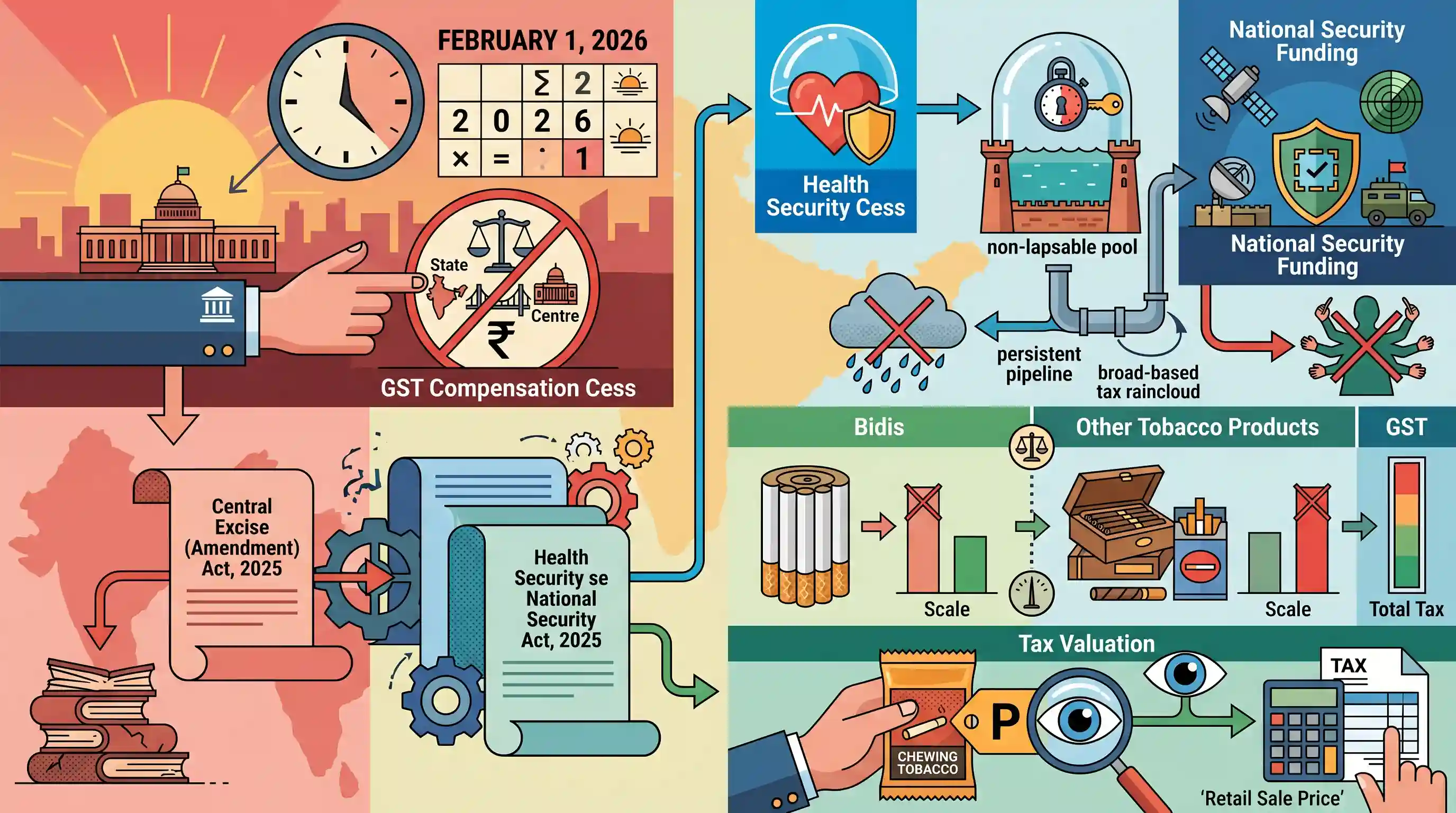
The Indian government has officially notified February 1, 2026, as the sunset date for the GST compensation cess, paving the way for a revamped tax regime on tobacco products. This transition will be facilitated by the implementation of the Central Excise (Amendment) Act, 2025, and the Health Security se National Security Act, 2025. The new structure abolishes the compensation cess and introduces a dedicated 'health security' cess to fund national security via a non-lapsable pool, avoiding broad-based tax hikes. Additionally, GST slabs for tobacco are restructured—bidis drop to 18% while other products shift to a 40% slab—and tax valuation will now rely on declared retail sale prices.
Key Points
- The Union Government has notified February 1, 2026, as the end date for the GST compensation cess, transitioning to a new indirect tax framework for tobacco.
- The Central Excise (Amendment) Act, 2025, and the Health Security se National Security Act, 2025, will be implemented simultaneously on February 1 to overhaul tobacco taxation.
- Under the new regime, GST on bidis is reduced from 28% to 18%, while other tobacco products are moved to a new 40% top GST slab.
- The Health Security se National Security Act introduces a dedicated cess on pan masala and tobacco to create a non-lapsable, predictable funding stream for national security.
- The valuation mechanism for tobacco products has been shifted to be based on the declared retail sale price, simplifying tax calculation and compliance.
Important Terms
Central Excise (Amendment) Act, 2025

2025 legislation amending the 1944 Act to significantly increase specific excise duties on tobacco products, maintaining high tax incidence after the phasing out of the GST compensation cess.
UPSC context
GS-III: Indian Economy (Taxation). Relevant for questions on "sin tax" structures and revenue neutrality post-GST reforms.
Health Security se National Security Cess Act, 2025
Law introducing a capacity-based levy on manufacturing machines for pan masala and tobacco, with proceeds earmarked for national security and public health via the Consolidated Fund.
UPSC context
GS-III: Internal Security / Public Finance. Tests understanding of earmarked cesses and non-lapsable funding for strategic sectors.
GST Compensation Cess
An additional levy on luxury and demerit goods introduced in 2017 to bridge state revenue shortfalls; officially set to end on February 1, 2026.
UPSC context
GS-III: Fiscal Federalism. Crucial for understanding the transition from state-guaranteed revenue to self-reliance under the GST regime.
GST (Compensation to States) Act, 2017
The 2017 statute that provided a legal guarantee to states for a 14% annual revenue growth for five years, funded by the compensation cess.
UPSC context
GS-II: Governance & Federalism. Examines the constitutional and legal frameworks of Centre-State financial relations.
GST Council
Constitutional body (Article 279A) chaired by the Union Finance Minister that makes recommendations on GST rates, exemptions, and administrative thresholds.
UPSC context
GS-II: Statutory/Constitutional Bodies. High-frequency topic regarding cooperative federalism and consensus-based economic decision-making.
Prelims Trap
Proceeds from the new Health Security cess on tobacco are divisible among States to compensate for GST shortfalls.
False. The new Health Security cess creates a dedicated non-lapsable pool specifically for national security funding, which is not shared with the States.
Static Concepts Connected
How does a 'Cess' differ from a general tax and a surcharge?
- Specific Purpose: A cess is levied exclusively for a defined objective (e.g., health security, road infrastructure) and cannot be diverted to general expenditure.
- Divisible Pool: Under Article 270, cesses and surcharges are excluded from the divisible pool of taxes, meaning they are retained entirely by the Union Government.
- Surcharge vs Cess: A surcharge is essentially a tax on tax meant for the Union's general revenues, whereas a cess targets a specific programmatic outcome.
How are non-lapsable funds structured within India's constitutional framework?
- Public Account: Dedicated non-lapsable pools are typically maintained in the Public Account of India (Article 266(2)), rather than the Consolidated Fund of India.
- Carry Forward mechanism: Unlike regular budget allocations, unspent balances in a non-lapsable fund do not expire at the end of the financial year, ensuring predictable long-term funding.
Cross-Topic Patterns
Sin taxes funding strategic defense
Earmarking tobacco tax for defense bridges public health disincentives with national security, alleviating pressure on the capital defense budget from broad-based tax hikes.
Shrinking the divisible tax pool
Replacing the GST compensation cess with a Union-retained defense cess highlights the ongoing Centre-State tension regarding the proliferation of cesses that bypass revenue-sharing formulas.

Expect a 2026 Prelims question testing the new 40% GST slab, the non-lapsable nature of the health security fund, and Article 270.
Linked PYQs · 3
Linked PYQs · 3
- 2020MainsGS3
Explain the rationale behind the Goods and Services Tax (Compensation to States) Act of 2017. How has COVID-19 impacted the GST compensation fund and created new federal tensions?
- 2019MainsGS3
Enumerate the indirect taxes which have been subsumed in the Goods and Services Tax (GST) in India. Also, comment on the revenue implications of the GST introduced in India since July 2017.
- 2017PrelimsGS1
What is/are the most likely advantages of implementing 'Goods and Services Tax (GST)'? 1. It will replace multiple taxes collected by multiple authorities and will thus create a single market in India. 2. It will drastically reduce the 'Current Account Deficit' of India and will enable it to increase its foreign exchange reserves. 3. It will enormously increase the growth and size of economy of India and will enable it to overtake China in the near future. Select the correct answer using the code given below:
