Opposition Demands Consultation on United States Reciprocal Tariffs
Source:The Hindu ↗
Why It Matters
The growing trend of protectionist policies by major economies like the US poses significant challenges to India's export-oriented sectors and the broader global trade architecture. Understanding the shift from multilateralism (WTO) to unilateralism and the strategic use of bilateral FTAs is crucial for UPSC candidates preparing for Economy and International Relations sections.
Summary
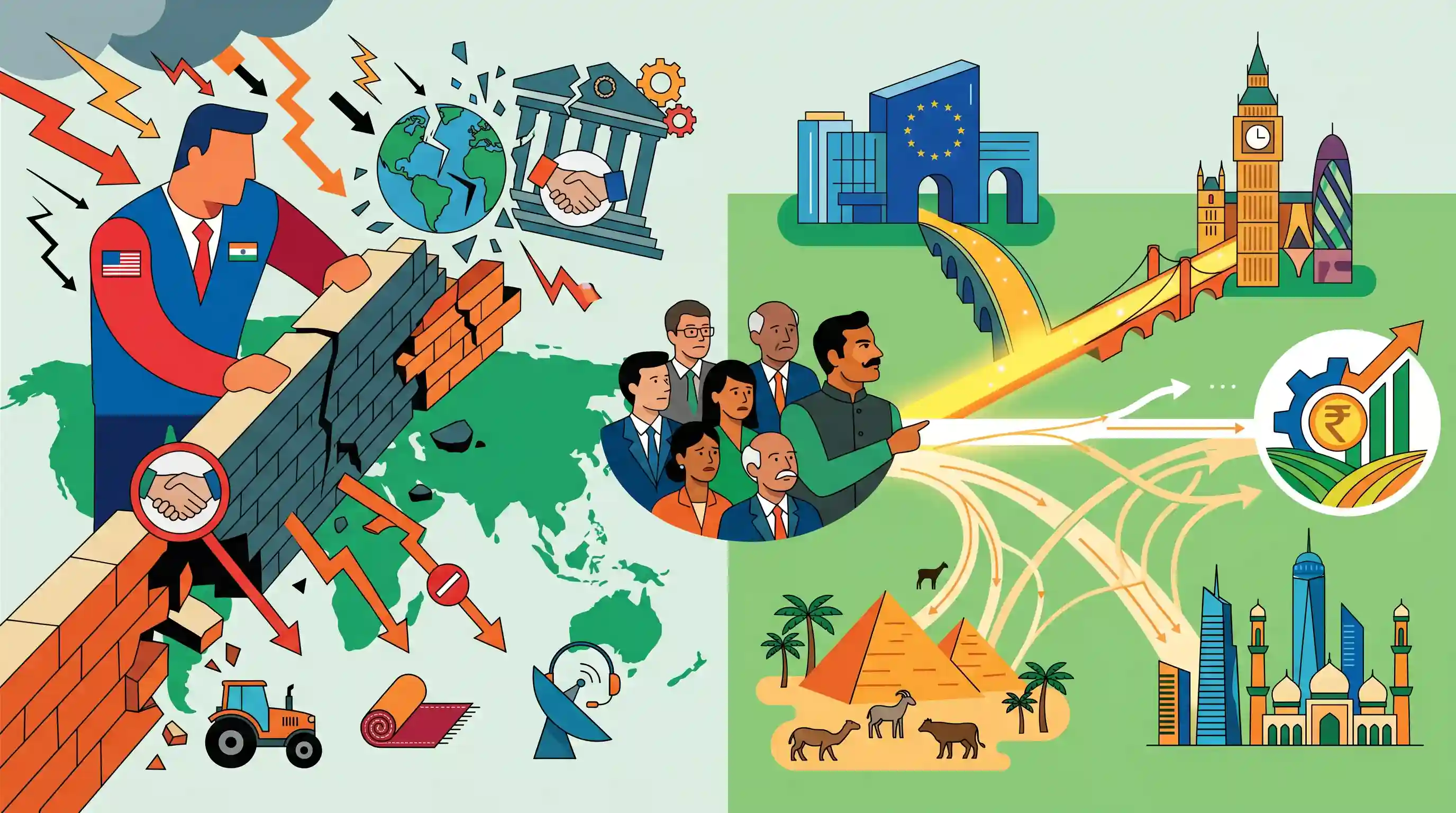
The Congress party has urged the Indian government to consult stakeholders and political parties before formulating a response to reciprocal tariffs imposed by the US Trump administration. Former Commerce Minister Anand Sharma highlighted that the US move violates international trade rules, disrupts the WTO-led multilateral trading system, and creates global economic upheaval. Warning of potential impacts on India's agriculture, textiles, and services sectors, Sharma emphasized the need to prioritize Free Trade Agreements (FTAs) with the EU and UK, while diversifying trade ties with Africa, Latin America, and Gulf countries to protect India's economic interests.
Key Points
- The Congress party has urged the Indian government to consult political parties and stakeholders and form an expert task force to respond to the US administration's reciprocal tariffs.
- Former Commerce Minister Anand Sharma criticized the US tariffs as 'unilateral' and a violation of international agreements, warning of severe disruptions to the WTO-led multilateral trading system.
- The tariffs could negatively impact key Indian sectors, including agriculture (poultry, dairy), textiles, and the broader business community.
- India is advised to prioritize its services sector in trade negotiations and avoid accepting agreements that neglect it.
- To safeguard economic interests, India should focus on finalizing Free Trade Agreements (FTAs) with the EU and the UK while diversifying trade relations with Africa, Latin America, and Gulf countries.
Important Terms
World Trade Organization (WTO)

The sole global international organization governing trade rules between nations, ensuring trade flows as smoothly, predictably, and freely as possible through agreements and dispute settlement.
UPSC context
GS Paper II: International Relations. Tests knowledge of global governance, trade disputes, and India's role in multilateral forums.
Free Trade Agreements (FTAs)
Pacts between two or more countries to reduce or eliminate trade barriers like tariffs and quotas on goods and services to enhance market access.
UPSC context
GS Paper III: Indian Economy. Tests understanding of trade policy, export competitiveness, and bilateral economic diplomacy.
Protectionism
Economic policy of restricting imports from other countries through methods such as tariffs on imported goods, restrictive quotas, and a variety of other government regulations.
UPSC context
GS Paper III: Economy. Tests analysis of global trade trends, impact on domestic industries, and challenges to globalization.
Reciprocal Tariffs
A policy where a country imposes tariffs on imports from another country at the same rate that the other country imposes on its exports.
UPSC context
GS Paper II & III: International Relations/Economy. Tests specific understanding of trade wars, US-India trade friction, and "tit-for-tat" diplomacy.
Multilateral Trading System
A rules-based framework for international trade, primarily managed by the WTO, emphasizing non-discrimination, transparency, and collective negotiation among multiple nations.
UPSC context
GS Paper II: International Relations. Tests comprehension of global order, challenges from unilateralism, and the shift toward regionalism.
European Union (EU)
A unique economic and political union of 27 European countries that operates as a single market and is a key FTA partner for India.
UPSC context
GS Paper II: Bilateral Groupings. Tests knowledge of India-EU strategic ties and stalled/re-started free trade negotiations.
India-US Relations
The comprehensive strategic partnership between the world's oldest and largest democracies, covering trade, defense, and technology, frequently impacted by tariff disputes.
UPSC context
GS Paper II: International Relations. Essential for understanding "Effect of policies of developed countries on India's interests."
Prelims Trap
WTO member countries can unilaterally impose reciprocal tariffs if a trading partner unfairly raises its duties.
Retaliation is strictly regulated. Members cannot act unilaterally; they must formally win a dispute at the WTO and get Dispute Settlement Body authorization before imposing retaliatory tariffs.
Static Concepts Connected
What core WTO principles are violated by unilateral reciprocal tariffs?
- Most-Favored-Nation (MFN): Requires treating all WTO member countries equally; unilateral tariffs targeting specific nations violate this foundational non-discrimination rule.
- Bound Tariffs: Countries commit to a ceiling rate (bound rate) for tariffs. Imposing punitive duties above this ceiling without WTO authorization breaks treaty obligations.
- Dispute Settlement Rules: Members cannot unilaterally retaliate against unfair trade. They must seek explicit authorization from the WTO Dispute Settlement Body after a formal ruling.
How do Free Trade Agreements (FTAs) legally bypass WTO non-discrimination rules?
- GATT Article XXIV: Under GATT Article XXIV, Regional Trade Agreements (RTAs) and FTAs are recognized as explicit exceptions to the MFN principle, allowing preferential bilateral treatment.
- Services Integration: Comprehensive agreements (like CEPA/CECA) go beyond goods, covering the services sector (GATS), investment, and intellectual property, which is crucial for India's service exports.
Cross-Topic Patterns
Trade Wars & Rupee Volatility
US protectionism restricts Indian exports, potentially widening India's Current Account Deficit (CAD) while strengthening the dollar, prompting capital flight and currency depreciation.
Global South as Economic Hedge
India’s diplomatic push in Africa and Latin America bridges IR and Economy, serving as a strategic market buffer against Western protectionism and stalled multilateral institutions.

Expect a 2026 multi-statement Prelims question linking WTO MFN exceptions, bound vs applied agricultural tariffs, and FTA mechanisms.
Linked PYQs · 5
Linked PYQs · 5
- 2018MainsGS3
How would the recent phenomena of protectionism and currency manipulations in world trade affect macroeconomic stability of India?
- 2025MainsGS3
What are the challenges before the Indian economy when the world is moving away from free trade and multilateralism to protectionism and bilateralism? How can these challenges be met?
- 2012MainsGS2
Discuss the likely negative impact of the protectionist measures proposed by the US on India's software industry.
- 2016MainsGS2
The broader aims and objectives of WTO are to manage and promote international trade in the era of globalization. But the Doha round of negotiations seem doomed due to differences between the developed and the developing countries." Discuss in the Indian perspective.
- 2016PrelimsGS1
The term 'Regional Comprehensive Economic Partnership' often appears in the news in the context of the affairs of a group of countries known as
