Polavaram Project Target and Lift Irrigation Schemes Revival Plan
Source:The Hindu ↗
Why It Matters
Irrigation forms the backbone of Andhra Pradesh's agrarian economy. Mega projects like Polavaram (a National Project) and Veligonda, along with river interlinking schemes, are staple topics in APPSC Prelims under AP Geography and State Economy. Candidates must track the status of these projects and the associated river systems.
Summary
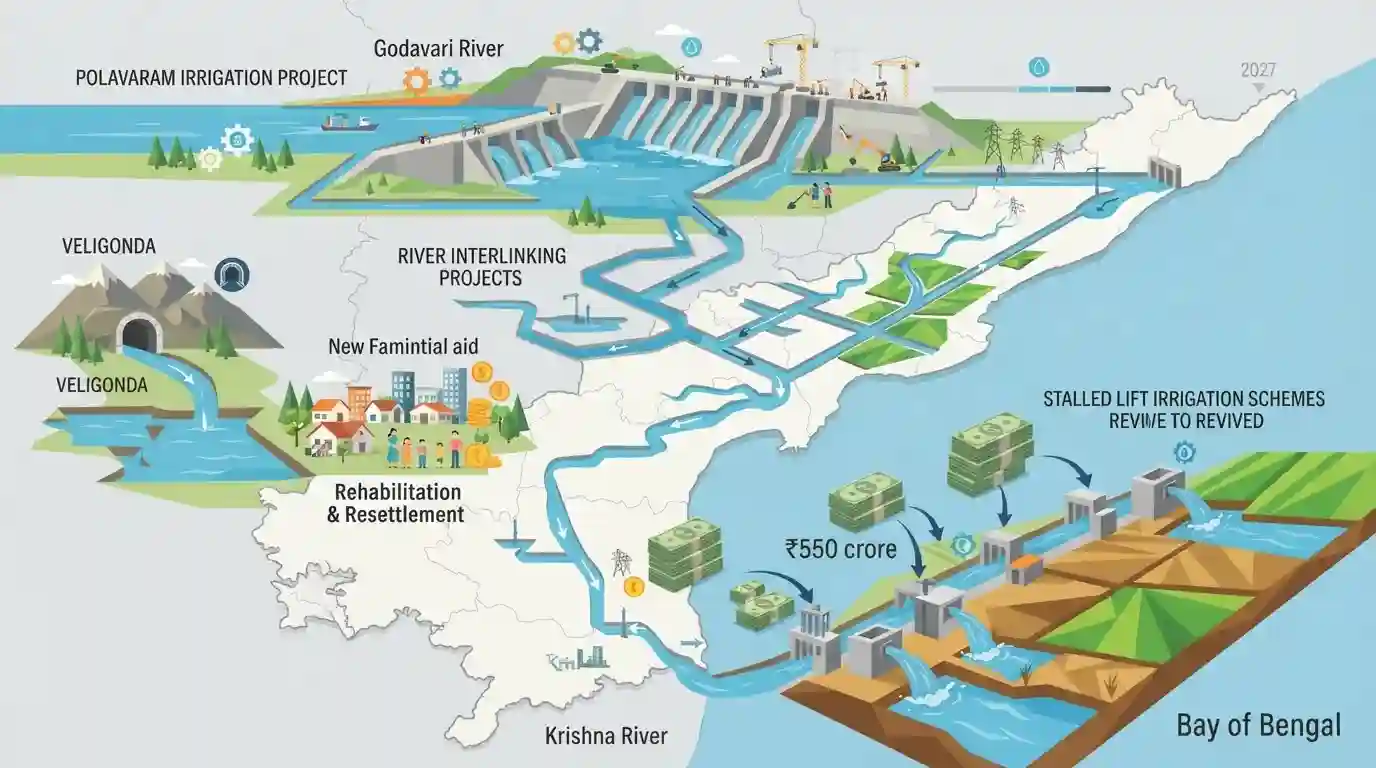
The Andhra Pradesh government is implementing a structured action plan to accelerate critical irrigation infrastructure, primarily targeting the completion of the Polavaram Irrigation Project by March 2027. The plan includes funding the rehabilitation for the Veligonda project, interlinking the Godavari with minor regional rivers, and a ₹550 crore initiative to revive hundreds of stalled lift irrigation schemes across the state.
Key Points
- The Andhra Pradesh government has set a firm target to complete the Polavaram Irrigation Project on the Godavari River by March 2027.
- ₹600 crore has been released to finalize the Rehabilitation and Resettlement (R&R) of families displaced by the Veligonda project.
- A comprehensive 10-year operation and maintenance action plan is being formulated to revive 890 defunct Lift Irrigation schemes out of 1,040 managed by the State IDC.
- Initiatives are being expedited to interlink the Godavari River with the Pampa, Tandava, Yeleru, and Varaha rivers to optimize regional water resources.
- Plans are underway to develop the Polavaram project area into a major tourism hub, capitalizing on the scenic Godavari landscape.
Important Terms
Polavaram Irrigation Project

A major multipurpose national project on the Godavari River in Andhra Pradesh. It aims to provide irrigation, generate hydropower, supply drinking water, and facilitate inter-basin water transfer to the Krishna River.
UPSC context
Important for GS1 and GS3 (Water Resources, Infrastructure). Tests knowledge of national river interlinking and multipurpose dams.
Veligonda Project
Also known as the Poola Subbaiah Project, it diverts Krishna River floodwaters to irrigate drought-prone regions in Andhra Pradesh (Prakasam, Nellore, Kadapa) through extensive tunnel systems across the Nallamala hills.
UPSC context
Relevant for GS1 and GS3 (Regional Development, Irrigation). Highlights state efforts to mitigate regional imbalances in drought-prone areas.
Lift Irrigation (LI) Schemes
An energy-intensive irrigation system where water is transported to higher elevations using mechanical pumps rather than natural gravity. This method brings essential water access to undulating terrains and upland fields.
UPSC context
Crucial for GS3 (Agriculture, Irrigation Technologies). Tests understanding of technological interventions in farming and energy-water nexus issues.
State Irrigation Development Corporation (APSIDC)
A state government enterprise established in 1974. It is responsible for executing, operating, and maintaining critical agricultural water infrastructure, most notably implementing and reviving hundreds of lift irrigation schemes across AP.
UPSC context
Connects to GS2 and GS3 (Governance, Infrastructure). Tests awareness of state-level institutional mechanisms managing agricultural water resources.
Prelims Trap
Polavaram is funded entirely by the Andhra Pradesh government as it is an intra-state project.
Polavaram was declared a 'National Project' under the AP Reorganisation Act, 2014. Therefore, the Central Government bears 100% of the remaining cost of the irrigation component.
Static Concepts Connected
What are the distinguishing features of Lift Irrigation compared to traditional gravity canals?
- Energy dependent: Requires significant electrical or mechanical power to pump water against gravity to higher elevations.
- Topographical utility: Highly effective in undulating or plateau terrains (like the Deccan) where traditional gravity flow is geographically impossible.
- Cost structure: Typically incurs lower land acquisition costs than extensive gravity canal networks but demands high recurrent operation and maintenance budgets.
What criteria qualify an irrigation project for 'National Project' status in India?
- Treaties and disputes: Projects arising from international treaties (e.g., Indus Water Treaty) or involving multi-state river basins with resolved disputes.
- Scale of impact: The project must generally have an irrigation potential of over 2 lakh hectares to be considered for this central status.
- Central funding: Eligible projects receive substantial central grant funding (often up to 90%) specifically for the irrigation and drinking water components.
Cross-Topic Patterns
River Interlinking vs. Tiger Reserves
Veligonda drawing Krishna water via tunnels under the Nagarjunasagar-Srisailam Tiger Reserve (NSTR) parallels the Ken-Betwa link's impact on Panna. Expect comparative questions on eco-sensitive infrastructure passing through protected areas.
Mega-dams & LARR Act bottlenecks
The ₹600 crore R&R release for Veligonda highlights how mandatory compensations under the LARR Act 2013 heavily drive mega-project fiscal delays, connecting GS3 infrastructure with GS2 social justice.

Expect a Prelims matching question linking intra-state river links (Godavari-Yeleru) or NSTR ecological impacts with specific mega-dams.
Linked PYQs · 3
Linked PYQs · 3
- 2023APPSC_PRELIMSGS1
Polavaram Project is a
- 2024APPSC_PRELIMSGS1
Within India, Ganga river basin has the largest catchment area. After that, following is the correct sequence in the decreasing order:
- 2023APPSC_PRELIMSGS1
Apex Council of Godavari and Krishna river water resources and their management consists of
