Bihar Lays Foundation for Integrated Aqua Park to Boost Fisheries
Source:times-of-india ↗
Why It Matters
With agriculture and allied sectors making up nearly 19% of Bihar's economy, boosting high-value primary activities like fisheries is crucial. This initiative bridges infrastructural gaps in processing, diagnostics, and high-quality seed supply, aligning with Bihar's massive potential in agro-based and aquaculture industries.
Summary
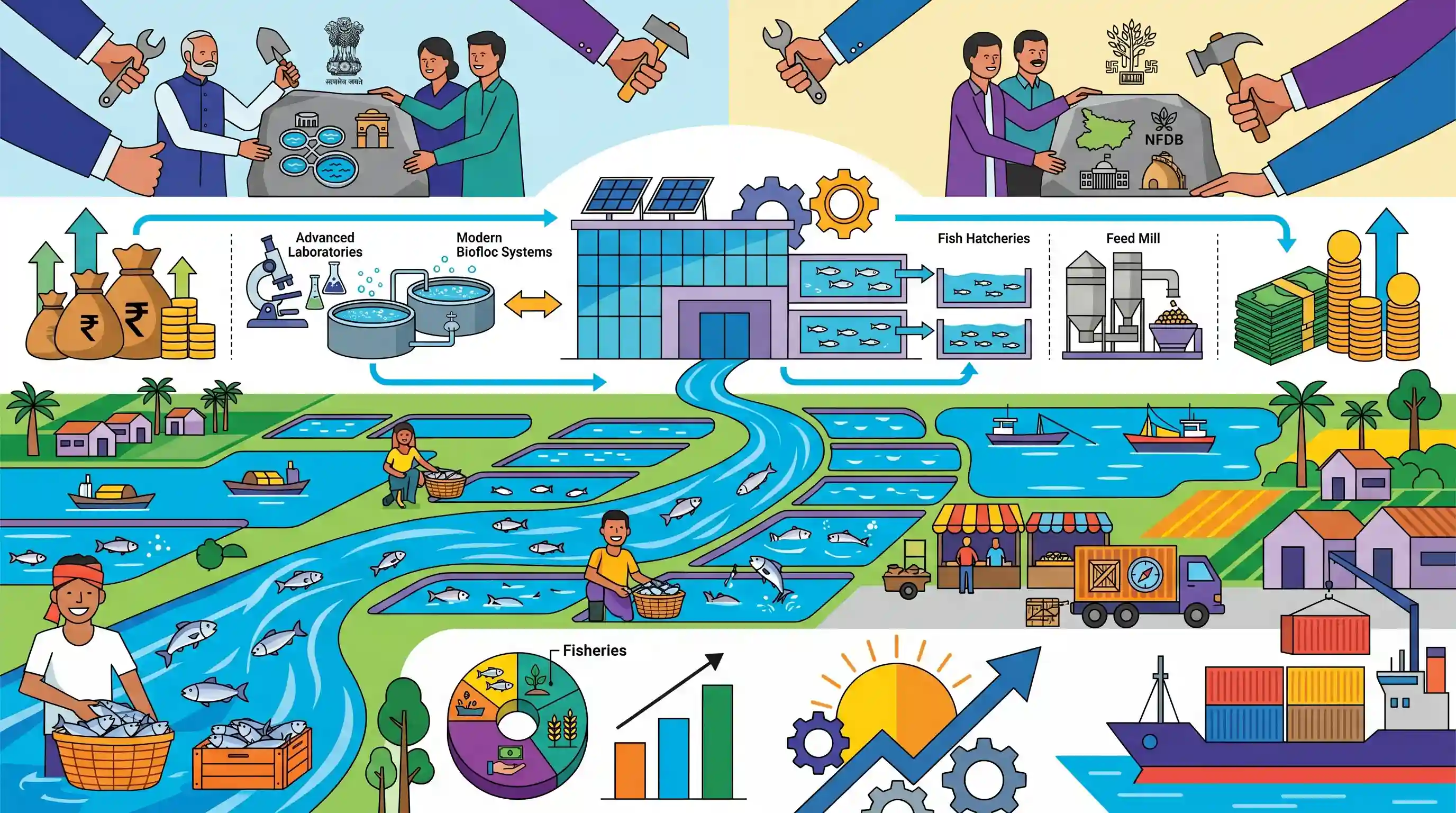
To boost inland aquaculture and increase farmers' income, the Union and Bihar governments have launched key fisheries initiatives. Foundation stones have been laid for an Integrated Aqua Park in Bhojpur and a National Fisheries Development Board (NFDB) regional centre in Patna. Built with an investment of over Rs 31 crore, the Bhojpur Aqua Park will establish advanced laboratories, biofloc systems, hatcheries, and feed mills. This push towards technology-driven and export-oriented fisheries is designed to resolve seed deficits and enhance livelihoods in Bihar's primary sector.
Key Points
- The Union and Bihar state governments laid the foundation stones for two major fisheries projects on June 15, 2026: an Integrated Aqua Park in Bhojpur and an NFDB Regional Centre in Patna.
- The foundation stones were laid by Union Minister for Fisheries, Animal Husbandry and Dairying Rajiv Ranjan Singh alongside Bihar CM Samrat Choudhary.
- The Integrated Aqua Park at Bhojpur is being built with a total investment of over Rs 31 crore.
- Features of the Aqua Park include carp and catfish hatcheries, brooder incubation units, biofloc systems, a fish feed mill, and diagnostic laboratories for water quality and disease detection.
- The development aims to modernize Bihar's inland fisheries, improve quality seed availability, promote high-tech aquaculture, and transition the state towards an export-oriented fisheries sector to boost farmers' income.
Important Terms
Pradhan Mantri Matsya Sampada Yojana (PMMSY)

A centrally sponsored flagship scheme launched in 2020 aiming to bring about a Blue Revolution through sustainable and responsible development of India's fisheries sector.
UPSC context
GS Paper III (Economy/Agriculture); tests government schemes for primary sector growth and doubling farmers' income.
Blue Revolution
The integrated, rapid, and sustainable growth of the fisheries and aquaculture sector, utilizing both inland and marine water resources to boost overall fish production.
UPSC context
GS Paper III (Agriculture/Animal Husbandry); tests knowledge of agricultural revolutions, food security, and rural livelihoods.
National Fisheries Development Board (NFDB)
An autonomous organization established in 2006 to enhance fish production and coordinate holistic, technology-driven fisheries development across India.
UPSC context
GS Paper III (Agriculture/Statutory Bodies); tests institutional frameworks supporting the primary sector and rural economy.
Ministry of Fisheries, Animal Husbandry and Dairying
The central Indian ministry responsible for policymaking, development, and administrative oversight of fisheries, animal husbandry, and dairy development sectors.
UPSC context
GS Paper II (Governance); tests awareness of executive machinery and ministerial jurisdictions regarding rural livelihoods.
Inland Fisheries and Aquaculture
Fish production activities conducted in freshwater and brackish environments, such as rivers, lakes, ponds, and reservoirs, rather than marine systems.
UPSC context
GS Paper I (Geography) & GS Paper III (Agriculture); tests geographic patterns of production and transition to inland farming.
Biofloc Technology
A sustainable, closed-loop fish farming technique utilizing beneficial heterotrophic bacteria to convert organic waste into high-protein feed while cleaning water.
UPSC context
GS Paper III (S&T/Environment); tests biotechnology applications in sustainable agriculture and water conservation.
Prelims Trap
Biofloc technology relies on continuous water exchange and autotrophic nitrification to flush out toxic nitrogenous aquaculture waste.
Biofloc is a closed-loop system that thrives on heterotrophic bacteria to recycle nutrients in-situ. It drastically reduces, rather than increases, the necessity for external water flushing or chemical inputs.
Static Concepts Connected
What is Biofloc Technology (BFT) in aquaculture?
- Microbial Mechanism: Utilizes heterotrophic bacteria (like Bacillus species) to convert toxic nitrogenous waste (ammonia) into nutrient-rich microbial biomass.
- Feed Efficiency: Enables fish to graze directly on the aggregated bacterial flocs, drastically reducing dependency on expensive commercial protein feeds.
- Eco-Sustainability: Operates as a high-biosecurity, closed-loop system that minimizes water exchange, preventing the discharge of polluted effluents.
What is the National Fisheries Development Board (NFDB)?
- Institutional Status: Established in 2006 as an autonomous society registered under the Societies Registration Act, 1860, rather than via a legislative statute.
- Administrative Setup: Operates under the administrative control of the Department of Fisheries, Ministry of Fisheries, Animal Husbandry and Dairying, headquartered in Hyderabad.
- Key Mandate: Serves as the primary executing nodal agency for deploying funds and technical standards under the Pradhan Mantri Matsya Sampada Yojana (PMMSY).
Cross-Topic Patterns
Aquaculture + Wetland conservation
Linking Bihar's extensive chaurs (oxbow lakes) with intensive inland fisheries highlights the policy trade-off between scaling economic aquaculture and preserving fragile wetland ecosystems under the Ramsar framework.
Agri-allied diversification + Farm distress
Absorbing disguisedly unemployed farm labor into high-value inland aquaculture acts as a structural buffer, boosting rural GSDP and insulating incomes from crop-specific climate shocks.

Scientific mechanisms of Biofloc (heterotrophic bacteria vs. autotrophic) and NFDB's status are highly probable targets for Prelims 2026.
Linked PYQs · 3
Linked PYQs · 3
- 2024-EBPSC_PRELIMSGS1
What is the contribution of agriculture in the Gross Domestic Product (GDP) of Bihar?
- 2018BPSC_PRELIMSGS1
Which type of industries has potentials and prospects in Bihar?
- 2024-IBPSC_PRELIMSGS1
Grey revolution is related to
