Mandatory Household Transition from LPG to Piped Natural Gas Networks
Source:Indian Express ↗
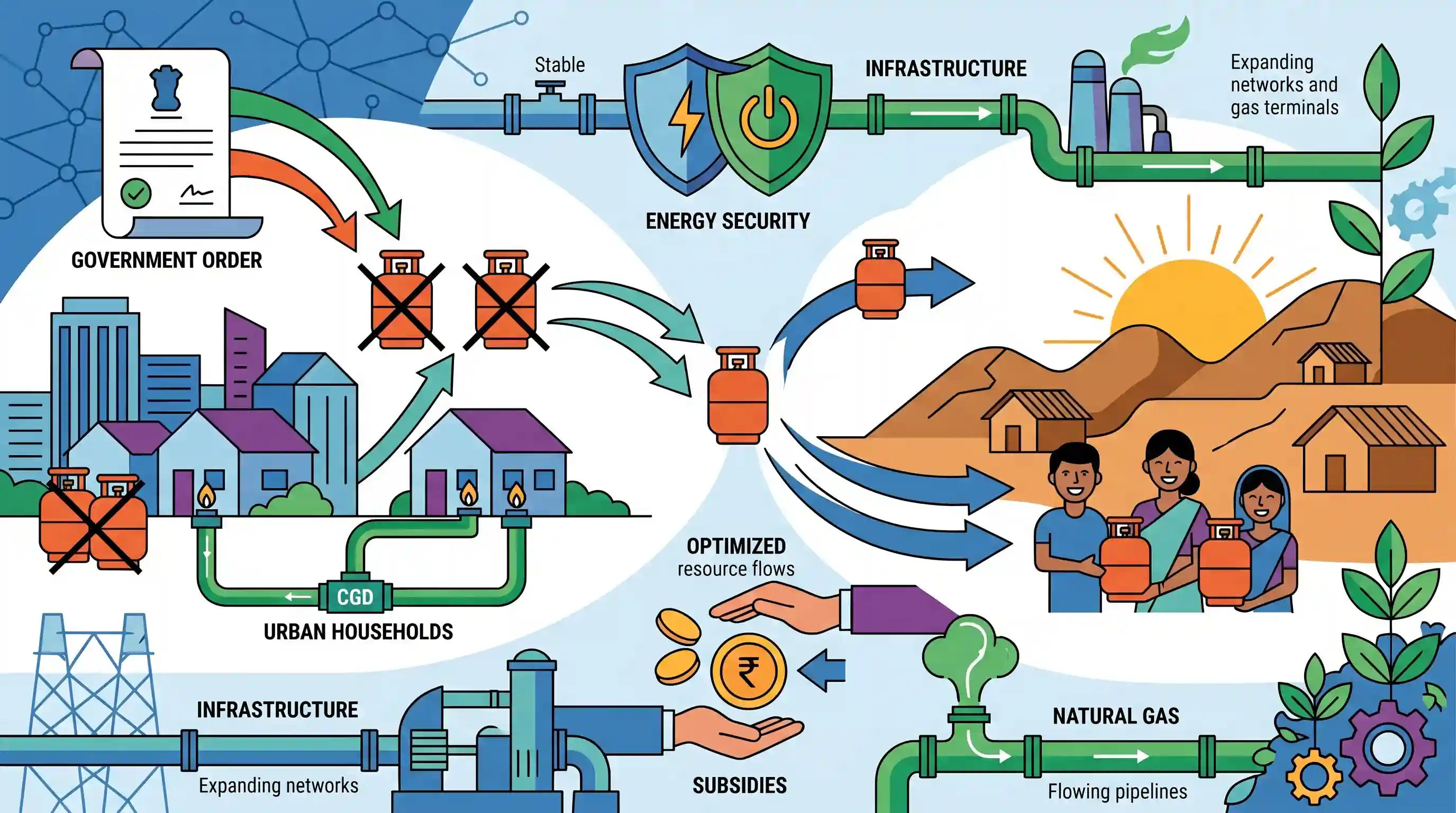
Why It Matters
This development is crucial for understanding India's energy transition strategies. It highlights the government's approach to infrastructure utilization (CGD networks), targeted subsidy management, and balancing urban energy modernization with rural energy access (PMUY). It also brings into focus the regulatory environment overseen by bodies like PNGRB.
Summary
The government has issued an order requiring households utilizing liquefied petroleum gas (LPG) to switch to piped natural gas (PNG) in areas where the PNG infrastructure is established. Households failing to transition will face termination of their LPG supply. This mandate is designed to boost the utilization of the City Gas Distribution (CGD) network while simultaneously freeing up LPG cylinders. The freed-up LPG resources can then be reallocated to rural and remote areas, specifically targeting beneficiaries of the Pradhan Mantri Ujjwala Yojana (PMUY). This strategic shift is part of India's larger effort to move towards a gas-based economy, reduce reliance on imported LPG, and optimize the distribution of energy subsidies.
Key Points
- The government has mandated that households with access to the Piped Natural Gas (PNG) network must transition from LPG to PNG.
- Households that fail to make the switch in areas where PNG is available will lose their LPG supply.
- The directive aims to promote the widespread adoption of the City Gas Distribution (CGD) network across urban and semi-urban areas.
- This transition will free up LPG cylinders, allowing the government to reallocate them to rural areas and beneficiaries of the Pradhan Mantri Ujjwala Yojana (PMUY) where PNG infrastructure is not feasible.
- The policy aligns with India's broader objective of transitioning to a gas-based economy, thereby optimizing energy security and managing petroleum subsidies more efficiently.
Important Terms
Pradhan Mantri Ujjwala Yojana (PMUY)

A flagship scheme launched in 2016 providing deposit-free LPG connections to women from low-income households. It aims to replace traditional unclean cooking fuels to reduce indoor air pollution and empower women.
UPSC context
GS II: Welfare schemes for vulnerable sections. Tests understanding of social justice, public health, and energy access.
City Gas Distribution (CGD) Network
An interconnected network of underground pipelines supplying Piped Natural Gas (PNG) to domestic and industrial users and Compressed Natural Gas (CNG) to vehicles within specific geographical areas.
UPSC context
GS III: Infrastructure and Energy. Tests knowledge of India's shift toward a gas-based economy and urban infrastructure development.
Petroleum and Natural Gas Regulatory Board (PNGRB)
A statutory body established under the PNGRB Act, 2006, to regulate downstream activities in the petroleum and natural gas sector, ensuring fair competition, consumer protection, and safe distribution infrastructure.
UPSC context
GS III: Regulatory Bodies. Tests knowledge of the legal and institutional framework governing India's energy markets.
PAHAL (DBTL)
The world's largest Direct Benefit Transfer (DBT) scheme where LPG subsidies are credited directly into consumer bank accounts to eliminate leakages, reduce diversions, and remove duplicate connections.
UPSC context
GS II/III: Subsidies and E-governance. Tests understanding of fiscal reforms and digital service delivery in welfare.
Piped Natural Gas (PNG)
A gaseous fuel, primarily methane, delivered directly to consumers through pipelines. It is preferred over LPG for being safer, more cost-effective, and providing a continuous, booking-free supply.
UPSC context
GS III: Energy Security. Relevant for topics concerning energy diversification and reducing reliance on fuel imports.
Prelims Trap
"PNGRB regulates the upstream exploration and production of crude oil and natural gas in India."
PNGRB only regulates midstream and downstream activities (refining, transport, city gas distribution). Upstream exploration and production (E&P) falls under the Directorate General of Hydrocarbons (DGH).
Static Concepts Connected
What are the key chemical and physical differences between LPG and PNG?
- Chemical makeup: Piped Natural Gas (PNG) is primarily composed of methane. Liquefied Petroleum Gas (LPG) consists mainly of propane and butane.
- Density and Safety: PNG is lighter than air and disperses safely during a leak. LPG is heavier than air, settling near the ground and creating a higher explosion risk in confined spaces.
- Supply Infrastructure: PNG requires the capital-intensive City Gas Distribution (CGD) pipeline network, while LPG requires a vast logistical supply chain of bottling plants, cylinder transport, and direct doorstep delivery.
What are the statutory powers and jurisdictional limits of the PNGRB?
- Statutory Origin: Established under the PNGRB Act, 2006 to protect consumer interests, foster fair trade, and promote competitive markets in the petroleum and natural gas sector.
- Downstream Focus: It regulates and authorizes midstream and downstream activities—refining, processing, storage, transport, and distribution networks, specifically including the City Gas Distribution (CGD) network.
- Upstream Exclusion: It explicitly does not regulate upstream activities. The exploration and production (E&P) of crude oil and natural gas are kept outside its statutory purview.
Cross-Topic Patterns
Strait of Hormuz + LPG dependency
India imports ~60% of its LPG, with 90% transiting the Strait of Hormuz. Shifting urban centers to domestic PNG reduces exposure to Middle East geopolitical shocks and chokepoint vulnerabilities.
Subsidy logistics + PMUY spatial targeting
Phasing out urban LPG acts as spatial targeting. It frees up the complex cylinder-bottling infrastructure, allowing PMUY (Ujjwala) to reach remote last-mile rural areas where pipelines are economically unfeasible.

Expect a 2026 Prelims question combining PNGRB's statutory limits (no upstream control) with the physical properties (methane vs propane).
Linked PYQs · 4
Linked PYQs · 4
- 2015MainsGS3
In what way could replacement of price subsidy with Direct Benefit Transfer (DBT) change the scenario of subsidies in India ? Discuss.
- 2018MainsGS3
“Access to affordable, reliable, sustainable and modern energy is the sine qua non to achieve Sustainable Development Goals (SDGs).” Comment on the progress made in India in this regard.
- 2019PrelimsGS1
Consider the following statements : 1. Petroleum and Natural Gas Regulatory Board (PNGRB) is the first regulatory body set up by the Government of India. 2. One of the tasks of PNGRB is to ensure competitive markets for gas. 3. Appeals against the decisions of PNGRB go before the Appellate Tribunals for Electricity. Which of the statements given above are correct?
- 2025PrelimsGS1
Consider the following activities : I. Production of crude oil II. Refining, storage and distribution of petroleum III. Marketing and sale of petroleum products IV. Production of natural gas How many of the above activities are regulated by the Petroleum and Natural Gas Regulatory Board in our country?
