Handloom and handicraft sector support initiatives in Andhra Pradesh
Source:The Hindu ↗
Why It Matters
Familiarity with the traditional crafts (like Pedana Kalamkari) and key administrative bodies (Lepakshi) of Andhra Pradesh is highly relevant for APPSC candidates. Tracking state government initiatives to boost artisan welfare, MSMEs, and handicraft exports links directly to the state's socio-economic development and cultural heritage preservation.
Summary
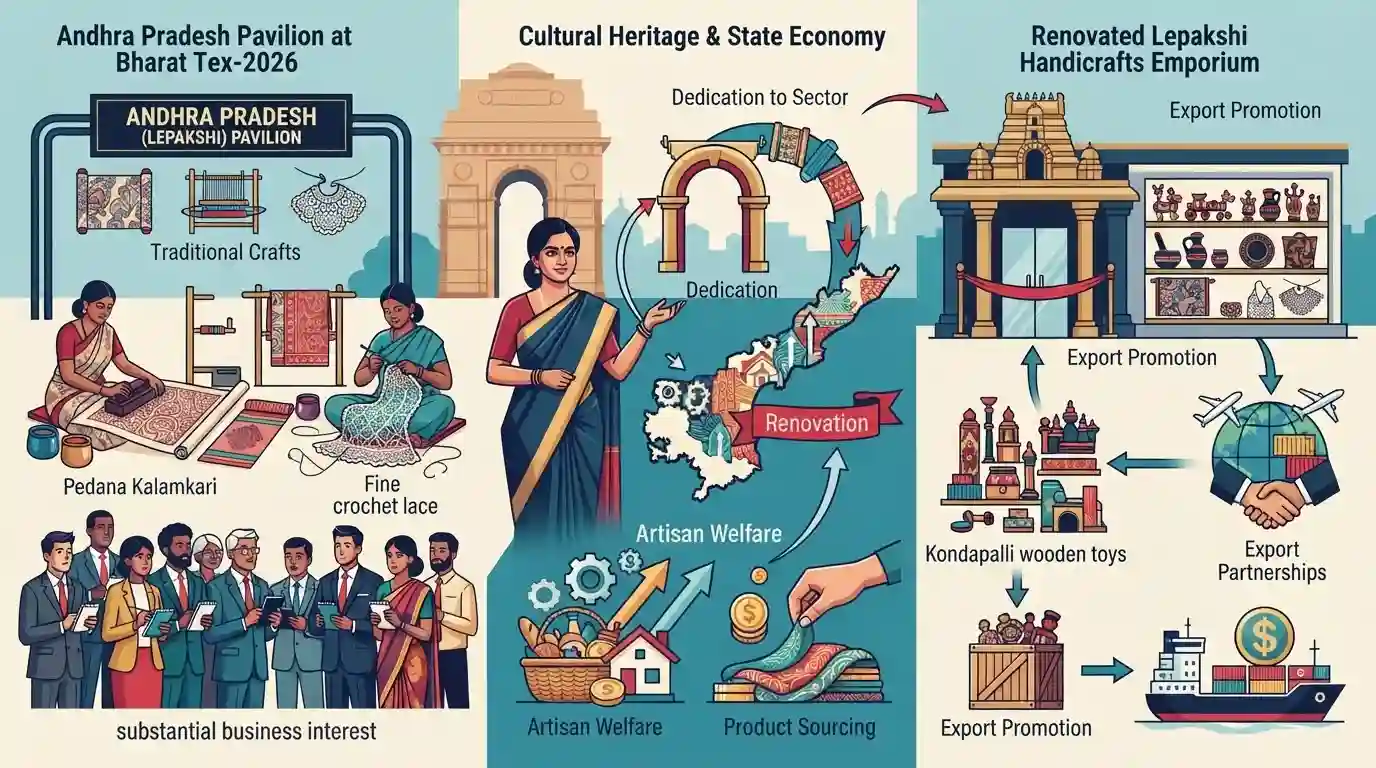
Andhra Pradesh Handlooms and Textiles Minister S. Savitha reaffirmed the state government's dedication to strengthening the handloom and handicraft sectors during her visit to the Andhra Pradesh (Lepakshi) Pavilion at Bharat Tex-2026 in New Delhi. The pavilion successfully highlighted the state's rich cultural heritage through live demonstrations of regional crafts like Pedana Kalamkari and crochet lace, attracting substantial domestic and international business interest. Additionally, the Minister is scheduled to inaugurate the renovated Lepakshi Handicrafts Emporium to further boost artisan welfare, product sourcing, and export partnerships.
Key Points
- Andhra Pradesh Handlooms and Textiles Minister S. Savitha emphasized the state government's commitment to empowering artisans and handloom weavers.
- The Minister visited the Andhra Pradesh (Lepakshi) Pavilion at Bharat Tex-2026 in New Delhi, which showcased traditional crafts through live demonstrations of crochet lace, Pedana Kalamkari, and carpet weaving.
- The AP pavilion received over 3,000 visitors and generated significant domestic and international business enquiries, highlighting its export potential.
- The renovated Lepakshi Handicrafts Emporium in New Delhi is set to be inaugurated to further promote the state's cultural heritage and handicraft sales.
Important Terms
Andhra Pradesh Handicrafts Development Corporation Ltd. (Lepakshi)

A state agency established in 1981 to promote and preserve Andhra Pradesh's artisanal heritage. It globally markets local handicrafts—like Kalamkari and Kondapalli toys—under the "Lepakshi" brand, ensuring fair trade and artisan welfare.
UPSC context
Important for GS Paper 1 (Art & Culture) and GS3 (Economy), testing institutional support for India's traditional crafts and rural employment.
Pedana Kalamkari
A traditional block-printing textile art from Pedana, Andhra Pradesh, using natural vegetable dyes. Influenced by Persian art under the Golconda Sultanate, it features intricate floral and geometric motifs and holds a Geographical Indication (GI) tag.
UPSC context
Highly relevant for Prelims and GS1 (Art & Culture), testing knowledge of GI-tagged crafts, regional textiles, and Indo-Islamic historical influences.
Narsapur Crochet Lace
An intricate cotton lace-making craft from Andhra Pradesh's Godavari region, originating in the 19th century. Granted a GI tag in 2024, it employs thousands of local women producing garments, accessories, and home furnishings for global export.
UPSC context
Relevant for GS1 (Art & Culture) and GS2 (Women Empowerment). UPSC often tests recent GI tags and women-centric traditional industries.
Bharat Tex 2026
India’s largest global textile exhibition held in New Delhi. Aligned with the government's 5F vision (Farm to Fibre, Factory, Fashion, Foreign), it aims to boost global investments, textile exports, innovation, and sustainability.
UPSC context
Significant for GS Paper 3 (Economy & Industrial Policy), testing initiatives for export promotion and India’s global trade positioning.
Prelims Trap
Narsapur crochet lace is an ancient, indigenous Indian craft practiced since the pre-colonial era in Andhra Pradesh.
It was introduced in 1844 by Scottish missionaries as a famine-relief livelihood initiative, not an ancient indigenous craft.
Static Concepts Connected
How do the two GI-tagged styles of Kalamkari textiles differ?
- Srikalahasti Style: Features freehand drawing using a bamboo pen ('kalam'), depicting Hindu mythological and temple themes.
- Machilipatnam Style: Uses hand block-printing with vegetable dyes, characterized by Persian-influenced floral and geometric motifs.
What makes the Bobbili Veena unique in Indian classical music instrumentation?
- Ekandi construction: Handcrafted from a single piece of seasoned jackwood, giving it superior acoustic reverberation.
- GI protection: Awarded a Geographical Indication tag in 2011/2012, preserving the craft of the Sarwasiddi community.
Cross-Topic Patterns
Colonial famine-relief to modern GI exports
Connects GS-1 British economic policies (famine-relief interventions like Narsapur lace) to GS-3 current export-promotion and rural women-led entrepreneurship models.
Forestry + Intellectual Property rights
Connects the conservation of softwoods like Wrightia tinctoria to the survival of GI-protected wooden toy industries (Kondapalli and Etikoppaka).

Distinctive wood species (Wrightia tinctoria) and textile styles (Kalamkari, Narsapur lace) are prime candidates for Match-the-Following MCQs.
Linked PYQs · 2
Linked PYQs · 2
- 2024APPSC_PRELIMSGS1
Which of the following statement/statements is/are valid regarding the socio-economic status of Andhra Pradesh ? I. Andhra Pradesh won the Best State Award of ICAR - National Research Center for Banana (NRCB) for export promotion. II. Andhra Pradesh GSDP growth rate has been registering a decline in recent times owing to repeated lower returns in certain sub-sectors of the Service Sector. III. For the FY 2024 - 25, the Revenue Deficit is budgeted higher than the Fiscal Deficit in terms of percentage of Andhra Pradesh GSDP. IV. The technology used by the Government of Andhra Pradesh while conducting resurvey of landholdings is referred to as 'Continuously Operating Reference Stations (CORS)' technology. Select the correct answer using the codes given below :
- 2024APPSC_PRELIMSGS1
Which of the following statements are valid regarding the interventions of the Government of Andhra Pradesh in the context of Healthcare ? I. Telemedicine facility is available in all Ayushman Bharat Health and Wellness Centres (AB-HWCs) to avail specialist services through district hub. II. The Family Doctor Programme has been planned to be implemented as a standalone project without the need to be integrated with Primary Health Centres (PHCs). III. Dr. YSR Aarogyasri Scheme has been revamped, by increasing the income limit from ₹ 2.5 lakh to ₹ 5 lakh per annum per family. IV. 'Aarogya Aasara' Scheme is intended to provide post-operative sustenance allowance with certain eligible conditions complied with. Select the correct answer using the codes given below :
