WhatsApp Username Feature Notice and Social Media Regulation
Source:The Hindu ↗
Why It Matters
It exemplifies the ongoing governance challenge of regulating encrypted, large-scale communication platforms in India. It highlights the tension between protecting user privacy/anonymity and preventing cybercrimes, misusing platforms by non-state actors, and ensuring law enforcement tracing under the IT Rules.
Summary
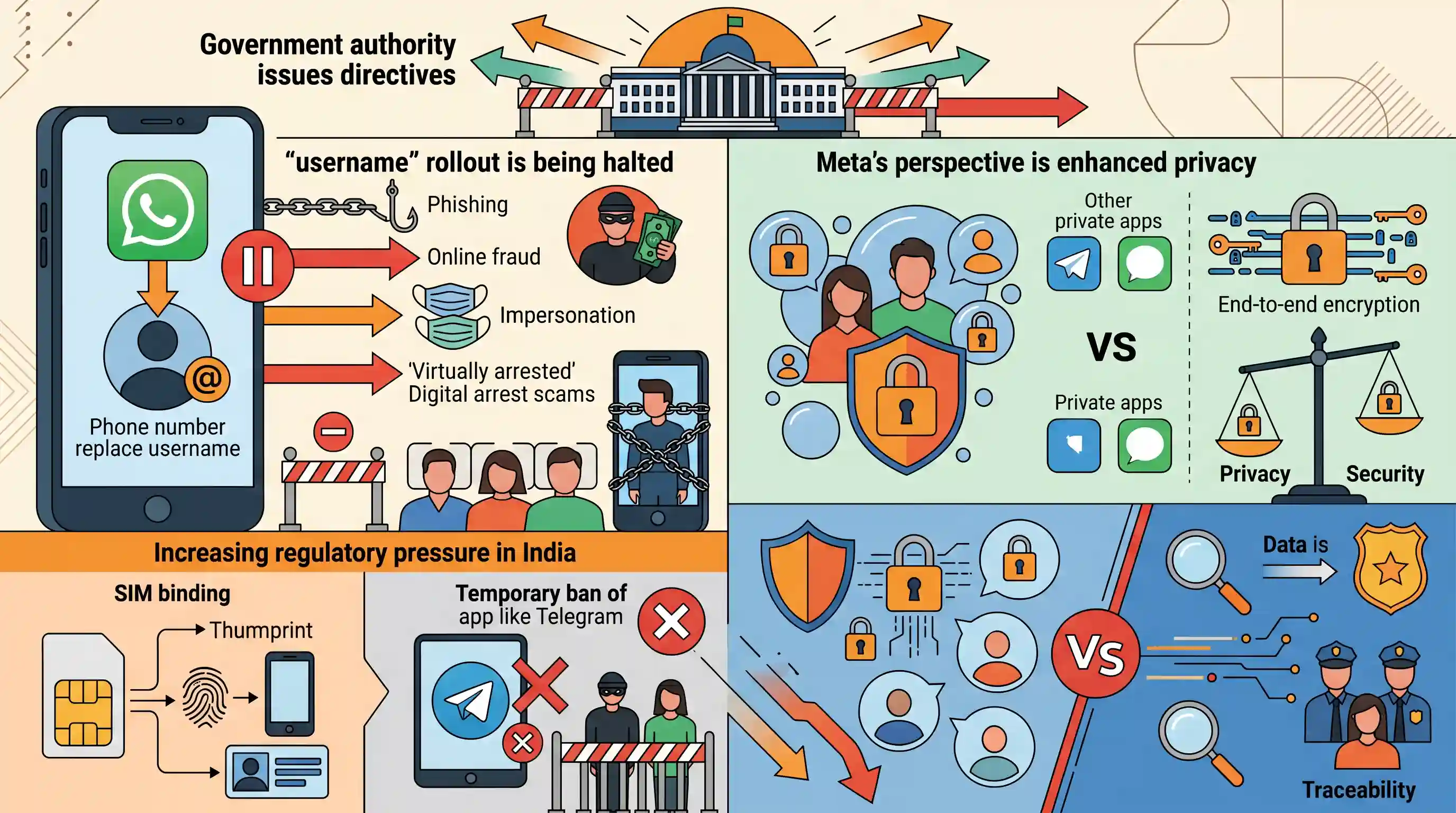
The Union government (MeitY) has directed WhatsApp to pause the rollout of its new "username" feature, raising concerns that the ability to chat without sharing a phone number could exacerbate online fraud, phishing, and impersonation attacks like digital arrest scams. While Meta argues the feature enhances privacy similar to Telegram and Signal, the government fears it enables bad actors to operate anonymously. The notice aligns with increasing regulatory pressure on large communication platforms in India—such as recent mandates for SIM binding and a temporary ban on Telegram—highlighting the ongoing conflict between user privacy (end-to-end encryption) and law enforcement's need for traceability.
Key Points
- MeitY has issued a notice to WhatsApp to put its upcoming "username" feature on hold, citing risks of online fraud, phishing, digital arrest scams, and impersonation attacks.
- The new feature mimics functionality on Telegram and Signal, allowing users to communicate without sharing their phone numbers.
- To mitigate risks, WhatsApp plans to withhold high-profile names, display the origin country of a phone number, and offer an optional "username key" for initiating contact.
- This intervention follows recent government actions, including a temporary ban on Telegram following the NEET paper leak and a DoT mandate requiring "SIM binding" for WhatsApp.
- The situation underscores the broader regulatory challenge of balancing user privacy (like end-to-end encryption and anonymity) with national security and traceability mandates under India\'s IT Rules.
Important Terms
IT Rules, 2021

Rules under the IT Act, 2000, regulating social media, OTT, and digital news through due diligence, grievance redressal, and oversight mechanisms to ensure platform accountability.
UPSC context
GS Paper 2 (Governance/Policies) and Paper 3 (Internal Security); tests digital rights, intermediary liability, and state regulation of cyberspace.
MeitY
The nodal ministry responsible for formulating policies related to IT, electronics, cybersecurity, and the digital economy, including the implementation of the Digital India program.
UPSC context
GS Paper 2 (Executive/Governance); tests understanding of departmental roles in technology governance and the legal framework for digital services.
Traceability Provision
A requirement under Rule 4(2) of the IT Rules 2021 mandating large messaging platforms to identify the 'first originator' of information for law enforcement purposes.
UPSC context
GS Paper 3 (Internal Security); tests the conflict between national security/law enforcement and the fundamental Right to Privacy (Puttaswamy judgment).
Digital Arrest
A cyber-extortion scam where fraudsters impersonate officials (police, CBI) via video calls to falsely 'arrest' victims and coerce them into transferring money.
UPSC context
GS Paper 3 (Internal Security/Cybersecurity); tests awareness of emerging cybercrime trends, social engineering, and the role of the I4C.
Department of Telecommunications (DoT)
A department under the Ministry of Communications responsible for telecom policy, licensing, and network security, including mandates like SIM-binding for user verification.
UPSC context
GS Paper 2 (Governance) and Paper 3 (Infrastructure); tests understanding of telecom security and inter-ministerial coordination to prevent digital fraud.
Significant Social Media Intermediary (SSMI)
Social media platforms with over 5 million Indian users, subject to higher due diligence, including appointing local grievance and compliance officers.
UPSC context
GS Paper 2 (Policy); tests knowledge of tiered regulatory frameworks based on platform scale and potential societal impact.
Prelims Trap
"Digital Arrest is a statutory provision under the Information Technology Act allowing remote detention of cyber criminals."
"Digital Arrest" is a psychological cyber-extortion scam used by criminals, not a legally valid detention procedure under Indian law. Aspirants often confuse it with legitimate cyber-surveillance provisions.
Static Concepts Connected
What are the key mandates for Significant Social Media Intermediaries (SSMIs) under IT Rules 2021?
- First Originator Traceability: Must enable the identification of the "first originator" of information on their platform when ordered by a court or authorized government agency.
- Domestic Grievance Redressal: Must appoint a Chief Compliance Officer, a Nodal Contact Person (available 24x7), and a Resident Grievance Officer, all residing in India.
- Monthly Compliance Reports: Must publish periodic compliance reports detailing the number of complaints received and the proactive actions taken to remove harmful content.
On what specific grounds can the government block online content under Section 69A (IT Act)?
- Sovereignty & Security: In the interest of the sovereignty and integrity of India, defense of India, or security of the State.
- Public Order: To maintain friendly relations with foreign States or public order.
- Preventing Incitement: For preventing incitement to the commission of any cognizable offense relating to the above grounds.
Cross-Topic Patterns
Fundamental Rights vs Intermediary Traceability
The clash between WhatsApp's username anonymity and MeitY's traceability mandates directly invokes the proportionality test laid down in the K.S. Puttaswamy (Right to Privacy) judgment.
Telecom Regulation extending to OTT Platforms
Mandates like "SIM binding" for OTT platforms blur the regulatory lines between traditional telecom operators and internet-based messaging apps, a key theme emerging from the Telecommunications Act 2023.

Expect a 2026 multi-statement Prelims question mixing IT Rules 2021 traceability, "Digital Arrest" scam mechanics, and I4C's nodal role.
Linked PYQs · 3
Linked PYQs · 3
- 2024MainsGS3
Social media and encrypting messaging services pose a serious security challenge. What measures have been adopted at various levels to address the security implications of social media? Also suggest any other remedies to address the problem.
- 2020MainsGS3
Discuss different types of cyber crimes and measures required to be taken to fight the menace.
- 2016MainsGS3
Use of Internet and social media by non-state actors for subversive activities is a major security concern. How have these been misused in the recent past? Suggest effective guidelines to curb the above threat.
