Bihar Inks Agreement to Operate Electric Buses Across Six Cities
Source:times-of-india ↗
Why It Matters
This green initiative is highly relevant for BPSC Prelims, where questions frequently test details of infrastructure development, environment-oriented schemes, PPP models, and specific city/district coverage of developmental projects in Bihar. It directly connects with the state's broader target of carbon reduction by 2030 and its emphasis on green budgets.
Summary
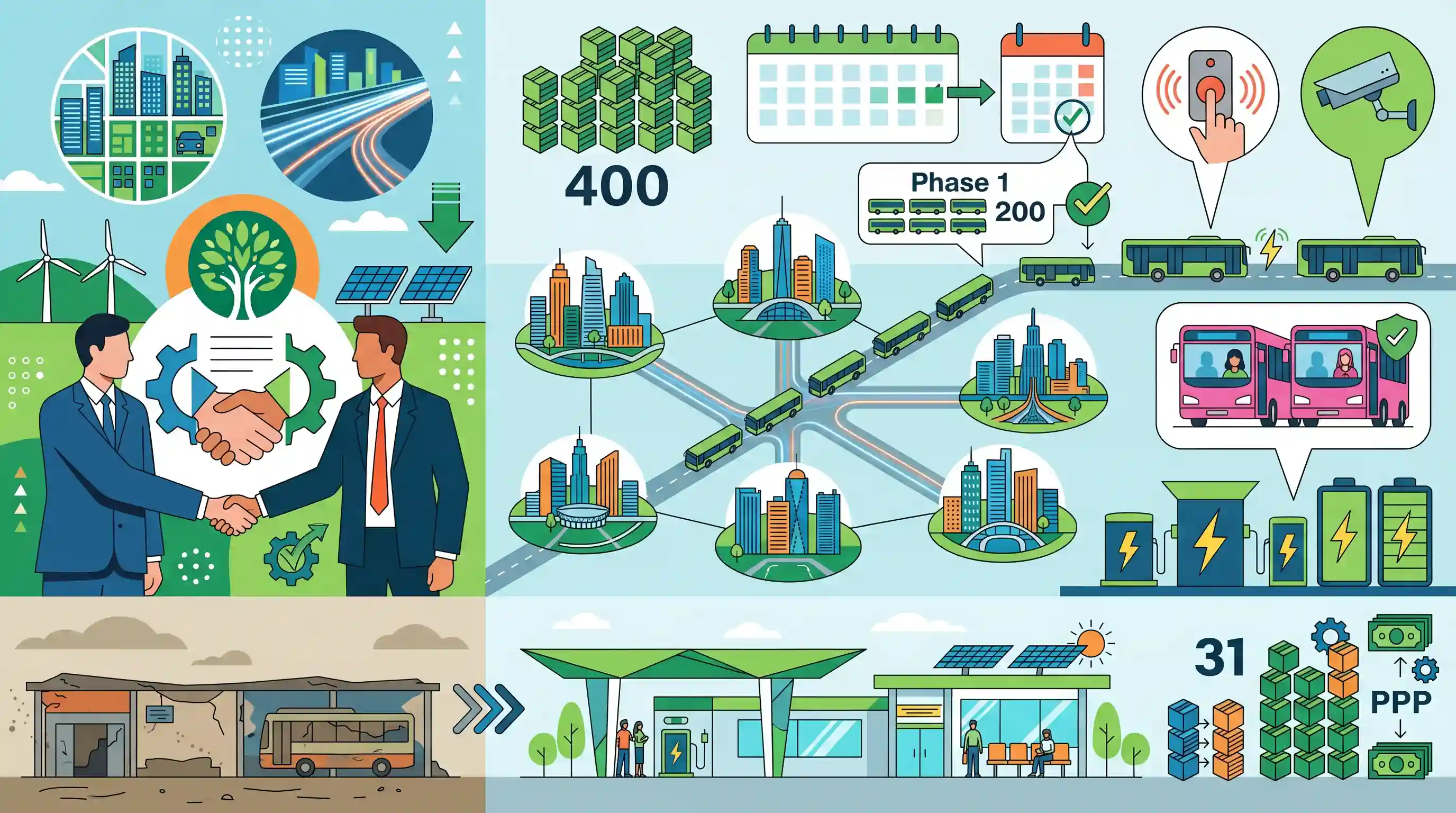
The Bihar government has signed a concession agreement with Greencell Mobility Private Limited to deploy and operate 400 air-conditioned electric buses across six key cities under the Centre's PM-eBus Sewa Scheme. Administered by the Bihar State Road Transport Corporation (BSRTC), the first phase of the project will roll out 200 buses by July 2026. The initiative includes dedicated pink buses for women, advanced safety features like panic buttons and CCTV, and the establishment of dedicated fast-charging depots. In tandem, BSRTC is upgrading 31 state bus depots to modern terminals on a PPP model.
Key Points
- Bihar State Road Transport Corporation (BSRTC) signed a concession agreement with Greencell Mobility Private Limited to operate 400 electric buses under the Central government's PM-eBus Sewa Scheme.
- The 400 air-conditioned electric buses will have seating capacities of 35 and 42 passengers and will run across six major cities of Bihar: Patna, Gaya, Bhagalpur, Muzaffarpur, Darbhanga, and Purnia.
- The rollout is planned in phases, with 200 electric buses in Phase 1 scheduled to hit the roads by July 2026.
- To enhance women's safety and comfort, the fleet will specifically include 50 pink buses exclusively for women travelers.
- Buses will be equipped with modern features such as CCTV cameras, GPS-based tracking, panic buttons, passenger information systems, first-aid kits, and fast mobile charging points.
- Charging infrastructure will be developed in coordination with the Bihar Energy Department across six divisions; each depot will have eight fast chargers capable of fully charging a bus in 1 to 1.5 hours.
- Additionally, BSRTC is upgrading 31 bus depots and stands across Bihar into modern terminals under the Public-Private Partnership (PPP) model to improve passenger facilities.
Important Terms
PM-eBus Sewa Scheme

A centrally sponsored scheme to deploy 10,000 electric buses on a public-private partnership (PPP) model across Indian cities, bolstering eco-friendly public transit and green urban mobility.
UPSC context
GS Paper III (Infrastructure/Environment); tests understanding of sustainable urban transit, clean energy initiatives, and public-private partnership models.
Concession Agreement
A contract between a government authority and a private entity, defining the rights, responsibilities, and risk-sharing framework for implementing and operating a public infrastructure project.
UPSC context
GS Paper III (Investment Models); tests knowledge of Public-Private Partnership (PPP) frameworks, project risk allocation, and public service procurement.
Bihar State Road Transport Corporation (BSRTC)
A statutory, state-owned public transportation company established in 1959 under the Road Transport Corporation Act, 1950, which manages intercity and intracity bus networks in Bihar.
UPSC context
GS Paper II & III (State Governance/Infrastructure); tests understanding of public utility management, statutory bodies, and regional transport infrastructure policies.
Greencell Mobility Private Limited
An Indian shared electric mobility platform offering electric Mobility-as-a-Service (eMaaS), executing public-private partnerships to deploy and run zero-emission electric buses across multiple states.
UPSC context
GS Paper III (Infrastructure & Environment); tests understanding of private-sector participation in climate-resilient transport, sustainable infrastructure, and clean technology adoption.
Prelims Trap
Under the Gross Cost Contract (GCC) model for public transit, the private operator bears the ticket-revenue risk and retains all farebox collections.
In GCC, the government authority collects fares and bears the revenue risk, paying the operator a fixed per-kilometer rate to operate and maintain the fleet.
Static Concepts Connected
What is the difference between Gross Cost Contract (GCC) and Net Cost Contract (NCC)?
- GCC mechanics: Private operators get paid a fixed per-km rate, while the public transit authority collects farebox revenue and bears ridership risk.
- NCC mechanics: The private operator keeps the fare revenue, manages ticketing, and bears the direct financial risk of low passenger turnout.
- Policy preference: GCC is favored in electric mobility to reduce private sector anxiety over high upfront battery and charging infrastructure costs.
What is Green Budgeting and its status in India?
- Concept: An environmental policy tool integrating green goals into budget formulation to systematically track ecological and climate-related expenditures.
- Bihar's pioneer role: Bihar was India's first state to introduce a separate Green Budget in FY 2020-21 to target climate resilience.
- SDG alignment: It maps budgetary allocations directly to Sustainable Development Goals (SDGs), especially climate action (SDG 13).
Cross-Topic Patterns
E-mobility + Fiscal Federalism
PM-eBus Sewa's tiered funding (60% for general, 90% for Himalayan states) shows how central schemes balance regional fiscal disparities to drive subnational green transitions.
Infrastructure + Gender Mainstreaming
Deploying pink fleets with panic buttons reflects GS-1/GS-3 synergy, directly addressing urban safety barriers that limit women's workforce participation and economic mobility.

PM-eBus Sewa's operational pillars (GUMI vs Segment A) and the mechanics of Gross Cost Contracts are highly probable targets for GS-3 2026.
Linked PYQs · 2
Linked PYQs · 2
- 2023BPSC_PRELIMSGS1
Bihar Government has planned to make Bihar State ‘pollution-free’ by reducing carbon emissions by which year?
- 2024-EBPSC_PRELIMSGS1
When did Bihar State introduce the Green Budget for the first time?
