Anti-Drone Systems to Secure Borders Against Narcotics Smuggling
Source:The Hindu ↗
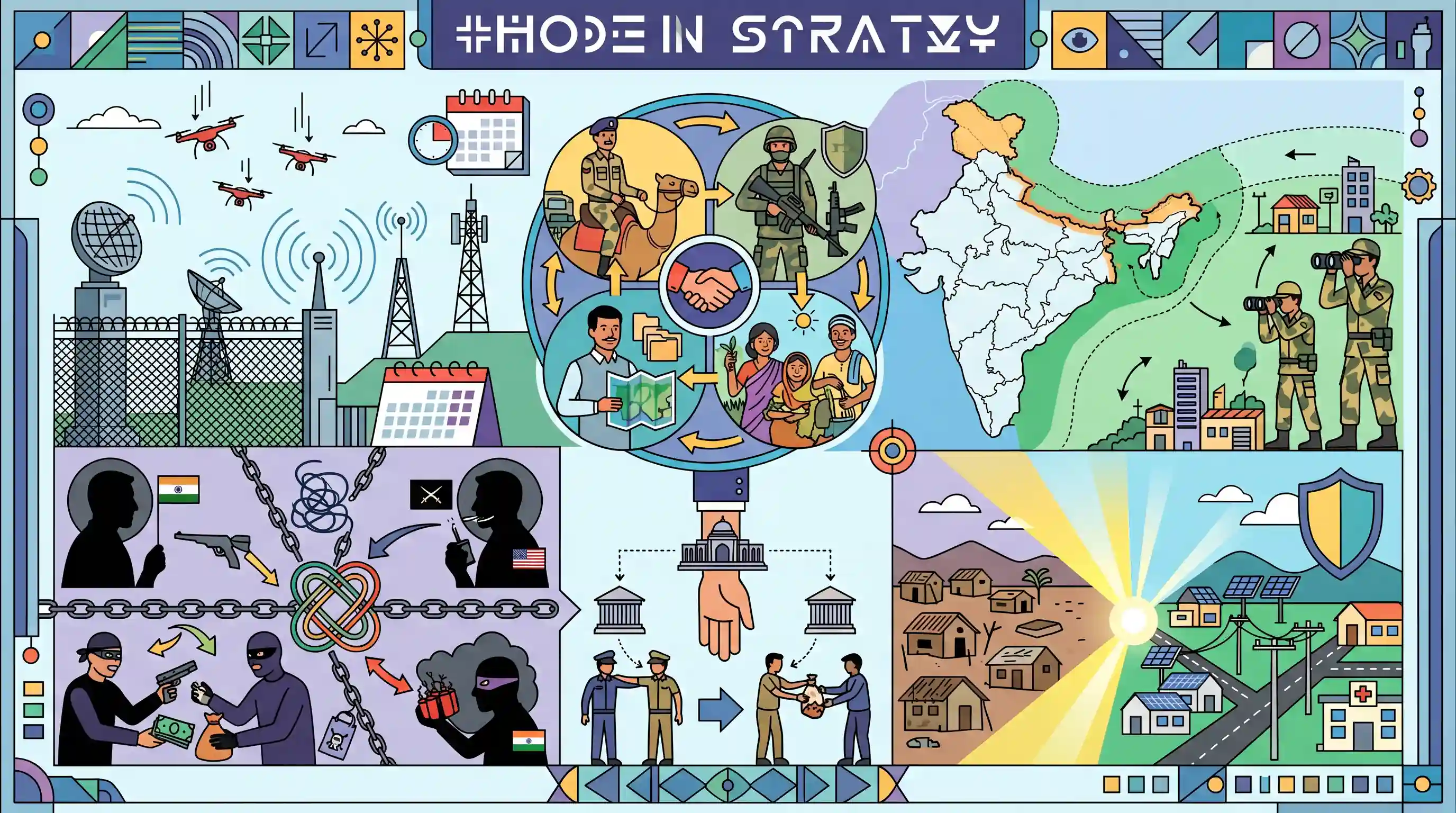
Why It Matters
The increasing use of drones for cross-border smuggling of drugs and arms is a prominent internal security threat (as directly asked in Mains 2023). Understanding the technological countermeasures (anti-drone systems), institutional changes (expanding BSF jurisdiction), and the concept of a multi-tier security grid is crucial for Mains GS3 answers on border management.
Summary
Union Home Minister Amit Shah has announced the impending installation of anti-drone systems along India's borders within the next six months to combat the illicit trafficking of narcotics and weapons. Emphasizing a comprehensive approach to border management, he proposed a 'four-point security grid' requiring synergistic cooperation among the BSF, armed forces, local administrations, and border communities. Shah strongly justified the decision to extend the BSF's operational jurisdiction up to 50 km from the international border, framing it as a necessary measure to tackle emerging technological threats and monitor suspicious demographic or infrastructural changes. He also highlighted the critical need for cooperative federalism, urging border states to aggressively target internal elements that facilitate cross-border crimes, while aligning security efforts with development initiatives like the Vibrant Villages Programme.
Key Points
- The Union government will install anti-drone systems along international borders within six months to counter the growing use of unmanned aerial vehicles (UAVs) for smuggling narcotics and weapons.
- A 'four-point security grid' involving the BSF, armed forces, local administration, and border residents has been proposed to create an impermeable border security architecture.
- The Union Home Minister defended the expansion of the BSF's operational jurisdiction from 15 km to 50 km, citing the need to combat new-age technological threats, demographic changes, and illegal constructions.
- Effective border management requires strong Centre-State coordination, particularly with local administrations in border states acting against internal elements aiding cross-border smuggling.
- The security strategy also incorporates developmental initiatives like the Vibrant Villages Programme to empower local populations and reduce vulnerabilities in frontier regions.
Important Terms
Vibrant Villages Programme (VVP)

A Centrally Sponsored Scheme aimed at developing infrastructure and improving livelihoods in villages along India's international borders to prevent out-migration and enhance national security.
UPSC context
GS Paper II & III: Governance and Internal Security; strategies for border area development and management.
Border Security Force (BSF)
India’s primary border-guarding organization, a Central Armed Police Force (CAPF) tasked with securing the India-Pakistan and India-Bangladesh borders and preventing trans-border crimes.
UPSC context
GS Paper III: Various Security forces and agencies and their mandate.
Operation Sindoor
A specific operational achievement or initiative by the BSF (highlighted in the Rajasthan sector) involving border defense and community engagement to boost civilian morale and counter threats.
UPSC context
GS Paper III: Security challenges and their management in border areas; role of CAPFs.
Four-point security grid
A multi-layered border management strategy proposed by the Home Ministry involving synergistic coordination between the BSF, armed forces, local administration, and border-dwelling citizens.
UPSC context
GS Paper III: Internal Security; modernizing border management through inter-agency coordination.
Anti-drone systems
Technology designed to detect, track, and neutralize Unmanned Aerial Vehicles (drones) used by anti-national elements for smuggling narcotics, weapons, or carrying out surveillance.
UPSC context
GS Paper III: Science and Technology; Security challenges and their management.
Cooperative Federalism
The operational and administrative partnership between the Union and State governments, crucial in border states for tackling cross-border crimes and maintaining internal security.
UPSC context
GS Paper II: Polity; issues and challenges pertaining to the federal structure.
Prelims Trap
The BSF has the power to register FIRs and independently investigate smuggling crimes within its expanded 50 km jurisdiction.
The BSF only has powers of search, seizure, and arrest. It cannot register FIRs or conduct independent investigations; suspects must be handed over to the local state police.
Static Concepts Connected
What are the legal powers and limitations of the BSF?
- Statutory backing: Operates under the BSF Act, 1968. Primarily mandated to secure the Indo-Pak and Indo-Bangladesh borders.
- Arrest & Seizure: Can arrest, search, and seize under laws like the NDPS, Customs, and Passports Acts within defined border limits.
- Investigative limits: Does not possess full police powers to register FIRs or investigate cases; must hand suspects to local state authorities.
What are the core features of the Vibrant Villages Programme?
- Geographic focus: Targets villages specifically along the northern border (China) across Arunachal Pradesh, Sikkim, Uttarakhand, Himachal Pradesh, and Ladakh.
- Funding model: A Centrally Sponsored Scheme designed to provide comprehensive infrastructure, connectivity, and livelihood opportunities.
- Strategic goal: Aims to reverse out-migration, preventing demographic voids and turning border residents into effective localized security assets.
Cross-Topic Patterns
Border security vs. Federalism
Expanding the BSF's operational jurisdiction to 50 km bridges GS3 border management with GS2 Centre-State relations, often clashing with the state-list subject of 'Public Order'.
Development as a security strategy
The Vibrant Villages Programme reflects a strategic shift from treating border areas as sterile buffer zones to developing them as inhabited first lines of defense.
Drones + Narco-terrorism nexus
Low-cost drones delivering drugs highlight the fusion of emerging technology with traditional organized crime networks stemming from the Golden Crescent.

Mains 2026 GS3 could ask to evaluate the 'four-point security grid' and anti-drone tech in tackling Golden Crescent narco-terrorism.
Linked PYQs · 4
Linked PYQs · 4
- 2023MainsGS3
The use of unmanned aerial vehicles (UAVs) by our adversaries across the borders to ferry arms/ammunitions, drugs, etc., is a serious threat to the internal security. Comment on the measures being taken to tackle this threat.
- 2018MainsGS3
India's proximity to two of the world's biggest illicit opium-growing states has enhanced her internal security concerns. Explain the linkages between drug trafficking and other illicit activities such as gunrunning, money laundering and human trafficking. What counter-measures should be taken to prevent the same?
- 2020MainsGS3
Analyze internal security threats and transborder crimes along Myanmar, Bangladesh and Pakistan borders including Line of Control (LoC). Also discuss the role played by various security forces in this regard.
- 2020MainsGS3
For effective border area management, discuss the steps required to be taken to deny local support to militants and also suggest ways to manage favourable perception among locals.
