Government Imposes License Restrictions on Silver Imports
Source:The Hindu ↗
Why It Matters
Understanding import restrictions and the role of the DGFT is vital for UPSC aspirants. It highlights the tools the government uses to manage the balance of payments, control the current account deficit (CAD), and stabilize foreign exchange reserves amidst fluctuating global precious metal trends.
Summary
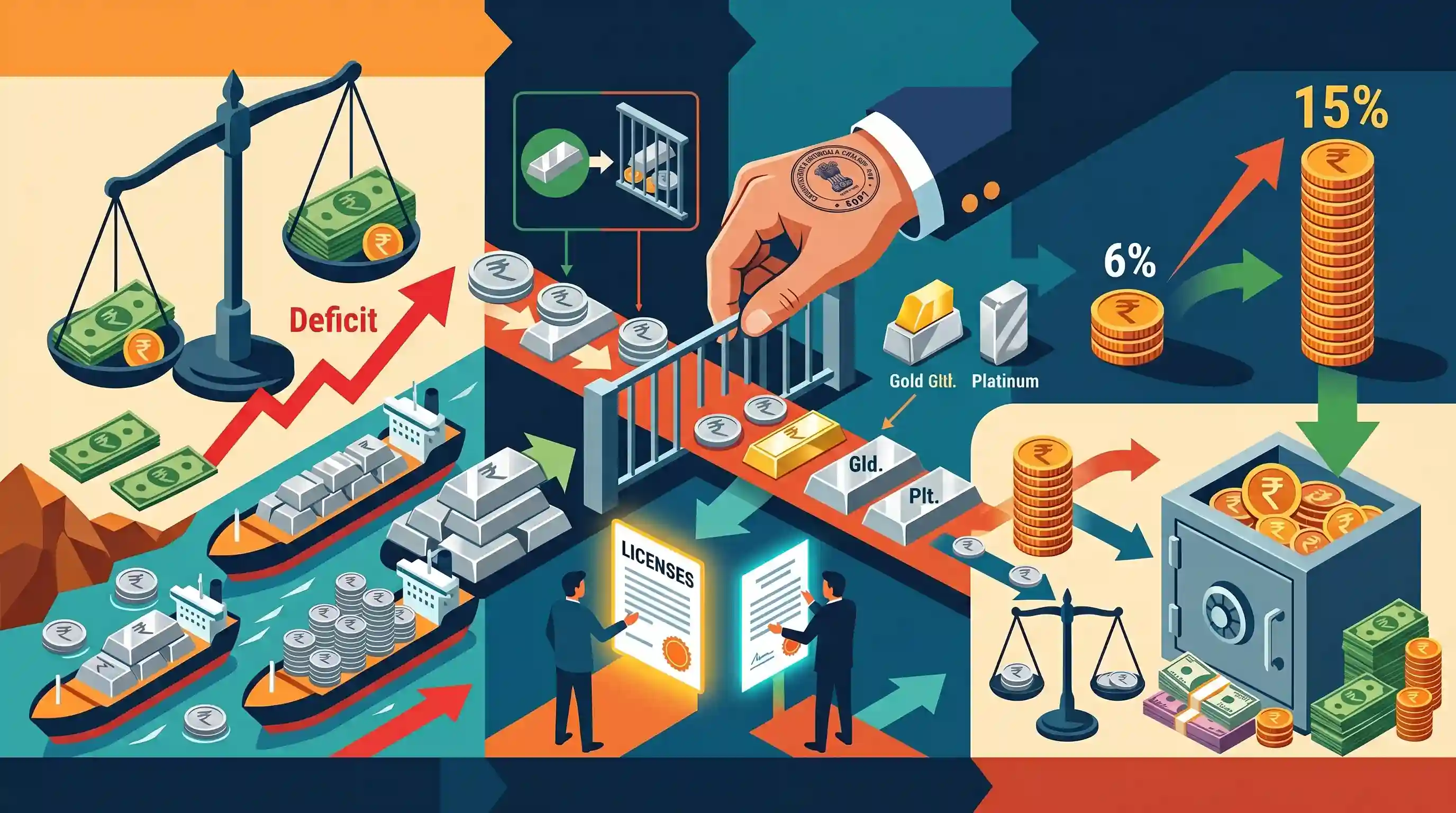
The Government of India, via the Directorate General of Foreign Trade (DGFT), has imposed restrictions on silver imports by shifting the metal from the 'free' to the 'restricted' import category. Consequently, importers must now secure a government license to bring silver—including silver plated with gold and platinum—into the country. This regulatory change closely follows a sharp hike in the import duty on precious metals from 6% to 15%. These measures reflect the government's efforts to regulate the inflow of precious metals, which is a critical aspect of managing India's current account deficit and foreign exchange reserves.
Key Points
- The Indian government has revised the import policy for silver, moving it from the 'free' to the 'restricted' category.
- The restriction requires importers to obtain a government license to bring silver into the country.
- The curbs also apply to silver plated with gold and platinum.
- This move follows a recent increase in the import duty on precious metals from 6% to 15%.
- The notification was issued by the Directorate General of Foreign Trade (DGFT).
Important Terms
Directorate General of Foreign Trade (DGFT)

An attached office of the Ministry of Commerce and Industry that formulates and implements India's Foreign Trade Policy and issues necessary trade licenses.
UPSC context
GS Paper 3: Economy; tests knowledge of regulatory bodies governing India's external trade and export-import (EXIM) framework.
Foreign Trade Policy (FTP)
A strategic government framework that outlines rules, incentives, and guidelines to promote exports, regulate imports, and maintain a favorable balance of payments.
UPSC context
GS Paper 3: Economic Development; essential for understanding India’s trade strategy, liberalization, and external sector management.
Current Account Deficit (CAD)
A macroeconomic indicator representing the shortfall when the total value of imported goods, services, and transfers exceeds the value of those exported.
UPSC context
GS Paper 3: Economy; tests conceptual clarity on Balance of Payments (BoP) and its impact on rupee stability and reserves.
Customs Duty
An indirect tax levied by the government on the movement of goods across international borders, used for revenue generation and domestic industry protection.
UPSC context
GS Paper 3: Economy/Taxation; tests knowledge of fiscal policy tools used to regulate trade and manage domestic competition.
Restricted Import Category
A trade classification for goods that require prior government authorization or a license from the DGFT before they can be legally imported.
UPSC context
GS Paper 3: Economy; tests understanding of non-tariff barriers and mechanisms used to curb non-essential imports.
Prelims Trap
"Silver is restricted because it forms a core component of India's official foreign exchange reserves."
Heavy silver imports drain foreign currency, but silver itself is NOT part of India's forex reserves. Official reserves strictly comprise Foreign Currency Assets (FCA), Gold, SDRs, and the IMF RTP.
Static Concepts Connected
What are the four components of India's Foreign Exchange Reserves?
- Foreign Currency Assets: The largest component of reserves, comprising foreign currencies, bonds, and treasury bills held by the RBI.
- Gold Reserves: Physical gold held by the RBI to provide stability and act as a hedge against inflation.
- Special Drawing Rights: Supplementary foreign exchange reserve assets defined and maintained by the International Monetary Fund (IMF).
- Reserve Tranche Position: The required quota of currency each member country must provide to the IMF, accessible without conditions.
What is the role of DGFT in classifying imports?
- Nodal Agency: Attached office under the Ministry of Commerce and Industry, responsible for formulating India's Foreign Trade Policy.
- Free Category: Items under this category can be imported without any restrictions or prior government authorization.
- Restricted Category: Items require a specific license or prior authorization from the DGFT to be imported into India.
- Prohibited Category: Goods that are completely banned from being imported into the country under any circumstances.
Cross-Topic Patterns
Tariff arbitrage via UAE CEPA
Traders often exploit duty differentials using the India-UAE CEPA to import silver bullion at lower tariffs. Shifting items to the 'restricted' list helps the government plug these FTA-driven import loopholes.
Precious Metals and CAD Dynamics
Curbing non-essential imports like precious metals is a classic RBI/Govt tool to contain the Current Account Deficit (CAD), mitigating heavy dollar outflows that put depreciating pressure on the Rupee.

Expect a Prelims 2026 multi-statement question contrasting DGFT import classifications (Free/Restricted) with Customs duty mechanisms.
Linked PYQs · 2
Linked PYQs · 2
- 2013PrelimsGS1
Which one of the following groups of items is included in India's foreign-exchange reserves?
- 2020PrelimsGS1
With reference to Trade-Related Investment Measures (TRIMS), which of the following statements is/are correct? 1. Quantitative restrictions on imports by foreign investors are prohibited. 2. They apply to investment measures related to trade in both goods and services. 3. They are not concerned with the regulation of foreign investment. Select the correct answer using the code given below:
