Excise Duty Adjustments and Fuel Price Stabilization Policy
Source:Indian Express ↗
Why It Matters
Petroleum pricing and taxation are critical to India's macroeconomic stability. Excise duty on fuel is a major revenue source for the Centre. Modulating these taxes without affecting retail prices demonstrates how the government manages inflation and fiscal deficits simultaneously. For UPSC aspirants, it is a practical example of indirect tax policy, OMC cross-subsidization, and the ongoing debate over including petroleum under GST.
Summary
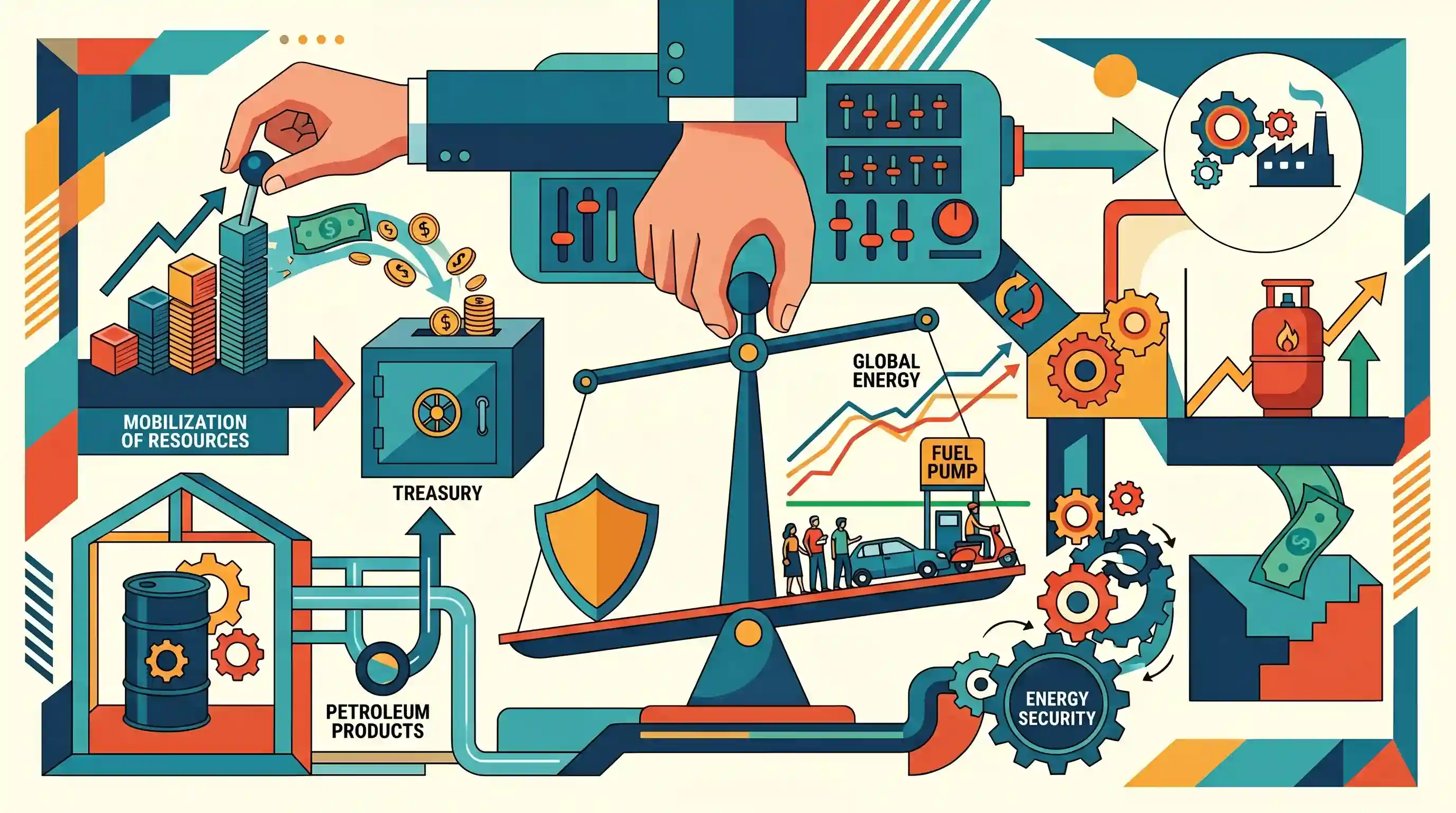
The government has increased the excise duty on petrol and diesel, though retail prices for consumers will remain unchanged. According to Petroleum Minister Hardeep Singh Puri, an accompanying hike in cooking gas (LPG) prices is intended to assist Oil Marketing Companies (OMCs) in recouping significant under-recoveries from previously subsidized LPG sales. This fiscal maneuver reflects the government's strategy to balance revenue mobilization, insulate citizens from auto-fuel inflation, and manage the financial health of energy companies. It also highlights the structural complexities of India's indirect tax system, where major petroleum products continue to be excluded from the GST framework.
Key Points
- The Union Government has hiked the excise duty on petrol and diesel without altering the retail prices for consumers.
- Instead of passing the tax burden to consumers, the move is likely offset by lower global crude prices or absorbed by OMCs, insulating the public from auto fuel inflation.
- Concurrently, cooking gas (LPG) prices have been increased to help Oil Marketing Companies (OMCs) recoup heavy losses resulting from previously subsidized LPG sales.
- Modulating excise duties is a key fiscal mechanism used by the government to manage revenue mobilization and fiscal deficit targets.
- The scenario underscores the broader debate around the taxation of petroleum products, which remain outside the Goods and Services Tax (GST) regime, leading to a reliance on central excise and state VAT.
Important Terms
Central Excise Duty

An indirect tax levied on goods produced or manufactured within India. While GST subsumed many taxes, petroleum products and alcohol remain subject to central excise duty, providing the Union government with significant revenue.
UPSC context
GS Paper III: Taxation/Resource Mobilization. Tests knowledge of indirect tax structures and products currently excluded from the GST regime.
Under-recoveries
The revenue shortfall incurred by Oil Marketing Companies when the retail selling price of a product (like LPG or diesel) is kept lower than its international cost-linked benchmark.
UPSC context
GS Paper III: Subsidies/Fiscal Policy. Tests understanding of fuel pricing mechanisms and their impact on fiscal health and OMCs' finances.
Oil Marketing Companies (OMCs)
Downstream companies engaged in refining, distributing, and retailing petroleum products. In India, the sector is dominated by state-run majors Indian Oil (IOCL), Bharat Petroleum (BPCL), and Hindustan Petroleum (HPCL).
UPSC context
GS Paper III: Infrastructure/Energy. Tests understanding of the downstream energy sector and the role of PSUs in ensuring energy security.
Goods and Services Tax (GST)
A unified destination-based indirect tax that replaced multiple central and state taxes. Petroleum products remain outside its framework to preserve the fiscal autonomy of both the Centre and State governments.
UPSC context
GS Paper III: Indian Economy. Tests knowledge of tax reforms, federalism, and the structural limitations of the current GST regime.
Petroleum and Natural Gas Regulatory Board (PNGRB)
A statutory body established under the PNGRB Act, 2006, to regulate midstream and downstream activities such as refining, pipelines, and marketing. Notably, it does not regulate upstream crude oil production.
UPSC context
GS Paper III: Regulatory Bodies. Tests knowledge of sectoral regulators and the distinction between upstream and downstream energy mandates.
Prelims Trap
"A Constitutional Amendment is required to bring petrol and diesel under the Goods and Services Tax (GST) regime."
Article 279A(5) explicitly empowers the GST Council to recommend the date for bringing these fuels under GST. No constitutional amendment is required to make this change.
Static Concepts Connected
Which five petroleum products are currently excluded from the GST framework?
- Excluded fuels: Crude oil, high-speed diesel, motor spirit (petrol), natural gas, and aviation turbine fuel (ATF) remain outside GST.
- Taxation structure: They attract Central Excise Duty and State VAT. Because they are outside GST, businesses cannot claim Input Tax Credit (ITC), leading to a cascading tax effect.
How do 'under-recoveries' differ from explicit government subsidies?
- Under-recoveries: Notional financial losses absorbed directly by Oil Marketing Companies (OMCs) when mandated to sell fuel below international market costs.
- Subsidies: Explicit financial support budgeted by the government and transferred to consumers or companies (e.g., direct benefit transfers under the PAHAL scheme for LPG).
Cross-Topic Patterns
Fiscal-Monetary Synergy in Inflation Targeting
Excise duty modulation by the Centre acts as a fiscal shock absorber, preventing fuel price hikes from spilling into retail CPI, thereby directly aiding the RBI's statutory inflation-targeting mandate.
EV Transition vs. Fiscal Revenue Dependency
Heavy reliance on central excise and state VAT from fossil fuels exposes structural vulnerabilities in government budgets as India accelerates its electric vehicle (EV) transition and net-zero 2070 targets.

Expect a 2026 Prelims question combining Article 279A(5) powers of the GST Council with the mechanics of cascading taxes on fuel inflation.
Linked PYQs · 3
Linked PYQs · 3
- 2019MainsGS3
Enumerate the indirect taxes which have been subsumed in the Goods and Services Tax (GST) in India. Also, comment on the revenue implications of the GST introduced in India since July 2017.
- 2017PrelimsGS1
What is/are the most likely advantages of implementing 'Goods and Services Tax (GST)'? 1. It will replace multiple taxes collected by multiple authorities and will thus create a single market in India. 2. It will drastically reduce the 'Current Account Deficit' of India and will enable it to increase its foreign exchange reserves. 3. It will enormously increase the growth and size of economy of India and will enable it to overtake China in the near future. Select the correct answer using the code given below:
- 2025PrelimsGS1
Consider the following activities : I. Production of crude oil II. Refining, storage and distribution of petroleum III. Marketing and sale of petroleum products IV. Production of natural gas How many of the above activities are regulated by the Petroleum and Natural Gas Regulatory Board in our country?
