First Uncrewed Gaganyaan Test Flight Scheduled Before March
Source:Indian Express ↗
Why It Matters
The Gaganyaan mission represents a major milestone in India's space program, elevating the nation's status to the elite group of countries with human spaceflight capability. It has high relevance for both Prelims and GS3 Mains in the Science and Technology sections.
Summary
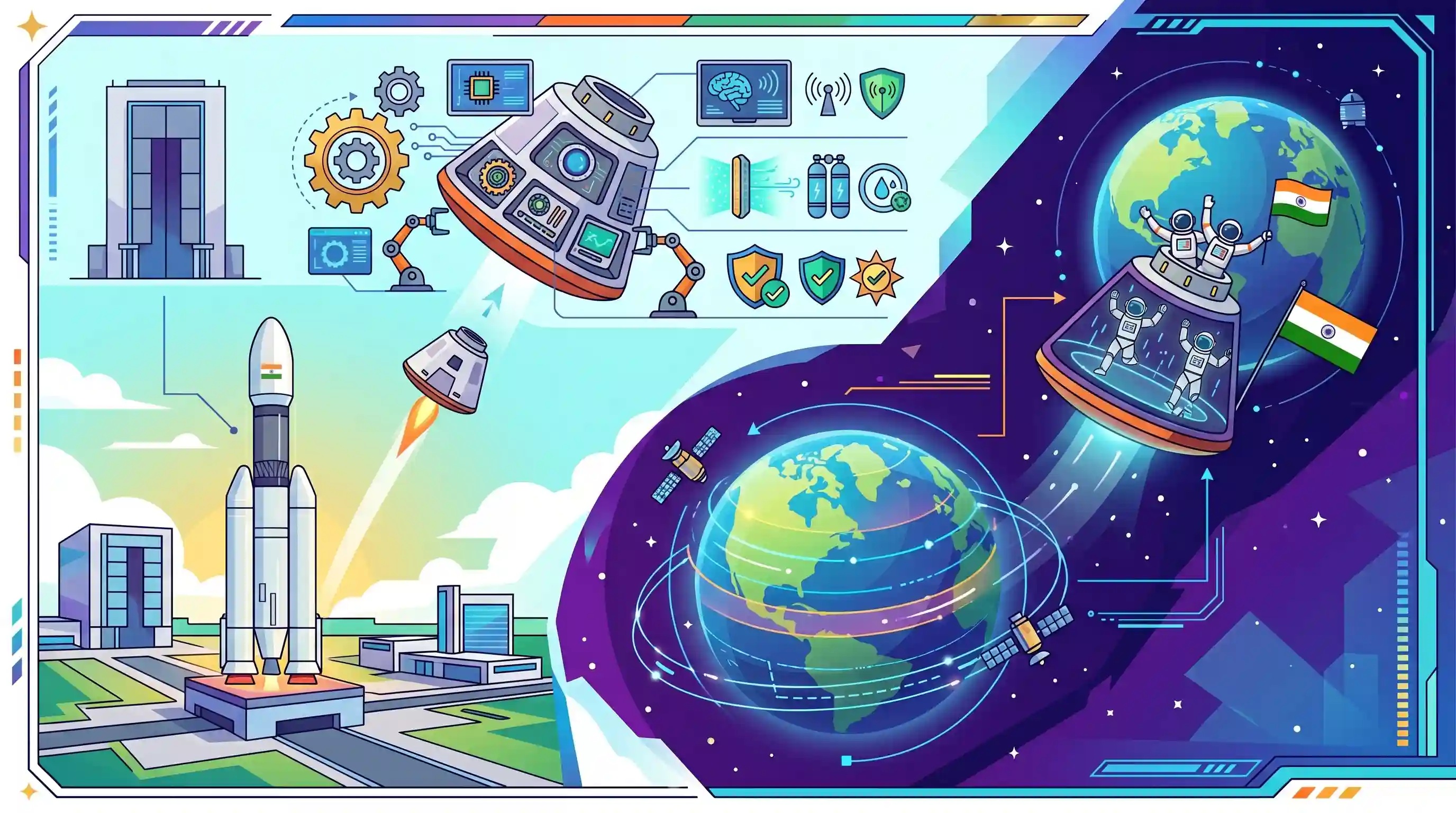
The Government has confirmed that the first uncrewed test flight for ISRO's ambitious Gaganyaan mission is slated for launch before March next year. These uncrewed missions serve as critical preliminary steps to validate the safety, avionics, and life-support functionality of the Human-Rated LVM3 launch vehicle and the orbital module. The successful execution of these uncrewed flights will clear the path for India's historic maiden human spaceflight mission, establishing indigenous capabilities in manned space exploration and operations in Low Earth Orbit (LEO).
Key Points
- The Indian government has announced that the first uncrewed test flight of the Gaganyaan mission is scheduled to be launched before March next year.
- Uncrewed flights (such as G1 and G2) are essential precursor missions to validate the safety, life-support systems, and overall reliability of the human-rated launch vehicle (HLVM3) and orbital module.
- Gaganyaan is ISRO's flagship human spaceflight programme, with the ultimate objective of sending a crew to Low Earth Orbit (LEO) and bringing them safely back to Earth.
Important Terms
Gaganyaan Mission

India's first human spaceflight program aiming to send a three-member crew to a 400 km orbit for three days and return them safely to Earth.
UPSC context
GS Paper III (Science & Tech); tests knowledge of indigenous space capabilities and India's position in global space exploration.
Human-Rated LVM3 (HLVM3)
A modified, human-rated version of ISRO's LVM3 (GSLV Mk III) heavy-lift rocket, featuring a Crew Escape System and enhanced reliability for manned missions.
UPSC context
GS Paper III (Science & Tech); focuses on indigenous launch vehicle technology and safety standards for human spaceflight.
Low Earth Orbit (LEO)
The region of space between 160 km and 2,000 km above Earth's surface, where the Gaganyaan mission and the International Space Station operate.
UPSC context
GS Paper III (Science & Tech); covers orbital mechanics and the strategic/scientific utility of various space altitudes.
Orbital Module
The spacecraft system for Gaganyaan comprising the pressurized Crew Module (habitable space) and the unpressurized Service Module (propulsion and power).
UPSC context
GS Paper III (Science & Tech); tests understanding of spacecraft design and critical life-support systems.
Vyommitra
A female-looking half-humanoid robot developed by ISRO to simulate human functions and monitor life-support systems during uncrewed Gaganyaan test flights.
UPSC context
GS Paper III (Science & Tech); relevant for robotics, AI applications in space, and experimental mission payloads.
ISRO (Indian Space Research Organisation)
India's national space agency under the Department of Space, responsible for the design, development, and execution of the Gaganyaan mission.
UPSC context
GS Paper III (Science & Tech); institutional roles in national development and achievements in space technology.
Prelims Trap
Gaganyaan aims to place astronauts in Geosynchronous Equatorial Orbit (GEO) using a modified PSLV.
Gaganyaan will deploy astronauts to Low Earth Orbit (LEO) at ~400 km, not GEO. It uses the human-rated LVM3 (HLVM3), not PSLV.
Static Concepts Connected
What distinguishes Low Earth Orbit (LEO) from Geosynchronous Orbit (GEO)?
- Altitude: LEO ranges from 160-2000 km in altitude, whereas GEO is fixed at approximately 35,786 km above the Earth's equator.
- Applications: LEO is used for human spaceflight (ISS, Gaganyaan) and earth observation due to low latency; GEO is primarily used for telecommunications and weather monitoring.
What are the three stages of the LVM3 (formerly GSLV Mk III)?
- Solid Stage: Two S200 solid rocket boosters strap onto the sides to provide immense thrust during the initial lift-off phase.
- Liquid Stage: The core L110 stage uses twin liquid-fueled Vikas engines to sustain the vehicle's atmospheric ascent.
- Cryogenic Stage: The CE-20 upper stage uses liquid oxygen and liquid hydrogen. This stage underwent rigorous 'human-rating' tests for Gaganyaan.
Cross-Topic Patterns
Gaganyaan to Bharatiya Antariksha Station
Gaganyaan's success directly underpins India's broader strategic timeline of establishing the Bharatiya Antariksha Station (BAS) by 2035 and achieving a manned lunar mission by 2040.
ISRO's shifting mandate & Privatization
As ISRO pivots its resources to human spaceflight (Gaganyaan) and deep-space exploration, routine LEO satellite launches are increasingly being offloaded to the private sector via NSIL and IN-SPACe.

Expect a 2026 multi-statement Prelims question combining HLVM3 cryogenic engine specs, Vyommitra's role, and LEO altitude limits.
Linked PYQs · 2
Linked PYQs · 2
- 2025PrelimsGS1
Consider the following space missions : I. Axiom-4 II. SpaDeX III. Gaganyaan How many of the space missions given above encourage and support micro-gravity research?
- 2016MainsGS3
Discuss India's achievements in the field of Space Science and Technology. How the application of this technology has helped India in its socio-economic development?
