Uttarakhand extends deadline for statehood activists applications
Source:garhwalpost ↗
Why It Matters
The recognition of statehood activists is a vital political and administrative issue in Uttarakhand. The government provides special welfare benefits, pensions, and job reservations to recognized activists who fought for the state's creation. For UKPSC aspirants, tracking these governance orders is essential as they link contemporary administrative policies directly to the history of the Uttarakhand statehood movement and its legacy.
Summary
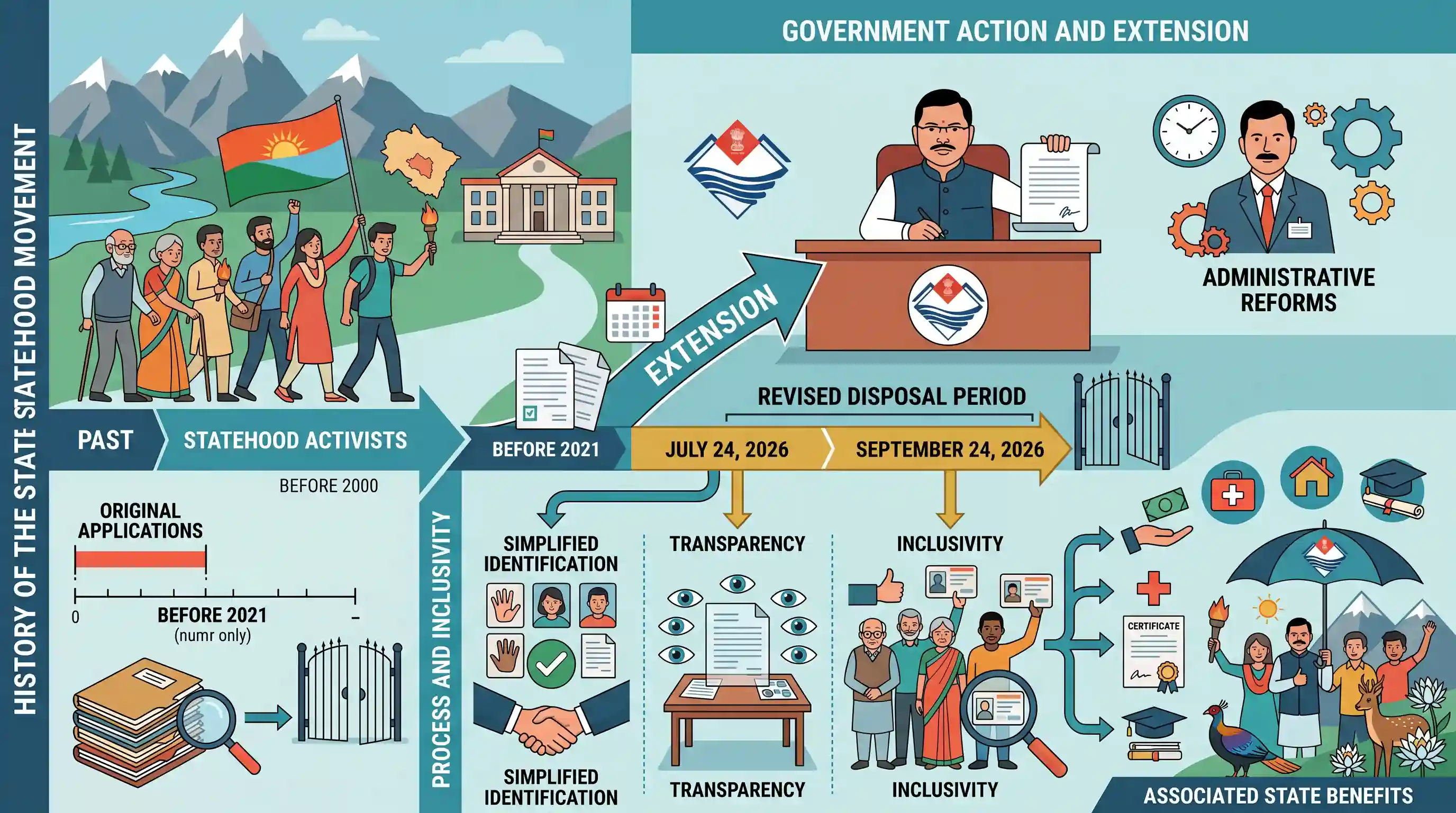
The Uttarakhand government has extended the timeframe for disposing of pending applications from Uttarakhand statehood movement activists (originally submitted up to the year 2021). Authorized by Chief Minister Pushkar Singh Dhami and issued via a government order by Secretary Shailesh Bagoli, the revised disposal period will run from July 24, 2026, to September 24, 2026. This administrative extension aims to make the identification process more transparent, simplified, and inclusive, ensuring that genuine activists of the statehood movement are not left out of recognition and associated state benefits.
Key Points
- The Uttarakhand government has extended the deadline for the disposal of pending applications submitted by Uttarakhand statehood movement activists up to the year 2021.
- Following approval from Chief Minister Pushkar Singh Dhami, a government order (GO) was issued by Secretary Shailesh Bagoli.
- The newly revised schedule sets the application disposal window from July 24, 2026, to September 24, 2026.
- The administrative step aims to streamline, simplify, and make the identification process of genuine statehood movement activists more transparent and inclusive.
- Official identification as a statehood activist makes individuals eligible for specific state welfare schemes, pensions, and job reservations in Uttarakhand.
Important Terms
Uttarakhand Statehood Movement

A socio-political campaign in the 1990s demanding the separation of Uttarakhand's hill regions from Uttar Pradesh due to cultural differences and administrative neglect, culminating in statehood on November 9, 2000.
UPSC context
GS Paper I: Post-independence consolidation, regionalism; GS Paper II: Federalism and creation of new states.
Horizontal Reservation
A policy providing equal opportunities to specific categories (e.g., women, veterans, or statehood activists) by cutting across vertical reservation categories (e.g., SC, ST, OBC) within each quota.
UPSC context
GS Paper II: Indian Constitution, social justice; tests affirmative action, Article 15(3), and equality of opportunity.
Article 3 of the Indian Constitution
A constitutional provision empowering Parliament to create new states, or alter the area, boundaries, and names of existing states, illustrating the flexible nature of Indian federalism.
UPSC context
GS Paper II: Indian Constitution and Polity; tests parliamentary authority in territorial reorganization and federal dynamics.
Regionalism
A socio-political ideology where people identify strongly with a specific geographic region, driven by cultural uniqueness, economic grievances, or administrative neglect, often leading to autonomy demands.
UPSC context
GS Paper I: Indian Society, regionalism; GS Paper II: Federalism; tests regional imbalances and sub-nationalism.
Uttarakhand Government
The sub-national executive and legislative authority governing Uttarakhand, responsible for administering regional policies, maintaining law and order, and implementing state-level welfare programs.
UPSC context
GS Paper II: State Executive and Legislature; tests center-state relations and sub-national governance in a federal system.
Prelims Trap
The name change of Uttaranchal to Uttarakhand in 2006 required a formal constitutional amendment passed under Article 368.
Renaming states or altering boundaries under Article 3 is done through ordinary legislative processes with a simple majority, and is explicitly excluded from Article 368's scope by Article 4.
Static Concepts Connected
How is a new state created or renamed under Article 3 of the Constitution?
- Presidential Recommendation: Prior recommendation of the President is mandatory before introducing the state reorganization bill in either House of Parliament.
- State Referral: The President must refer the bill to the affected state legislature for its views, though these views are not binding on Parliament.
- Simple Majority: Parliament can pass the bill using a simple majority, as Article 4 clarifies this is not an Article 368 constitutional amendment.
What is the constitutional mechanism of horizontal reservation?
- Cross-Cutting Quota: Horizontal reservation cuts across vertical categories (like SC, ST, OBC) to benefit specific groups such as women, veterans, or local activists.
- Adjustment Principle: Beneficiaries are adjusted within their respective category quotas rather than adding extra seats outside the vertical limits.
- Constitutional Basis: It is generally carved out under the enabling provisions of Article 16(1) or Article 15(3) of the Indian Constitution.
Cross-Topic Patterns
Statehood struggles and regionalism dynamics
Traces how economic neglect of hilly terrains drives demands for separate statehood, highlighting the intersection of geography, cultural identity, and governance in federal India.
Horizontal quotas and Article 16 limits
Examines how state-level special reservations for localized interest groups (like statehood activists) navigate constitutional judicial scrutiny regarding equality of opportunity.

Questions on Article 3 federal procedures and the judicial boundaries of horizontal reservations are highly likely in the 2026 exam.
Linked PYQs · 2
Linked PYQs · 2
- 2021UKPSC_PRELIMSGS1
The state of Uttarakhand came into existence on which of the following dates ?
- 2021UKPSC_PRELIMSGS1
The Uttaranchal (Change of Name) Act, came into existence is which of the following years ?
