Maharashtra launches statewide drive to assign Bhu Aadhaar numbers
Source:Indian Express ↗
Why It Matters
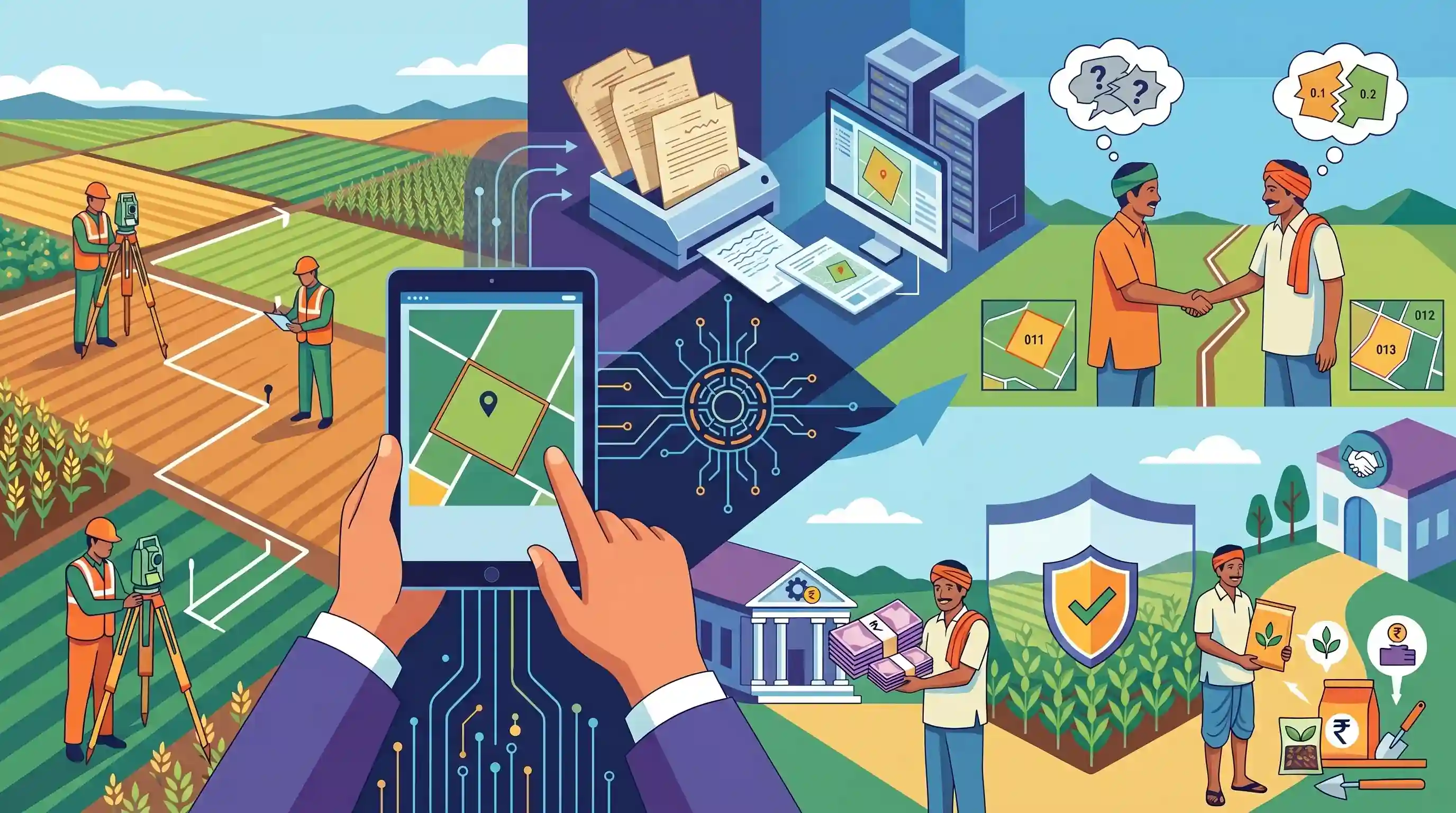
Accurate land titling is considered the unfinished agenda of land reforms in India. Projects like Bhu-Aadhaar (ULPIN) demonstrate the application of digital technology in agriculture to formalize the rural economy, reduce litigation burdens on the judiciary, and ensure precise targeting for welfare subsidies and institutional lending.
Summary
The Maharashtra government has initiated a statewide drive to physically measure agricultural land sub-divisions and assign a 14-digit 'Bhu-Aadhaar' (Unique Land Parcel Identification Number - ULPIN) to every parcel. This effort seeks to update the Record of Rights (7/12 extracts) by aligning them with digitized maps. By resolving ambiguities over land boundaries and ownership, the scheme aims to reduce property disputes, expedite real estate transactions, and facilitate easier access to institutional credit, crop insurance, and agricultural welfare schemes for farmers.
Key Points
- The Maharashtra government has launched a campaign to measure sub-divisions of agricultural land ('pot hisse') and update records.
- Each measured land parcel will be assigned a 14-digit Unique Land Parcel Identification Number (ULPIN), branded as 'Bhu-Aadhaar'.
- The initiative will align physical land boundaries with official Record of Rights (7/12 extracts) and digital maps.
- The modernization aims to drastically reduce rural land disputes, which often arise from unrecorded family partitions.
- Accurate and digitized land records will simplify farmers' access to institutional credit, crop insurance, and direct benefit transfers.
Important Terms
Unique Land Parcel Identification Number (ULPIN)

A 14-digit alpha-numeric identifier for land parcels based on geo-coordinates (longitude/latitude). It provides a unique identity to every surveyed plot to prevent fraud and boundary disputes.
UPSC context
GS Paper III: Land Reforms. Critical for e-technology in agriculture and facilitating institutional credit through digital records.
Bhu-Aadhaar
Commonly referred to as the 'Aadhaar for land,' it is the popular branding for the ULPIN system, facilitating a unified database for ownership, area, and transaction history.
UPSC context
GS Paper II: E-Governance. Represents the integration of digital ID systems with public land records for transparency.
7/12 Extract
An extract from the land register in Maharashtra and Gujarat detailing ownership, occupancy, and cultivation of agricultural plots. It is the primary legal evidence for land rights.
UPSC context
GS Paper III: Land Reforms. Essential for verifying ownership in welfare schemes and legal land transactions in Western India.
Record of Rights (RoR)
A legal register specifying ownership, possession, and liabilities associated with a land parcel. It is the foundational document for verifying title and resolving property disputes.
UPSC context
GS Paper III: Land Reforms. Core concept in understanding Indian land administration and tenure security.
Digital India Land Records Modernization Programme (DILRMP)
A central scheme aimed at digitizing land records, survey maps, and registration. It seeks to create a real-time, integrated land information management system across India.
UPSC context
GS Paper II & III: E-governance and Land Reforms. Tests knowledge of national digital infrastructure for rural development.
Settlement Commissionerate
The state-level nodal agency responsible for land surveys, revenue settlement, and maintaining updated land records. It leads the digitization and physical measurement drives in Maharashtra.
UPSC context
GS Paper II: Governance. Important for understanding state-level institutional frameworks for executing land reforms and e-governance.
Prelims Trap
"Bhu-Aadhaar is a 12-digit number generated under a Centrally Sponsored Scheme implemented by States."
ULPIN is a 14-digit number (not 12 like regular Aadhaar), and DILRMP is a Central Sector Scheme (100% funded by Centre), despite land being a State subject.
Static Concepts Connected
What is the difference between presumptive and conclusive land titling?
- Presumptive Titling: Current Indian system; land registration is only a record of transaction, not a guaranteed title. It is subject to legal challenge.
- Conclusive Titling: The State provides guaranteed land titles with a provision for compensation if a title is proven false. India aims to transition to this.
What are the core pillars of the Digital India Land Records Modernization Programme (DILRMP)?
- Computerization: Digitizing Records of Rights (RoRs) and computerizing registration offices to create a single-window system.
- Survey/Resurvey: Updating ground records using modern technology like GIS, drone mapping, and satellite imagery.
- Integration: Seamlessly connecting revenue courts, registration offices, and banks to automate property mutations and curb benami transactions.
Cross-Topic Patterns
Agri-Stack and Institutional Credit
ULPIN acts as the foundational layer for the national Agri-Stack, enabling banks to verify holdings instantly and sanction Kisan Credit Card (KCC) loans without physical verification.
Judicial Pendency and Land Disputes
Unclear property titles account for a massive chunk of civil suits. Conclusive land titling via ULPIN directly reduces lower-judiciary burden, linking land reforms to judicial pendency.

Expect a 2026 Prelims question pairing ULPIN's 14-digit format with DILRMP's Central Sector funding status and conclusive titling aim.
Linked PYQs · 5
Linked PYQs · 5
- 2023MainsGS3
State the objectives and measures of land reforms in India. Discuss how land ceiling policy on landholding can be considered as an effective reform under economic criteria.
- 2016MainsGS3
Discuss the role of land reforms in agricultural development. Identify the factors that were responsible for the success of land reforms in India.
- 2015MainsGS3
How can the 'Digital India' programme help farmers to improve farm productivity and income ? What steps has the Government taken in this regard?
- 2023MainsGS3
How does e-Technology help farmers in production and marketing of agricultural produce? Explain it.
- 2019PrelimsGS1
With reference to land reforms in independent India, which one of the following statements is correct?
