Telangana Phone Tapping Case and Investigative Accountability
Source:The Hindu ↗
Why It Matters
This incident serves as a practical case study for UPSC aspirants on the intersection of state surveillance (Article 21 - Right to Privacy), the ethical responsibilities of the media (avoiding media trials), and the imperative for independent investigative agencies free from political interference.
Summary
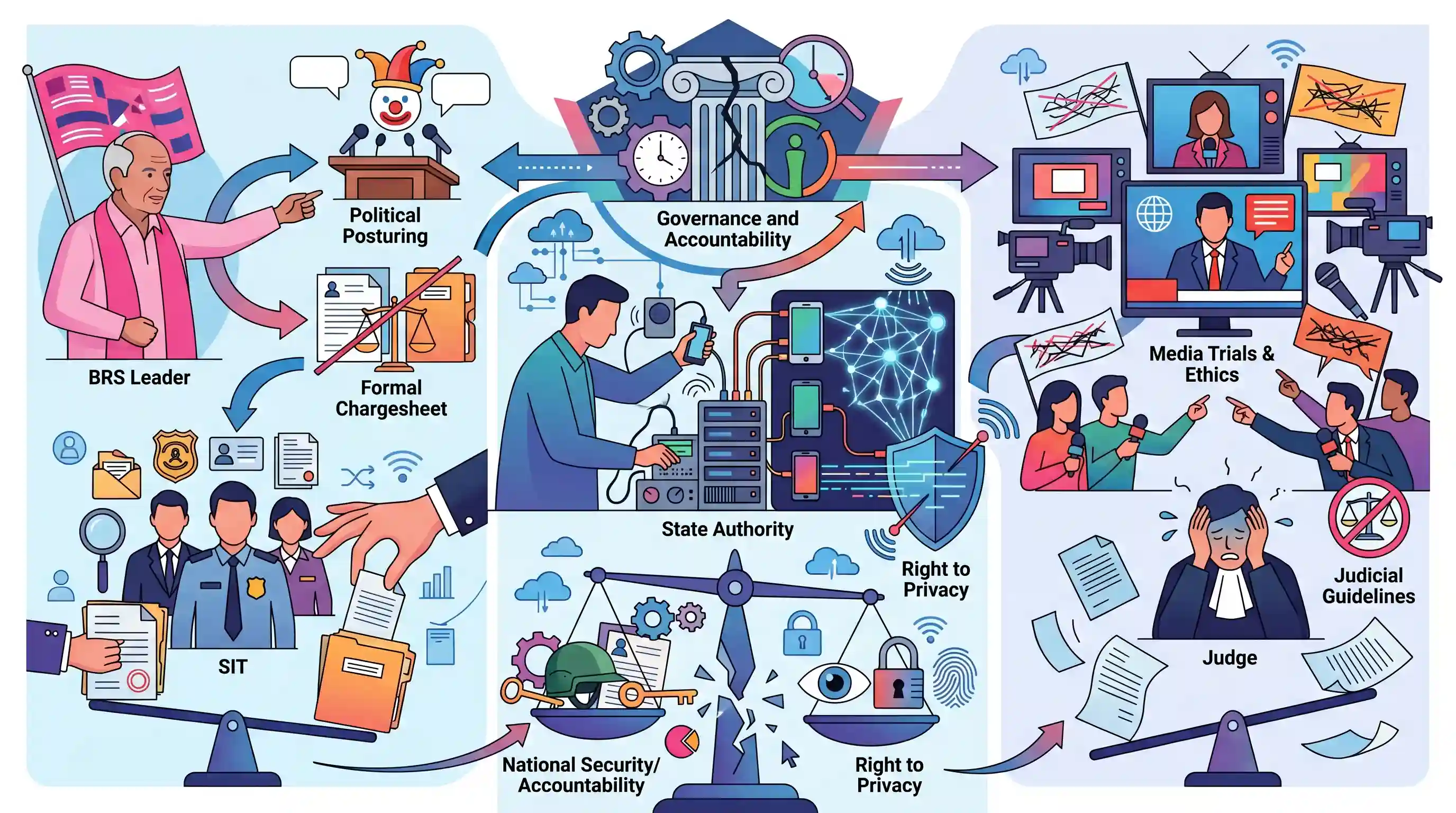
A senior BRS leader has urged the Telangana government to file a formal chargesheet in the alleged phone-tapping case instead of using the issue for political posturing. The controversy highlights key governance and ethical concerns, including the misuse of state surveillance mechanisms, the politicization of investigative agencies like the SIT, and the damaging impact of 'media trials' where news channels broadcast unverified defamatory content in defiance of judicial guidelines. The issue underscores the delicate balance between national security, political accountability, and the fundamental Right to Privacy.
Key Points
- BRS leader R.S. Praveen Kumar challenged the Telangana government to file a formal chargesheet in the ongoing phone-tapping case if credible evidence exists, rather than resorting to media leaks.
- He strongly criticized the role of certain media outlets in conducting a 'media trial' by broadcasting defamatory content about individuals before they are proven guilty, violating guidelines set by the Supreme Court and High Courts.
- The statements underscore the growing concerns over the politicization of investigative mechanisms, such as Special Investigation Teams (SITs), to target opposition figures.
- The alleged phone-tapping incident raises critical questions regarding state surveillance, internal security, and the violation of citizens' fundamental Right to Privacy.
Important Terms
Right to Privacy

A fundamental right under Article 21, established by the Supreme Court as intrinsic to life and personal liberty, protecting individuals from unauthorized state surveillance.
UPSC context
GS Paper II (Fundamental Rights). Tested via landmark judgments like Puttaswamy and the balance between security and liberty.
Special Investigation Team (SIT)
An ad-hoc investigative body appointed by the government or judiciary to probe complex, high-profile, or sensitive cases requiring specialized expertise or impartial scrutiny.
UPSC context
GS Paper II (Executive/Statutory Bodies). Relevant for issues of police reforms and administrative accountability in criminal justice.
Media Trial
The phenomenon where media reporting creates a widespread perception of guilt or innocence before a court verdict, potentially prejudicing the judicial process.
UPSC context
GS Paper IV (Ethics) and GS Paper II (Judiciary). Tests the conflict between freedom of speech and the right to a fair trial.
Indian Telegraph Act, 1885
The primary legislation governing phone tapping in India; Section 5(2) allows interception only during public emergencies or in the interest of public safety.
UPSC context
GS Paper II (Governance/Legislation). Critical for understanding the legal basis and procedural safeguards for state surveillance.
Justice K.S. Puttaswamy Judgment
The landmark 2017 Supreme Court ruling that declared privacy a fundamental right, mandating that state interference must pass tests of legality, necessity, and proportionality.
UPSC context
GS Paper II (Judiciary/Polity). The foundational case for digital rights and individual autonomy in modern Indian jurisprudence.
Chargesheet
A final police report filed in court after an investigation, containing evidence and witness statements used to initiate a formal criminal trial.
UPSC context
GS Paper II (Criminal Justice System). Focuses on the procedural stages of law enforcement and the right to a timely trial.
Prelims Trap
"Phone tapping by State police requires prior authorization from a Judicial Magistrate or the Union Home Ministry."
Phone tapping orders do not require judicial or Union approval for state matters. They are authorized by the respective Union OR State Home Secretary.
Static Concepts Connected
What are the legal grounds and safeguards for phone tapping in India?
- Legal Basis: Section 5(2) of the Indian Telegraph Act, 1885 allows interception only during a "public emergency" or for "public safety."
- Authorization: Orders can only be issued by the Secretary to the Ministry of Home Affairs (Centre) or the Home Secretary (State).
- Review Committee: Orders must be scrutinized by a Review Committee headed by the Cabinet Secretary (Centre) or Chief Secretary (State) within 60 days.
How does the Constitution view 'Media Trials' and parallel investigations?
- Constitutional Conflict: Media trials often create a clash between Freedom of Speech and Expression [Art 19(1)(a)] and the Right to a Fair Trial [Art 21].
- Presumption of Innocence: Courts hold that media trials violate the core criminal jurisprudence principle of "innocent until proven guilty," prejudicing public and judicial opinion.
- Postponement Orders: To balance these rights, higher courts can issue "postponement orders" (gag orders) temporarily restricting media reporting on sensitive, ongoing trials.
Cross-Topic Patterns
Pegasus, Cyber Surveillance & Telegraph Act
The transition from analog wiretapping to modern spyware (e.g., Pegasus) highlights the obsolescence of the 1885 Telegraph Act, sparking debates on needing a modern, rights-compliant surveillance framework.
Freedom of Press vs. Fair Trial (Art 21)
Rampant media trials create friction between Article 19(1)(a) and Article 21, frequently invoked by the Supreme Court when assessing the integrity of ongoing investigations by agencies like ED or SIT.

Expect a 2026 multi-statement prelims question on the statutory authorization of phone tapping and the composition of its Review Committees.
Linked PYQs · 3
Linked PYQs · 3
- 2024MainsGS2
Right to privacy is intrinsic to life and personal liberty and is inherently protected under Article 21 of the constitution. Explain. In this reference discuss the law relating to D.N.A. testing of child in the womb to establish its paternity.
- 2017MainsGS2
Examine the scope of Fundamental Rights in the light of the latest judgement of the Supreme Court on Right to Privacy.
- 2025MainsGS4
In the present digital age, social media has revolutionised our way of communication and interaction. However, it has raised several ethical issues and challenges. Describe the key ethical dilemmas in this regard.
