Uttarakhand Implements First Yoga Policy to Promote Wellness Tourism
Source:indiatvnews ↗
Why It Matters
The article highlights state-specific policies and major infrastructural developments (like the Sharda Corridor) and integrates geography (Sharda/Kali river basin in Champawat) with wellness tourism. This is crucial for UKPSC PCS Prelims questions focusing on regional geography, state-run tourism initiatives, and unique developmental policies.
Summary
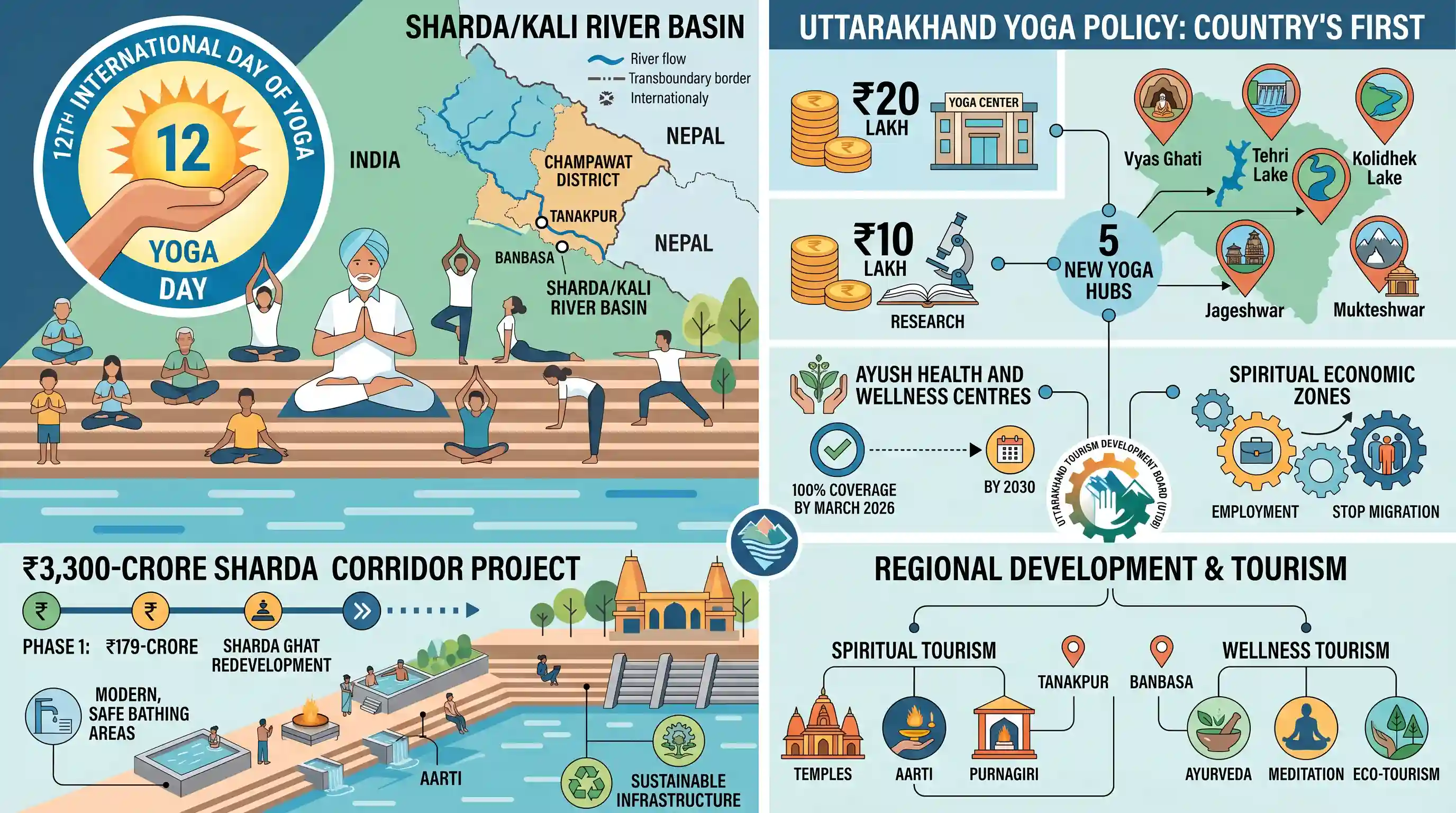
On the occasion of the 12th International Day of Yoga (June 21, 2026), Uttarakhand Chief Minister Pushkar Singh Dhami participated in the state-level event organized on the banks of the Sharda River in Banbasa, Champawat district. The CM highlighted Uttarakhand's vision of becoming the global capital of yoga and wellness, bolstered by the implementation of the country's first Yoga Policy. The policy features financial incentives (subsidies up to ₹20 lakh for centers and ₹10 lakh for research) and the creation of five new yoga hubs. Additionally, the government launched the first phase of the ₹3,300-crore Sharda Corridor Project, commencing with the ₹179-crore redevelopment of Sharda Ghat to promote spiritual and wellness tourism from Tanakpur to Banbasa.
Key Points
- Uttarakhand has implemented India's first dedicated Yoga Policy to promote yoga, meditation, and naturopathy.
- The Yoga Policy provides financial subsidies up to ₹20 lakh for establishing yoga/meditation centers and grants up to ₹10 lakh for research and studies in yoga and naturopathy.
- Five new yoga hubs are being developed across Uttarakhand, and yoga services are being integrated into all Ayush Health and Wellness Centres.
- The state-level event for the 12th International Day of Yoga (June 21, 2026) was held at Banbasa in Champawat district, situated along the banks of the Sharda River.
- The Sharda Corridor Project is a major spiritual tourism initiative being developed at an estimated cost of ₹3,300 crore along the Sharda Riverfront from Tanakpur to Banbasa.
- The first phase of the Sharda Corridor Project, involving the redevelopment of the Sharda Ghat at a cost of ₹179 crore, was officially launched.
Important Terms
Uttarakhand Yoga Policy

India's first dedicated state policy aiming to develop Uttarakhand as a global yoga and wellness capital. It offers subsidies for yoga centers, research grants, and targets five new international-class yoga hubs by 2030.
UPSC context
GS Paper II: Government policies and interventions. Tests understanding of wellness tourism, state-level development policies, and reverse migration strategies.
Sharda Corridor Project
A ₹3,300-crore infrastructural and ecological development initiative in Champawat, Uttarakhand. It focuses on redeveloping the Sharda Riverfront (from Banbasa to Mata Rankochi), disaster-resilient ecological corridors, and boosting spiritual and adventure tourism.
UPSC context
GS Paper III: Infrastructure and Sustainable Development. Tests regional development planning, border-area economic models, and eco-sensitive infrastructure projects.
Ayushman Arogya Mandir
Formerly Ayush Health and Wellness Centres, these are upgraded primary health facilities under the National Ayush Mission. They provide comprehensive, community-level primary healthcare integrating preventive care, wellness, and yoga.
UPSC context
GS Paper II: Social Sector and Health. Tests public health infrastructure, universal health coverage goals, and AYUSH integration.
Sharda River
Also known as the Kali or Mahakali River, it originates in Uttarakhand's Great Himalayas and forms the India-Nepal border. It serves as a vital water source for northern India's irrigation and bilateral hydropower initiatives.
UPSC context
GS Paper I: Geography (Indian Drainage). Tests Himalayan river systems, transboundary boundaries, and bilateral water cooperation.
Prelims Trap
The Sharda River originates as 'Sharda' near Lipulekh and is joined by the Western Dhauliganga before entering the plains.
It originates as the Kali/Mahakali, becoming Sharda only in the plains. Its tributary is the Eastern Dhauliganga; the Western Dhauliganga feeds the Alaknanda at Vishnuprayag.
Static Concepts Connected
What is the drainage geography of the Sharda-Kali river system?
- Origin and Boundary: The Kali (Mahakali) river originates at Kalapani in Pithoragarh, Uttarakhand, forming a natural international boundary between India and Nepal.
- Transition to Sharda: The river descends into the plains near Tanakpur in Champawat, where it is officially renamed the Sharda River.
- Key Tributaries: It receives the Kuthi Yankti, Eastern Dhauliganga, Goriganga, Sarju, and Ladhia rivers before joining the Ghaghara in Uttar Pradesh.
How do Eastern and Western Dhauliganga rivers differ?
- Western Dhauliganga: Flows through the Garhwal division and joins the Alaknanda River at Vishnuprayag, forming the first of the sacred Panch Prayag.
- Eastern Dhauliganga: Flows through the Kumaon division and is a major right-bank tributary of the Kali River, joining it at Tawaghat.
Cross-Topic Patterns
Spiritual tourism and border migration
Integrating the Sharda Corridor with border economic zones helps curb distress migration in Uttarakhand's hill districts, reinforcing national security along the sensitive Indo-Nepal border.
AYUSH infrastructure and federal schemes
Uttarakhand’s Yoga Policy acts as a localized template for the National AYUSH Mission, showcasing how states customize fiscal incentives to expand traditional medicine infrastructure.

Map-based questions distinguishing Eastern/Western Dhauliganga and Kali-Sharda river confluences are highly probable for Prelims 2026.
Linked PYQs · 4
Linked PYQs · 4
- 2025UKPSC_PRELIMSGS1
Which one of the following is incorrectly matched about festivals/exhibitions/expos held in Uttarakhand in 2025?
- 2024UKPSC_PRELIMSGS1
UTDB is established in Uttarakhand to promote:
- 2016UKPSC_PRELIMSGS1
Eastern Dhauliganga (Poorvi Dhauliganga) is a tributary of
- 2025UKPSC_PRELIMSGS1
Which of the following is the correct order of rivers from west to east in Uttarakhand?
