Uttarakhand Clean Mobility Transformation Policy and Green Transport
Source:garhwalpost ↗
Why It Matters
State-specific environmental policies and green mobility schemes are highly relevant for UKPSC PCS Prelims. Recognizing the goals of the Uttarakhand Clean Mobility Transformation Policy-2024 and its linkage to broader climate objectives (like net-zero by 2070 and PM Surya Ghar) is essential for answering questions on state governance and ecology.
Summary
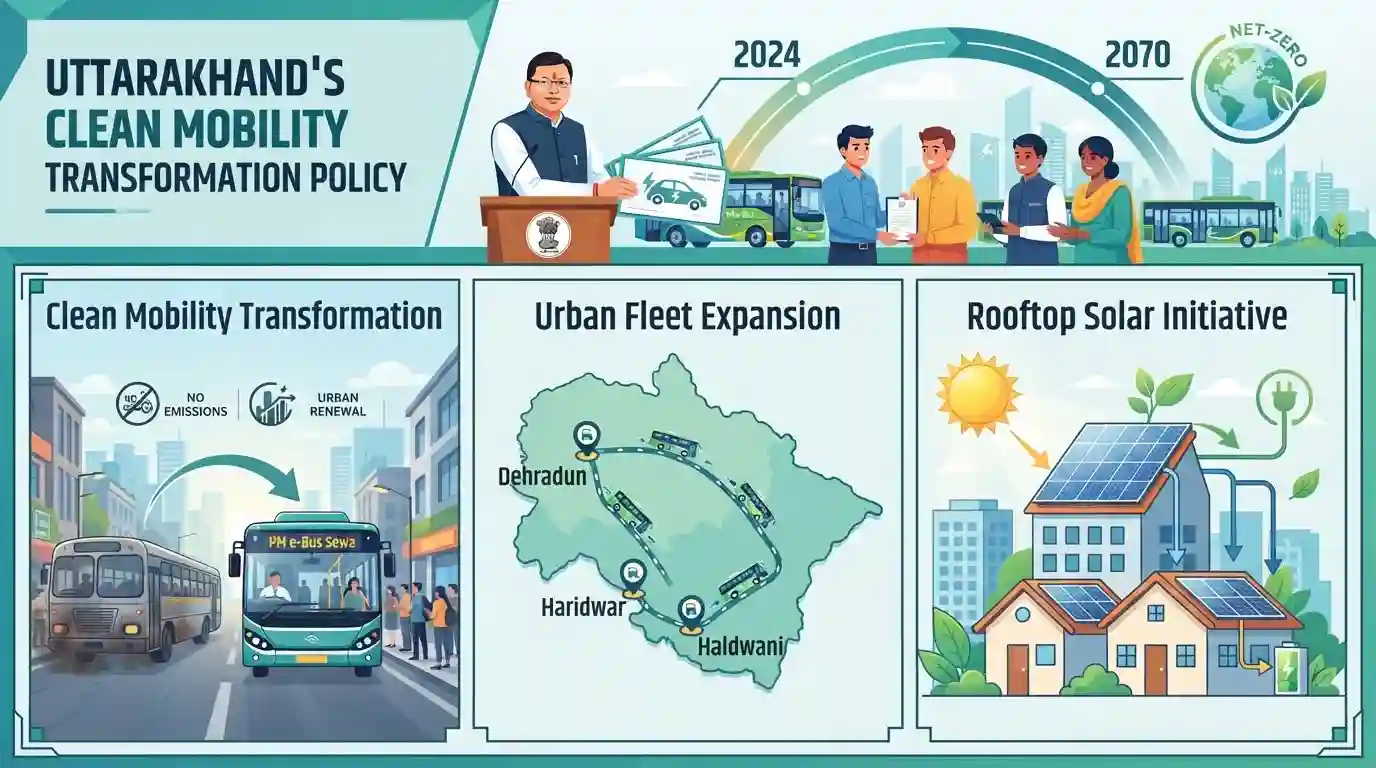
Uttarakhand Chief Minister Pushkar Singh Dhami distributed subsidy cheques under the state's Clean Mobility Transformation Policy-2024, emphasizing the government's push for eco-friendly public transport. The initiative focuses on replacing diesel vehicles with electric alternatives to curb pollution in urban centers. Dhami linked state efforts to national climate goals, notably India's target of net-zero emissions by 2070 and the LiFE campaign. The event also highlighted the expansion of PM e-Bus services in Dehradun, Haridwar, and Haldwani, alongside the PM Surya Ghar scheme for boosting rooftop solar energy.
Key Points
- Uttarakhand Clean Mobility Transformation Policy-2024 promotes the adoption of eco-friendly public transport in urban areas, targeting a reduction in diesel emissions.
- Electric bus operations (under PM e-Bus service) are set to expand in major cities including Dehradun, Haridwar, and Haldwani.
- The initiative aligns with India's national goal to achieve net-zero carbon emissions by 2070 and the LiFE (Lifestyle for Environment) campaign.
- The PM Surya Ghar scheme is also actively promoted to encourage the installation of rooftop solar panels for clean energy generation.
Important Terms
Uttarakhand Clean Mobility Transformation Policy-2024

A state-level initiative to transition urban transport from diesel vehicles to cleaner alternatives like CNG and EVs. It offers capital subsidies to operators for scrapping old vehicles and purchasing clean-fuel ones.
UPSC context
Relevant for GS Paper 3 (Environment & Infrastructure). Tests knowledge of state-level interventions for vehicular pollution and sustainable urban mobility.
PM e-Bus Sewa
A central scheme deploying 10,000 electric buses across tier-2 and tier-3 cities under a Public-Private Partnership (PPP) model. It also supports the development of behind-the-meter power and charging infrastructure.
UPSC context
Important for GS Paper 2 (Policies) and GS Paper 3 (Infrastructure). Tests knowledge of e-mobility, urban transport, and PPP frameworks.
PM Surya Ghar Muft Bijli Yojana
A national rooftop solar scheme offering subsidies and low-interest loans to install residential solar panels. It aims to provide up to 300 units of free electricity monthly to one crore households.
UPSC context
Crucial for GS Paper 3 (Renewable Energy). Tests India's strategies for energy security, grassroots solar adoption, and net-zero targets.
LiFE (Lifestyle for Environment) Campaign
An international mass movement introduced by India at COP26. It aims to replace mindless consumption with a circular economy by promoting sustainable, eco-friendly lifestyle choices at the individual and community levels.
UPSC context
Highly relevant for GS Paper 3 (Environment). Tests India's climate diplomacy, circular economy concepts, and grassroots climate mitigation strategies.
Prelims Trap
PM-eBus Sewa provides 100% Central funding to states to purchase electric buses outright.
The scheme actually operates on a Public-Private Partnership (PPP) model, with Central assistance for operations provided over 10 years, not as upfront purchase grants.
Static Concepts Connected
What are the core targets of India's 'Panchamrit' strategy declared at COP26?
- Net-Zero Target: Achieve net-zero carbon emissions by the year 2070.
- Renewable Capacity: Reach 500 GW of non-fossil energy capacity and meet 50% of energy requirements from renewables by 2030.
- Emission Reduction: Reduce total projected carbon emissions by one billion tonnes and reduce carbon intensity by 45% by 2030.
How is the PM-eBus Sewa scheme structured for urban centers?
- Target Deployment: Targeted deployment of 10,000 electric buses in 169 cities across India.
- PPP Model: Operates on a Public-Private Partnership (PPP) model, rather than direct government procurement and operation.
- Central Assistance: Provides Rs. 20,000 crore in central financial support spread over a 10-year period to sustain operations.
Cross-Topic Patterns
Green Mobility + PPP Models
Urban greening schemes like PM-eBus are leveraging PPP models to distribute financial risk, linking environmental mitigation with infrastructure financing.
LiFE + Circular Economy
The 'Pro-Planet People' approach of the LiFE campaign connects directly to UPSC mains topics on solid waste management and transitioning to a circular economy.

Expect a 2026 prelims question merging PM-eBus Sewa's PPP model with PM Surya Ghar's subsidy structure to test green finance mechanisms.
Linked PYQs · 2
Linked PYQs · 2
- 2025UKPSC_PRELIMSGS1
Consider the following statements and select the correct answer from the options given below : Statement 1 : Uttarakhand is highly vulnerable to climate change. Statement 2 : Climate change is causing water stress and depleting biodiversity in Uttarakhand.
- 2025UKPSC_PRELIMSGS1
Consider the following statements and select the correct answer from the options given below : Statement 1 : The State Council for Climate Change (SCCC) of Uttarakhand was established in the year 2011. Statement 2 : The responsibility of preparing Uttarakhand Action Plan on Climate Change (UAPCC) was given to the State Revenue Department.
