Government cautions exporters against violating rules of origin norms
Source:Indian Express ↗
Why It Matters
Understanding the impact of global trade wars on India's exports is crucial for aspirants. It highlights the importance of trade compliance, international 'Rules of Origin' (ROO), and how geopolitical tensions create both supply chain opportunities and severe regulatory risks for the Indian economy.
Summary
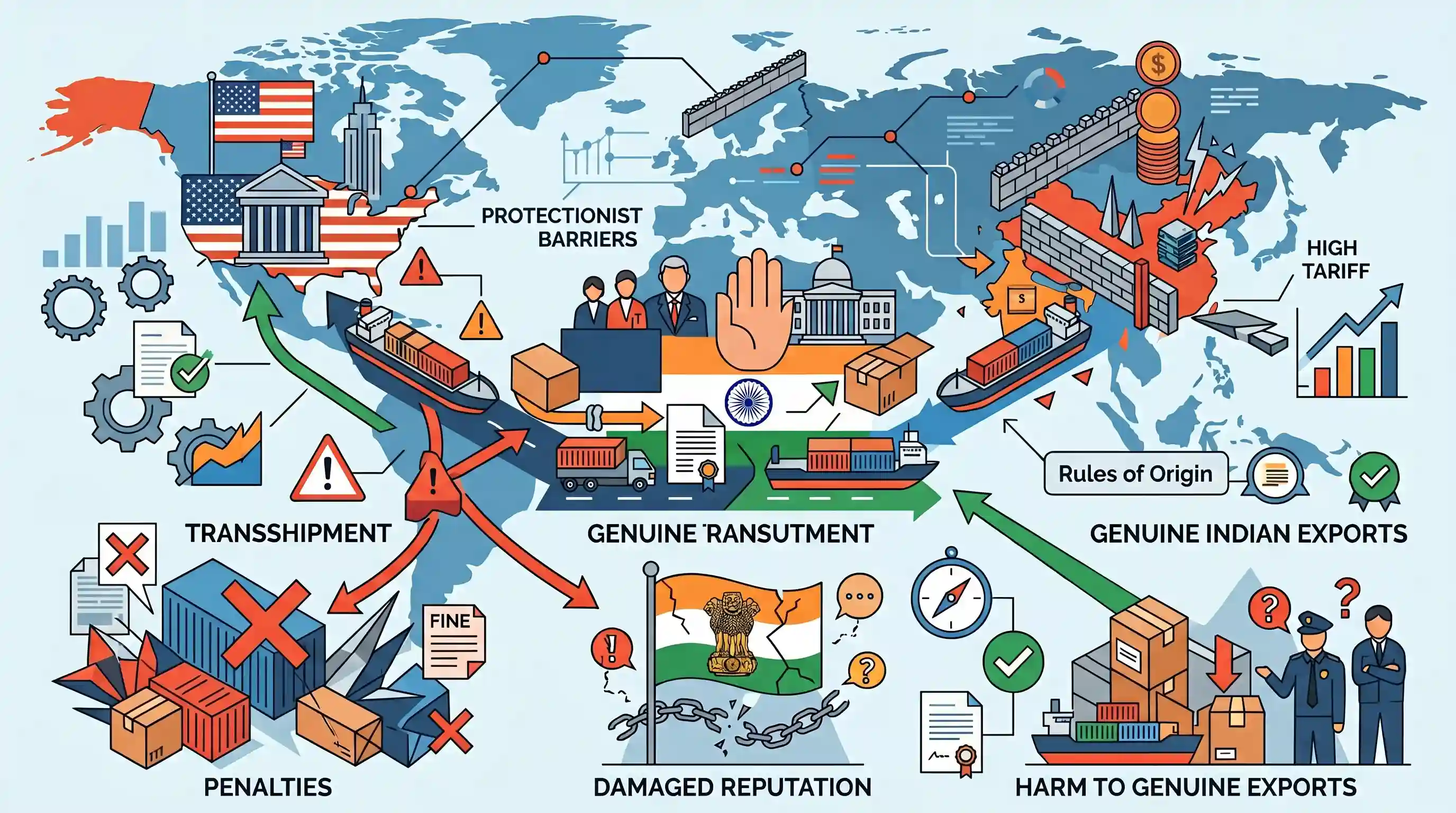
Amidst the intensifying trade war between the US and China, the Indian government has cautioned domestic exporters against participating in the transshipment of third-country goods to the United States. Exporters are warned that diverting goods from countries facing high US tariffs by passing them off as Indian products violates "Rules of Origin" norms. Engaging in such tariff circumvention could invite severe penalties from US authorities, jeopardizing genuine Indian exports and damaging India's reputation as a reliable global supply chain partner in an era of rising global protectionism.
Key Points
- The Indian government has warned domestic exporters against acting as conduits for rerouting third-country goods to the United States to evade high US tariffs.
- Such transshipment practices violate international "Rules of Origin" norms, which require substantial transformation and value addition for goods to legitimately claim Indian origin.
- Engaging in tariff circumvention could invite strict penalties, anti-dumping duties, or enhanced scrutiny from US customs, severely jeopardizing legitimate Indian export businesses.
- The advisory comes amidst an escalating trade war between the US and China, highlighting the growing challenges of global protectionism and strict supply chain monitoring.
Important Terms
Rules of Origin (ROO)

Criteria used to determine the 'economic nationality' of goods. They ensure trade benefits (like lower tariffs under FTAs) apply only to products genuinely manufactured in a specific partner country.
UPSC context
GS Paper 3 (Economy); crucial for understanding Free Trade Agreements (FTAs) and anti-evasion measures like CAROTAR 2020.
Directorate General of Foreign Trade (DGFT)
An attached office of the Ministry of Commerce and Industry responsible for formulating and implementing India’s Foreign Trade Policy (FTP) and issuing Importer-Exporter Codes (IEC).
UPSC context
GS Paper 2 & 3; the primary regulatory body for India's external trade and export promotion.
Ministry of Commerce and Industry
The nodal Union Ministry responsible for formulating trade, investment, and industrial policies. It oversees both the Department of Commerce and the Department for Promotion of Industry and Internal Trade (DPIIT).
UPSC context
GS Paper 2 (Governance); central to India's 'Make in India' and global trade integration strategies.
Transshipment
The practice of re-routing goods through intermediate ports or third countries to disguise their true origin, often used to bypass high tariffs or trade sanctions.
UPSC context
GS Paper 3 (Economy); relevant to global supply chain ethics and the impacts of international trade wars.
Tariff Circumvention
Illegal methods used by exporters to evade import duties or quotas, such as mislabeling a product's country of origin or minor processing in a third country.
UPSC context
GS Paper 3 (Economy); tests knowledge of trade barriers, custom enforcement, and international trade law compliance.
Prelims Trap
"Mere repackaging or assembling of third-country goods in India qualifies them for 'Indian origin' status under WTO."
WTO Rules of Origin strictly require 'substantial transformation' or a minimum threshold of local value addition, not just minor processing, repackaging, or transit.
Static Concepts Connected
What are the 3 major Trade Remedy Measures under the WTO?
- Anti-Dumping Duty (ADD): Imposed on foreign imports priced below their normal domestic market value to protect local industries.
- Countervailing Duty (CVD): Levied to neutralize the negative effects of specific subsidies provided by the exporting country's government to its producers.
- Safeguard Duty: A temporary measure applied when a sudden, unforeseen surge in imports threatens serious injury to domestic producers.
How does India regulate 'Rules of Origin' for imports?
- Concept: Rules of Origin define the economic nationality of a product based on substantial transformation or specific value-addition thresholds.
- CAROTAR 2020: Introduced in 2020, these rules shift the burden of proof to importers, requiring strict due diligence to claim concessional customs duties under FTAs.
Cross-Topic Patterns
China Plus One vs. Transshipment
The temptation to reroute goods mirrors the 'China Plus One' strategy's dark side, where companies bypass tariffs via transit hubs rather than setting up genuine alternative manufacturing bases.
ASEAN FTA and CAROTAR 2020 parallels
India's warning to exporters mirrors its own domestic struggles with Chinese goods flooding in via the ASEAN FTA, which prompted the stringent CAROTAR 2020 rules for importers.

Expect a 2026 Prelims question testing the distinction between Rules of Origin, Anti-Dumping Duties, and Countervailing Duties under WTO.
Linked PYQs · 3
Linked PYQs · 3
- 2025MainsGS3
What are the challenges before the Indian economy when the world is moving away from free trade and multilateralism to protectionism and bilateralism? How can these challenges be met?
- 2018MainsGS2
What are the key areas of reform if the WTO has to survive in the present context of "Trade War', especially keeping in mind the interest of India?
- 2012MainsGS2
Discuss the likely negative impact of the protectionist measures proposed by the US on India's software industry.
