Government Trade Margin Capping on Anti Cancer Drugs
Source:The Hindu ↗
हे का महत्त्वाचे आहे
Directly relates to issues of social justice, inclusive growth, public health administration, and curbing catastrophic health expenditures in India.
सारांश
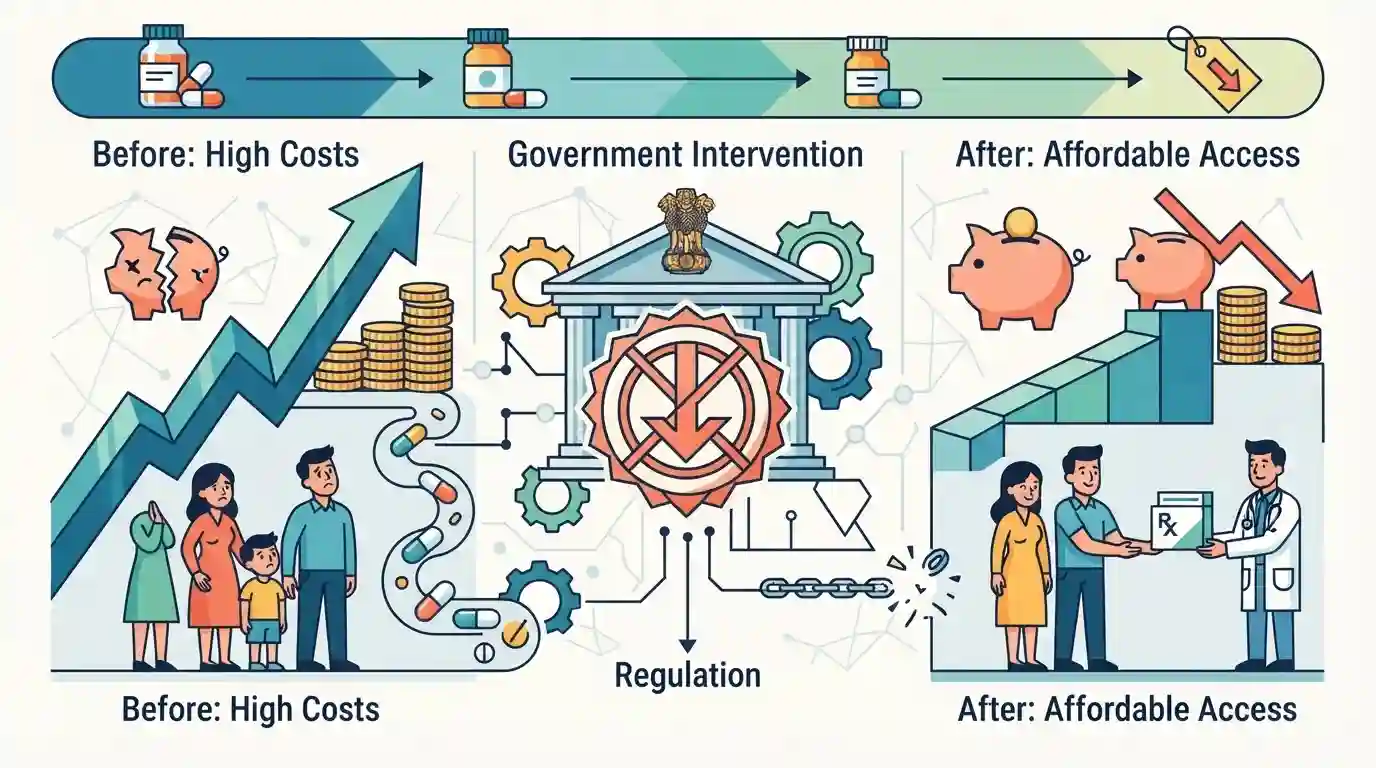
The Indian government has capped trade margins on 137 anti-cancer drugs to significantly reduce treatment costs and curb exorbitant mark-ups in the pharmaceutical supply chain. Implemented via the National Pharmaceutical Pricing Authority (NPPA), this step targets healthcare affordability and aims to ease out-of-pocket expenditure for cancer care.
मुख्य मुद्दे
- The government capped trade margins on 137 anti-cancer drugs under the 'trade margin rationalisation' approach.
- The move aims to make critical life-saving cancer medications more affordable for patients by curbing excessive markups across the supply chain.
- Regulated by the National Pharmaceutical Pricing Authority (NPPA) under the Department of Pharmaceuticals.
- Addresses catastrophic out-of-pocket health expenditure linked to non-communicable diseases like cancer in India.
महत्त्वाच्या संज्ञा
National Pharmaceutical Pricing Authority (NPPA)

An attached office of the Department of Pharmaceuticals, Ministry of Chemicals and Fertilizers, responsible for fixing and revising drug prices and implementing the Drugs (Prices Control) Order in India.
UPSC context
UPSC Prelims/Mains (GS Paper II - Health Policy, Governance): Tests regulatory bodies, price control mechanisms, and accessibility of essential medicines.
Drug Prices Control Order (DPCO)
An order issued under the Essential Commodities Act, 1955, empowering the government to regulate and fix the prices of scheduled and non-scheduled pharmaceutical formulations in the public interest.
UPSC context
UPSC Prelims (Economy/Polity): Evaluates statutory instruments for market intervention, welfare state policies, and regulation of essential commodities.
Ministry of Chemicals and Fertilizers
The Union ministry responsible for formulating policies, regulating prices, and ensuring the availability of fertilizers, chemicals, and pharmaceuticals across India.
UPSC context
UPSC Prelims/Mains (GS Paper II - Governance & Welfare Schemes): Tests administrative jurisdiction over industrial policy and pharmaceutical regulation.
पूर्वपरीक्षा सापळा
NPPA only exercises advisory oversight on drug manufacturers without binding statutory enforcement powers.
The NPPA does not merely monitor prices; it has statutory powers under the DPCO (issued via the Essential Commodities Act) to legally cap trade margins on both scheduled and non-scheduled drugs.
संबंधित स्थिर संकल्पना
What are the statutory powers and structural mandate of the National Pharmaceutical Pricing Authority (NPPA)?
- Parent Body: Established under the Department of Pharmaceuticals, Ministry of Chemicals and Fertilizers, to fix and revise prices of controlled bulk drugs and formulations.
- Legal Backing: Empowered by the Drugs (Prices Control) Order (DPCO), issued under Section 3 of the Essential Commodities Act, 1955.
- Core Mandate: Monitors and enforces price caps, handles drug shortages, and recovers overcharged amounts from pharmaceutical companies violating pricing limits.
आंतर-विषय नमुने
Health Policy + Household Indebtedness Economics
High out-of-pocket health expenditure in India directly fuels chronic household debt, directly linking pharma pricing policy with rural poverty alleviation and social sector vulnerability analysis.
DPCO + Essential Commodities Act Linkages
The NPPA enforces price ceilings through statutory orders under the Essential Commodities Act, linking public health intervention with core food and drug security legislation.

Expect a statement-based prelims question on NPPA powers, DPCO applicability to scheduled vs non-scheduled drugs, and statutory backing.
