Government Caps Trade Margins on Anticancer Drugs
Source:The Hindu ↗
Why It Matters
It directly relates to public healthcare governance, pricing regulation of life-saving drugs by regulatory authorities like the NPPA, and ensuring equitable access to healthcare for vulnerable populations.
Summary
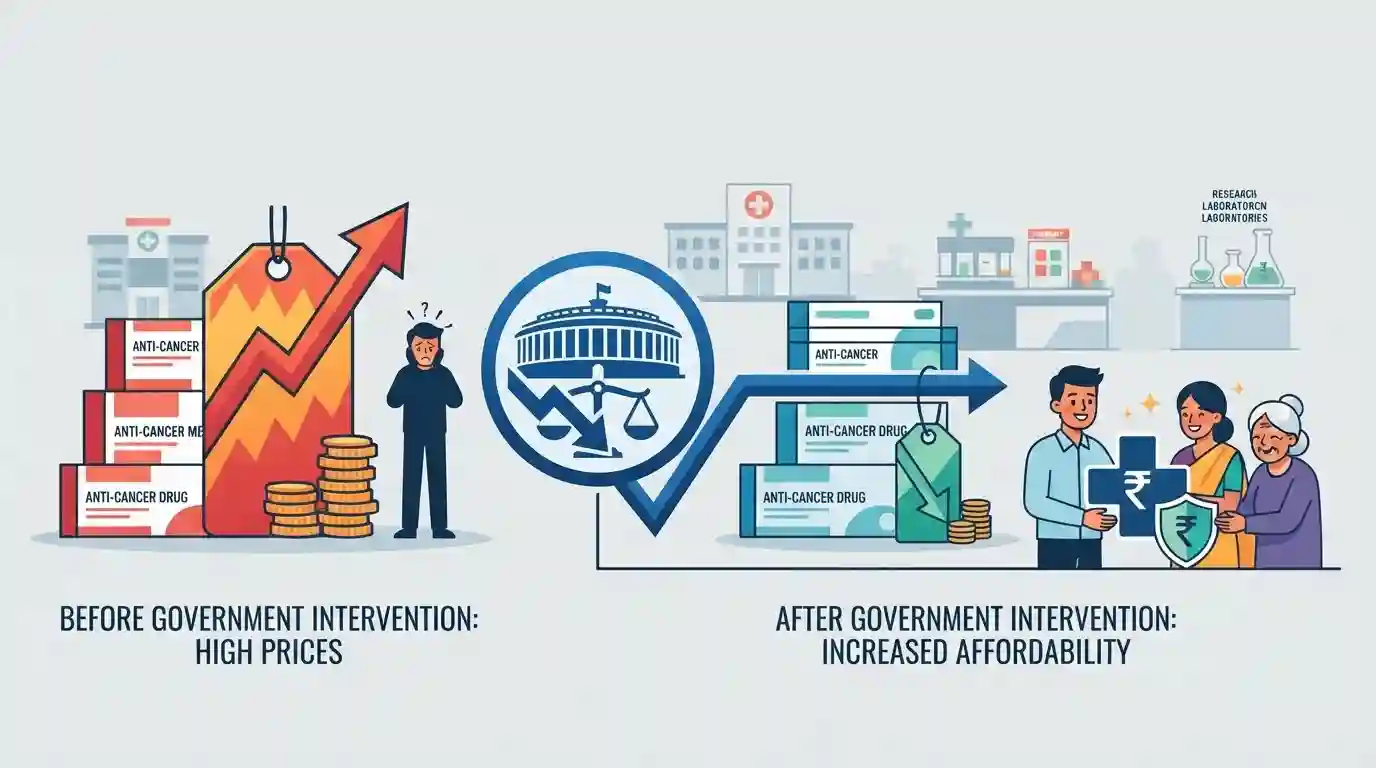
The Indian government has capped trade margins on 137 anti-cancer drugs to curb exorbitant pricing and make critical cancer care therapies more accessible and affordable for patients, addressing the adverse impacts of excessive market markups in the healthcare sector.
Key Points
- The government capped trade margins on 137 anti-cancer drugs to make cancer treatment more affordable.
- This measure targets excessive markups across the supply chain, ensuring relief for patients relying on critical oncology medicines.
- Regulatory bodies like the National Pharmaceutical Pricing Authority (NPPA) play a crucial role in balancing pharmaceutical marketization with public health welfare.
Important Terms
National Pharmaceutical Pricing Authority

A statutory body under the Ministry of Chemicals and Fertilizers responsible for fixing and revising drug prices and enforcing the Drugs (Prices Control) Order in India.
UPSC context
GS Paper II & III: Health policy, regulation of essential medicines, and government interventions to ensure affordable healthcare access.
Trade Margin
The percentage difference between the purchase price of a drug (at the stockist level) and its Maximum Retail Price (MRP), often regulated to curb exorbitant markups.
UPSC context
GS Paper III: Indian Economy and pricing policies affecting affordability of critical healthcare and pharmaceutical products.
Static Concepts Connected
What are the statutory powers and functions of the National Pharmaceutical Pricing Authority (NPPA) in India?
- Establishment: Established in 1997 as an independent body of the Department of Pharmaceuticals, Ministry of Chemicals and Fertilizers.
- Price Control: Entrusted with fixing and revising prices of scheduled formulations under the Drugs (Prices Control) Order (DPCO).
- Monitoring Role: Empowered to monitor the prices of decontrolled (non-scheduled) drugs and implement Trade Margin Rationalisation.
Cross-Topic Patterns
Pharma Price Control vs. Competition Law
Measures to curb excessive drug markups connect public health with competition law, testing the balance between market incentives for pharma R&D and consumer protection under welfare mandates.

NPPA's power over scheduled vs. non-scheduled drugs under DPCO is a classic statement-trap area for UPSC Prelims.
Linked PYQs · 1
Linked PYQs · 1
- 2024MainsGS2
In a crucial domain like the public healthcare system the Indian State should play a vital role to contain the adverse impact of marketisation of the system. Suggest some measures through which the State can enhance the reach of public healthcare at the grassroots level.
