Delimitation and Women Reservation Rollout in Parliament
Source:Indian Express ↗
Why It Matters
Understanding delimitation and the implementation of women's reservation is critical for GS2 Governance and Polity, as it directly alters the federal equilibrium, electoral geography, and gender representation in India's highest legislative bodies.
Summary
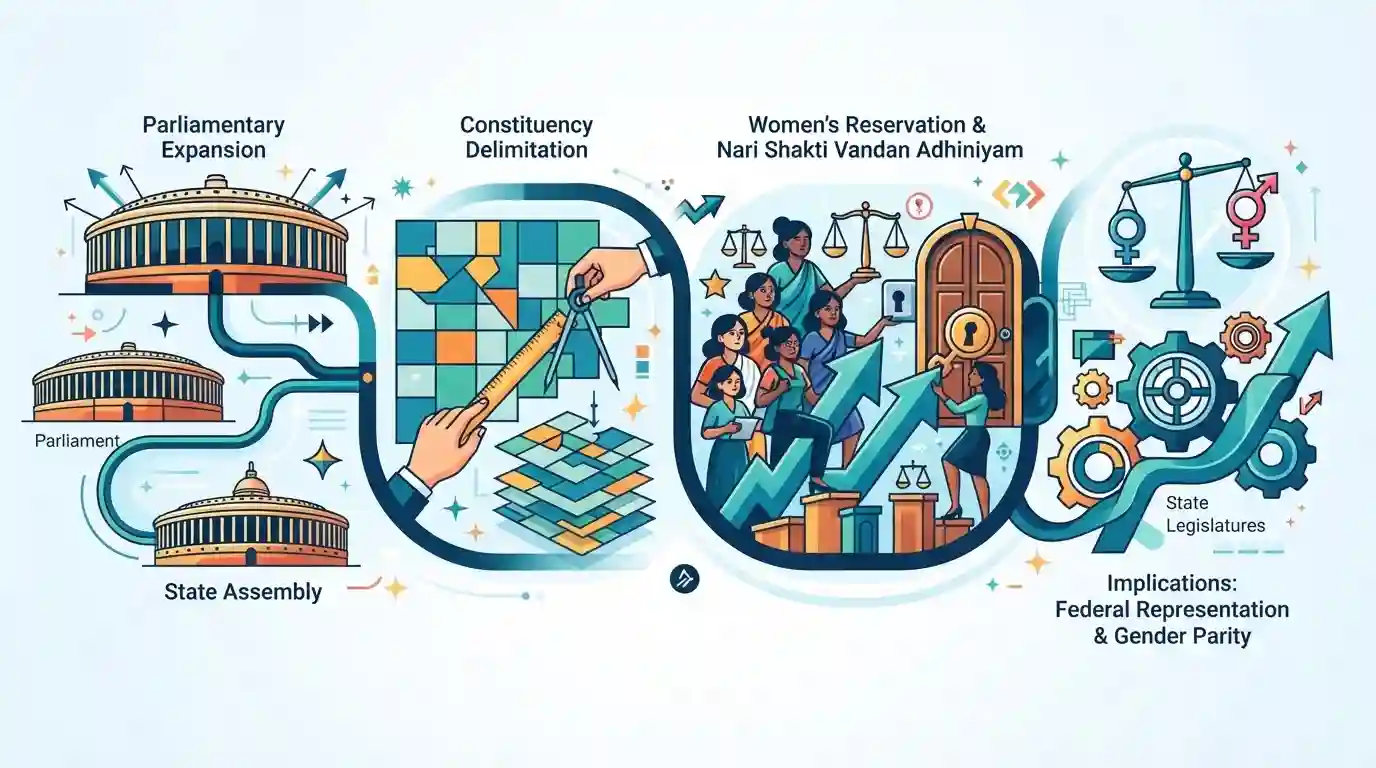
The article discusses the government's upcoming rollout of crucial legislative reforms including constituency delimitation and the implementation of the women's reservation quota under the Nari Shakti Vandan Adhiniyam, highlighting implications for federal representation, gender parity, and parliamentary expansion.
Key Points
- The Indian government is preparing to roll out major legislative and constitutional exercises, including delimitation and the implementation of the women's reservation quota.
- The delimitation process will redraw parliamentary constituencies based on updated census data, impacting regional representation.
- The implementation of the Nari Shakti Vandan Adhiniyam (Women's Reservation Act) will reserve one-third of seats in the Lok Sabha and state legislative assemblies for women.
- These overlapping structural changes raise significant questions regarding federal balance, population-based representation, and gender equity in Indian governance.
Important Terms
Nari Shakti Vandan Adhiniyam

The Constitution (106th Amendment) Act, 2023, which mandates a one-third reservation for women in the Lok Sabha and State Legislative Assemblies, to be implemented after the next census and delimitation.
UPSC context
GS Paper 2 (Polity & Governance - Women Empowerment): Tests understanding of legislative measures for gender parity and inclusive governance in India.
Delimitation Commission
A statutory body established by an Act of Parliament to redraw electoral constituency boundaries based on the latest census data to ensure equal representation.
UPSC context
GS Paper 2 (Indian Constitution and Polity): Tests knowledge of statutory bodies, federal representation, and electoral reforms.
Delimitation Act
Legislation enacted by Parliament to set up a Delimitation Commission for redrawing parliamentary and assembly constituency boundaries following census updates.
UPSC context
GS Paper 2 (Parliament and State Legislatures): Tests the legal and procedural framework governing constituency demarcation and federal balance.
Parliament of India
India’s bicameral supreme legislative body consisting of the President, the Lok Sabha, and the Rajya Sabha, responsible for law-making and national representation.
UPSC context
GS Paper 2 (Structure, Functioning, and Conduct of Business): Core topic testing legislative powers, accountability, and parliamentary democracy.
Prelims Trap
The Nari Shakti Vandan Adhiniyam immediately reserves one-third of Lok Sabha seats in the ongoing parliamentary term.
Aspirants often assume the Nari Shakti Vandan Adhiniyam is already operational in Parliament, but its implementation is legally contingent upon the completion of the first census after 2026 and subsequent delimitation.
Static Concepts Connected
What are the constitutional provisions and legal status governing the Delimitation Commission in India?
- Constitutional Basis: Constitutional basis: Under Articles 82 and 170, Parliament enacts a Delimitation Act after every census to readjust Lok Sabha and Assembly seats.
- Composition: Appointment & Composition: Appointed by the President of India, working in collaboration with the Election Commission of India.
- Judicial Bar: Judicial finality: Orders issued by the Delimitation Commission have the force of law and cannot be questioned in any court under any circumstances.
- Seat Freeze: Seat freeze history: Seat counts were frozen based on the 1971 census via the 42nd (1976) and 84th (2002) amendments to prevent penalizing population-control states.
Cross-Topic Patterns
Delimitation vs. Federal Fiscal & Political Equity
Delimitation based on post-2026 census data risks widening the legislative seat imbalance between southern states that controlled population growth and northern states with higher growth rates.
Women's Reservation & Constitutional Amendment Complexity
The Constitution 106th Amendment links women's reservation directly to post-delimitation census data, creating a multi-layered procedural dependency unseen in prior amendments.

Expect statement-based Qs linking the 106th Amendment's operational trigger to post-2026 census delimitation and Article 82 finality.
Linked PYQs · 2
Linked PYQs · 2
- 2024PrelimsGS1
How many Delimitation Commissions have been constituted by the Government of India till December 2023?
- 2023MainsGS2
Discuss the contribution of civil society groups for women's effective and meaningful participation and representation in state legislatures in India.
