Dharavi slum redevelopment master plan and public private partnership
Source:Indian Express ↗
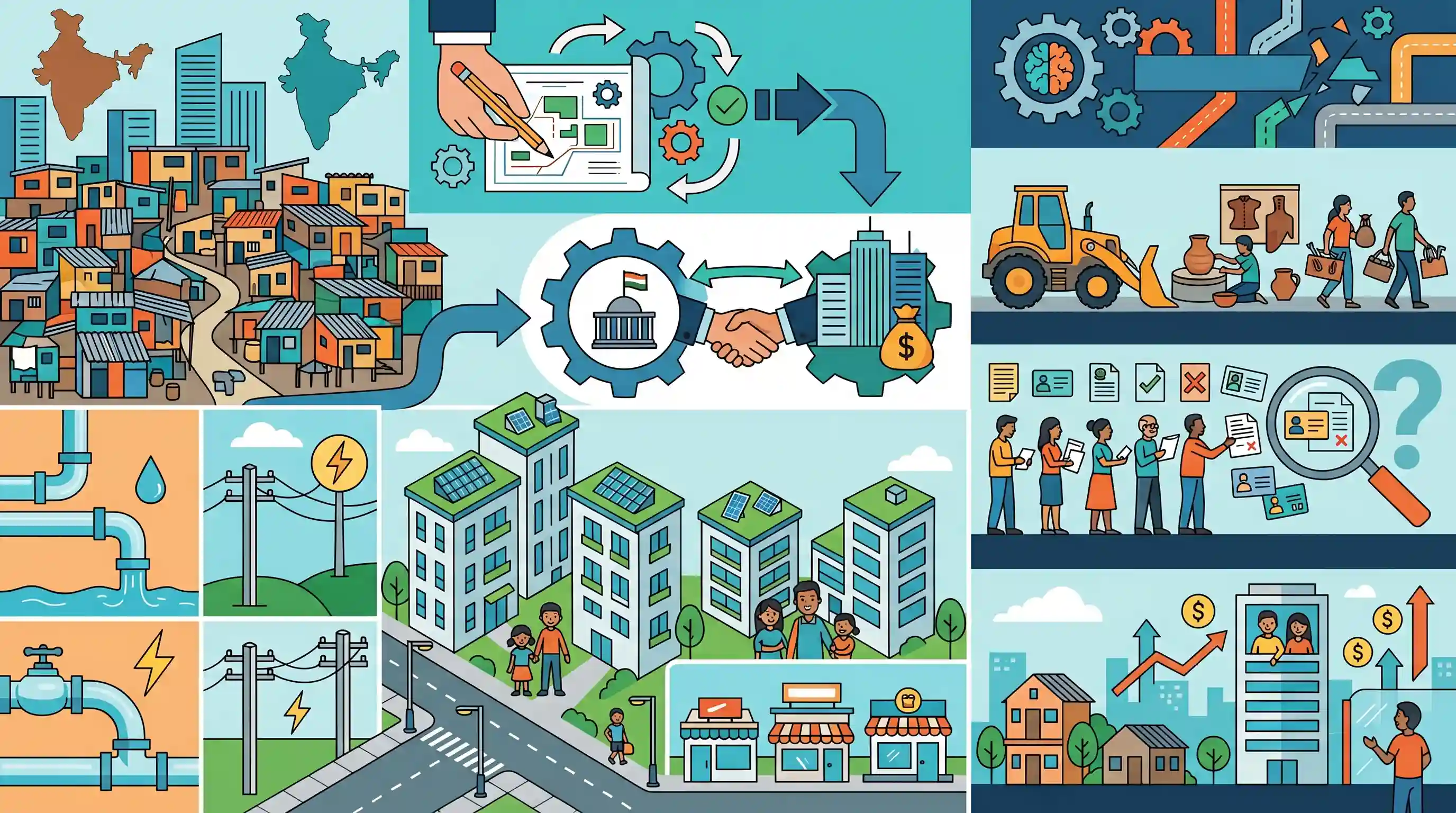
Why It Matters
The redevelopment of Dharavi serves as a crucial case study for India's urbanization challenges. It highlights the complexities of integrating informal settlements into formal city planning, the socio-economic impacts on the urban poor, and the efficacy of PPP models in executing large-scale, long-gestation infrastructure and housing projects.
Summary
The government has officially approved the master plan for the Dharavi Redevelopment Project, paving the way for the revamp of one of Asia's largest slums located in Mumbai. The ambitious urban renewal initiative will utilize a Public-Private Partnership (PPP) model to provide formal housing, improved civic infrastructure, and commercial spaces to current residents and businesses. While the project is set to unlock prime real estate and improve living standards, it also presents complex socio-economic challenges, including the displacement of informal industries, resident eligibility verification, and the broader implications of urban gentrification.
Key Points
- The state government has approved the master plan for the massive Dharavi Redevelopment Project (DRP) in Mumbai.
- The project aims to transform one of Asia's largest informal settlements into a planned urban area with modern housing, infrastructure, and commercial spaces.
- It involves a massive rehabilitation exercise to provide formal housing to thousands of eligible slum dwellers and businesses.
- The redevelopment relies heavily on the Public-Private Partnership (PPP) model to fund and execute the large-scale urban renewal.
- Key challenges involve verifying resident eligibility, managing the transition of thriving informal micro-industries, and preventing the marginalization of the urban poor.
Important Terms
Dharavi Redevelopment Project (DRP)

A major urban renewal initiative to transform Mumbai's Dharavi slum into an integrated township with formal housing, infrastructure, and commercial spaces.
UPSC context
GS Paper 1 (Urbanization); GS Paper 3 (Infrastructure). Tests knowledge of urban renewal and slum rehabilitation strategies.
Slum Rehabilitation Authority (SRA)
A statutory body established by the Maharashtra government to plan and implement slum redevelopment schemes and provide formal housing to slum dwellers.
UPSC context
GS Paper 2 (Governance/Statutory Bodies). Relevant for questions on institutional frameworks for urban development.
Special Purpose Vehicle (SPV)
A legal entity created for a specific, limited purpose—often to manage a project like DRP to isolate financial risk and facilitate joint ventures.
UPSC context
GS Paper 3 (Investment Models). Tests understanding of project financing and public-private implementation structures.
Public-Private Partnership (PPP) Model
A collaborative arrangement between a government agency and a private sector company to finance, build, and operate public infrastructure.
UPSC context
GS Paper 3 (Investment Models). A core concept in infrastructure development and resource mobilization.
Transferable Development Rights (TDR)
A market-based mechanism allowing developers to use or sell additional construction rights in exchange for rehabilitating slums or preserving heritage.
UPSC context
GS Paper 3 (Urban Planning/Infrastructure). Relevant for understanding land use policy and incentive-based urban development.
Prelims Trap
"Under in-situ slum redevelopment, all current residents are guaranteed free formal housing."
Eligibility relies strictly on state-mandated domicile cut-off dates and documentary proof. Newer or undocumented migrants are excluded and often displaced, rather than rehabilitated.
Static Concepts Connected
What are FSI and TDR in urban redevelopment projects?
- FSI (Floor Space Index): Ratio of total built-up area to plot size. Granting higher FSI incentivizes private developers to undertake financially heavy slum rehabilitation.
- TDR (Transferable Development Rights): Certificates allowing developers who surrender land for public use/rehabilitation to build additional floors elsewhere or sell these development rights.
- Cross-subsidization: Profits from the commercial sale of extra FSI/TDR are used by developers to fund the construction of free housing for slum dwellers.
What is In-Situ Slum Redevelopment (ISSR) under PMAY-Urban?
- Land as Resource: Utilizes the high-value underlying land of existing urban slums to attract private sector participation and capital.
- Financial Viability: Developers recover the cost of providing free slum housing by commercially developing the remaining unlocked prime land.
- Central Assistance: The Centre provides a standard rehabilitation assistance of ₹1 lakh per house to states/UTs to supplement the private developer's effort.
Cross-Topic Patterns
Informal Economy vs. Urban Gentrification
Formal redevelopment often dismantles unzoned informal micro-industries (like Dharavi's recycling and leather hubs), severing the crucial link between urban housing and established livelihood networks.
Swiss Challenge and PPP Bidding
Mega urban redevelopment projects often utilize the Swiss Challenge bidding method to maximize private capital, linking GS1 urbanization with GS3 infrastructure investment models.

Mains 2026: Expect a GS1/GS3 question evaluating if PPP-led mega slum redevelopments destroy informal micro-economies in metropolises.
Linked PYQs · 5
Linked PYQs · 5
- 2023MainsGS1
Does urbanization lead to more segregation and/or marginalization of the poor in Indian metropolises?
- 2025MainsGS1
How does smart city in India, address the issues of urban poverty and distributive justice?
- 2022MainsGS3
Why is Public Private Partnership (PPP) required in infrastructural projects ? Examine the role of PPP model in the redevelopment of Railway Stations in India.
- 2014MainsGS3
Explain how Private Public Partnership arrangements, in long gestation infrastructure projects, can transfer unsustainable liabilities to the future. What arrangements need to be put in place to ensure that successive generations' capacities are not compromised?
- 2013MainsGS3
Adoption of PPP model for infrastructure development of the country has not been free of criticism. Critically discuss pros and cons of the model.
