Parliamentary Winter Session Duration and Legislative Accountability
Source:Indian Express ↗
Why It Matters
The declining number of parliamentary sitting days is a critical issue for GS Paper 2. It directly impacts the quality of law-making, the efficacy of Parliamentary Committees, and the fundamental democratic principle of holding the executive accountable to the legislature. This trend is frequently tested in UPSC Mains concerning the functioning and decline of the Indian Parliament.
Summary
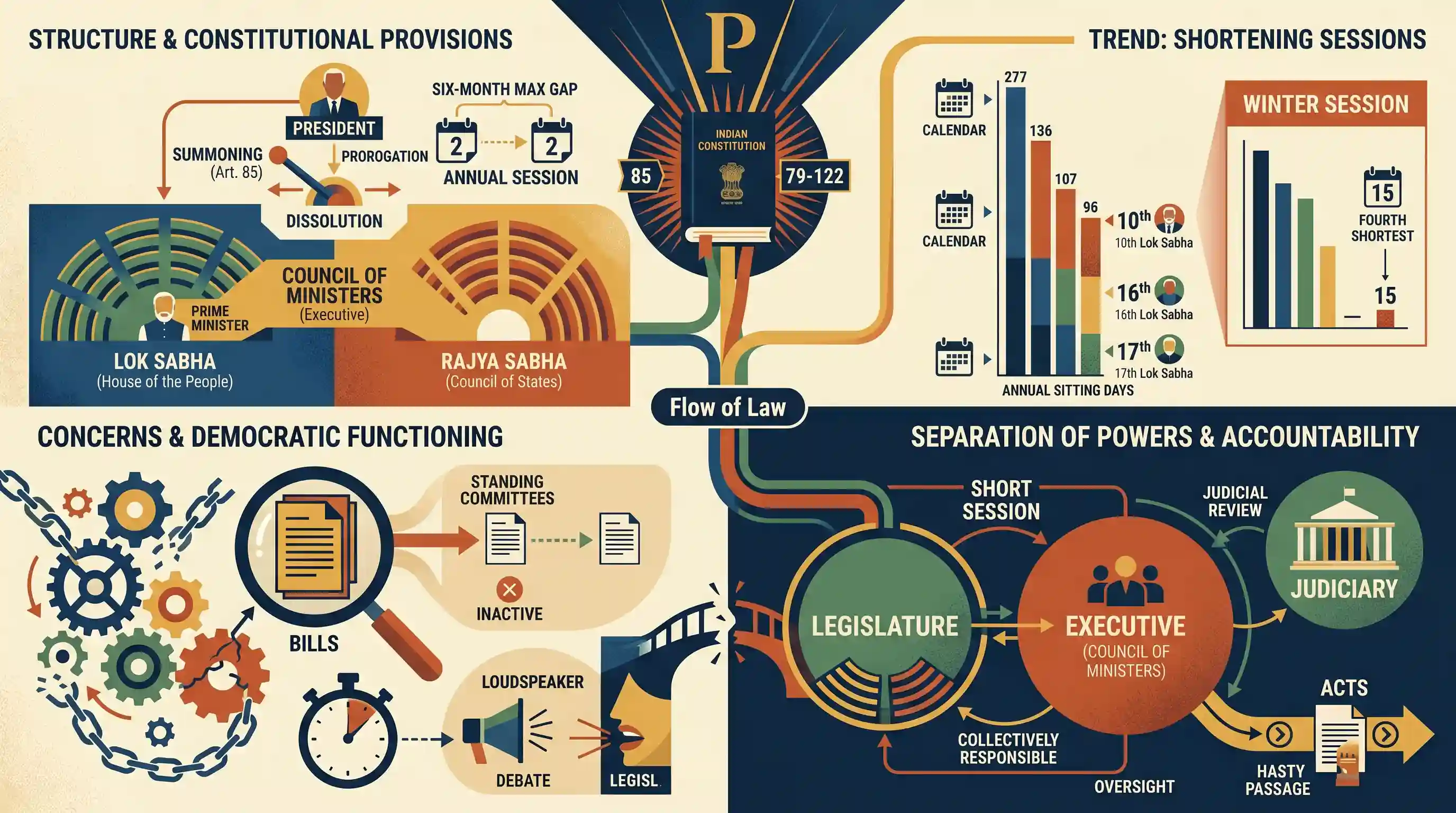
The Union Government has announced a 15-day Winter Session for Parliament, making it the fourth shortest Winter Session during Prime Minister Narendra Modi's tenure. The persistent shortening of parliamentary sessions has raised substantial concerns among constitutional experts and the opposition over reduced legislative scrutiny, limited time for substantive debates, and the weakening of executive accountability to the legislature. While the Constitution does not mandate a minimum number of sitting days, the declining duration of sessions often results in the hasty passage of bills without adequate committee review.
Key Points
- The Union Government has announced that the upcoming Winter Session of Parliament will run for a brief duration of just 15 days.
- This upcoming session is set to be the fourth shortest Winter Session convened under the Modi administration.
- Under Article 85 of the Indian Constitution, the President summons Parliament sessions, with the only condition being that the gap between two consecutive sessions must not exceed six months. There is no constitutionally mandated minimum number of sitting days.
- A continued trend of abbreviated parliamentary sessions has led to concerns regarding weakened legislative scrutiny and the bypassing of Parliamentary Standing Committees.
- The reduction in sitting days compromises the Parliament's ability to effectively debate national issues and hold the executive accountable, a core tenet of parliamentary democracy.
Important Terms
Article 85

Constitutional provision empowering the President to summon, prorogue, and dissolve Parliament. It mandates that no more than six months shall intervene between two consecutive sessions of the House.
UPSC context
GS Paper 2: Parliament and State Legislatures. Tests knowledge of constitutional mandates and executive powers regarding legislative functioning.
Cabinet Committee on Parliamentary Affairs (CCPA)
An extra-constitutional body responsible for recommending the dates for summoning and proroguing Parliament. It manages the government's legislative agenda and floor strategy.
UPSC context
GS Paper 2: Executive and Ministries/Departments. Essential for understanding how the executive controls the legislative calendar.
Executive Accountability
A constitutional principle (Article 75) ensuring the Council of Ministers remains responsible to the Lok Sabha. It is enforced through Question Hour, debates, and motions.
UPSC context
GS Paper 2: Separation of Powers and Constitutional Governance. Core concept for Mains questions on the weakening of parliamentary oversight.
Winter Session
The final of the three annual conventions (with Budget and Monsoon sessions) usually held in November-December. It serves to clear legislative backlogs and review government performance.
UPSC context
GS Paper 2: Conduct of Business. Relevant for discussing the declining duration of sessions and its impact on democracy.
Parliamentary Standing Committees
Permanent panels of MPs from both Houses that provide detailed scrutiny of bills, budgets, and department policies, ensuring specialized legislative oversight.
UPSC context
GS Paper 2: Parliamentary Committees. Tests understanding of the "Mini-Parliament" concept and the consequences of bypassing committee review.
Indian Parliament
The supreme legislative body of India (Articles 79-122), consisting of the President, Lok Sabha (Lower House), and Rajya Sabha (Upper House).
UPSC context
GS Paper 2: Structure and Functioning. Foundational knowledge for all polity-related topics in Prelims and Mains.
Prelims Trap
The Constitution of India mandates a minimum number of parliamentary sittings per year.
Article 85 only dictates that the gap between two sessions cannot exceed six months. It neither names the sessions nor prescribes a minimum duration.
Static Concepts Connected
What is the constitutional framework for convening Parliament sessions?
- Article 85: Empowers the President to summon both Houses; the only restriction is a maximum six-month gap between sessions.
- CCPA's Role: The Cabinet Committee on Parliamentary Affairs (CCPA) actually decides the session dates, advising the President.
- No Minimum Days: India lacks a constitutional minimum for sitting days, despite NCRWC recommendations (120 days for Lok Sabha).
How does bypassing Standing Committees impact legislative scrutiny?
- DRPSCs Function: Department-Related Parliamentary Standing Committees examine bills in detail, away from partisan cameras, ensuring technical soundness.
- Hasty Legislation: Shorter sessions mean bills are passed without committee referral, directly reducing executive accountability and stakeholder consultation.
Cross-Topic Patterns
Ordinances vs Short Sessions
Reduced parliamentary sittings are frequently correlated with an increased reliance on executive ordinance-making (Article 123), bypassing the legislature entirely.
Subordinate Legislation blind spots
When primary bills are rushed through short sessions, excessive rule-making powers are delegated to the executive without adequate parliamentary oversight.

A Prelims question mixing Article 85, the role of CCPA in summoning, and the lack of mandated minimum sitting days is highly probable in 2026.
Linked PYQs · 3
Linked PYQs · 3
- 2020PrelimsGS1
Consider the following statements: 1. The President of India can summon a session of the Parliament at such place as he/she thinks fit. 2. The Constitution of India provides for three sessions of the Parliament in a year, but it is not mandatory to conduct all three sessions. 3. There is no minimum number of days that the Parliament is required to meet in a year. Which of the statements given above is/are correct?
- 2019MainsGS2
Individual Parliamentarian's role as the national law maker is on a decline, which in turn, has adversely impacted the quality of debates and their outcome. Discuss.
- 2021MainsGS2
To what extent, in your view, the Parliament is able to ensure accountability of the executive in India?
