AI Intervention and Smart Infrastructure for Two-Wheeler Safety
Source:Indian Express ↗
Why It Matters
Road safety is a critical infrastructure and public health challenge in India. The application of emerging technologies like AI to solve real-world governance issues—specifically curbing high two-wheeler fatalities—is highly relevant for GS-3 (Science & Tech and Infrastructure) and demonstrates the practical utility of technology in public administration.
Summary
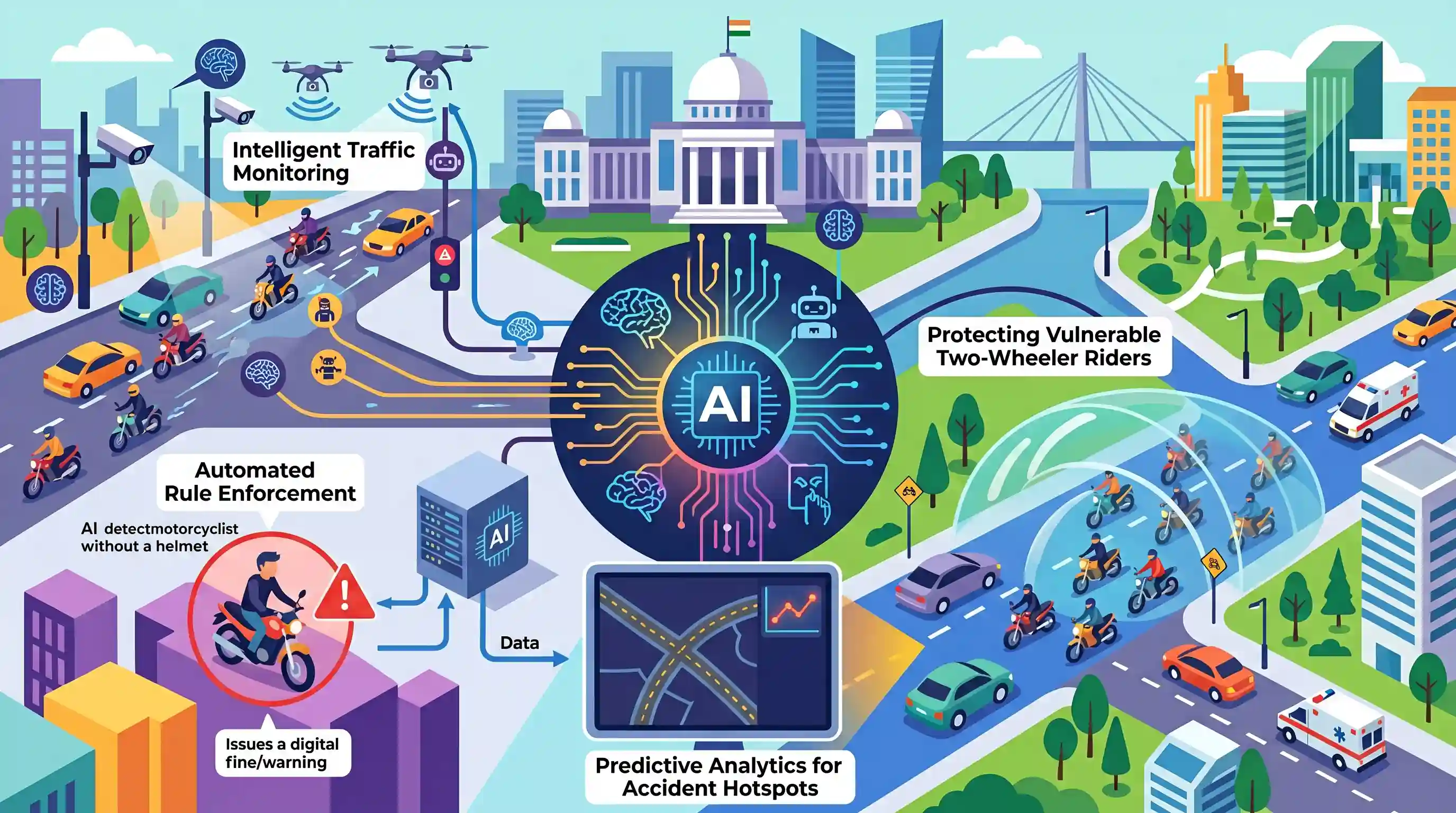
The government is considering the integration of Artificial Intelligence (AI) to address the severe issue of two-wheeler accidents, which account for tens of thousands of deaths annually in India. Discussed at the AI Impact Summit, the proposed AI interventions aim to shift the focus from predominantly car-centric road safety measures to protecting vulnerable two-wheeler riders. Potential applications include intelligent traffic monitoring, automated rule enforcement, and predictive analytics for accident hotspots. This initiative reflects a broader push to leverage emerging technologies for public safety and effective governance in managing infrastructure.
Key Points
- The government is exploring Artificial Intelligence (AI) interventions to mitigate two-wheeler accidents, aiming to address approximately 35,000 fatalities annually.
- Current road safety frameworks are criticized for being heavily car-centric, often overlooking the vulnerabilities of two-wheeler riders who form a major portion of Indian traffic.
- AI technology could be deployed for automated helmet and traffic rule enforcement, predictive analytics to identify accident hotspots, and intelligent traffic management systems.
- The initiative was discussed at the AI Impact Summit, highlighting the increasing role of emerging technologies in governance and public infrastructure safety.
Important Terms
Intelligent Transport Systems (ITS)

Advanced applications integrating Information and Communication Technology (ICT) into transport management to improve safety, efficiency, and sustainability of road networks.
UPSC context
GS Paper III (Infrastructure); tests understanding of modernizing transport and technological interventions in public safety.
Project iRASTE
A collaborative project (Intel, IIIT-H, CSIR-CRRI) leveraging AI and ADAS to predict risks and reduce accidents in Indian cities by identifying high-risk locations.
UPSC context
GS Paper III (Science & Tech/Infrastructure); case study for AI-led governance and 'Safe Systems' approach.
Vulnerable Road Users (VRUs)
Road users lacking structural protection, primarily pedestrians, cyclists, and two-wheeler riders, who account for over 60% of India’s road fatalities.
UPSC context
GS Paper III (Infrastructure); critical for inclusive urban planning and targeted road safety policies.
Blackspots and Greyspots
'Blackspots' are accident-prone sites identified from historical data; 'Greyspots' are potential high-risk areas identified through AI-driven predictive analysis before accidents occur.
UPSC context
GS Paper III (Disaster Management/Infrastructure); highlights data-driven preventive measures in public safety.
Advanced Driver Assistance Systems (ADAS)
Electronic systems in vehicles using sensors (radar, cameras) to provide real-time alerts or automated actions (like collision avoidance) to assist drivers.
UPSC context
GS Paper III (Science & Technology); focuses on emerging technologies and their socio-economic impact.
Vision Zero
A global strategy and national goal aiming to eliminate all road traffic fatalities and serious injuries through safe system design and technology.
UPSC context
GS Paper III (Infrastructure/Public Safety); pertains to India's target of 50% reduction in road deaths by 2030.
India AI Impact Summit
A national forum organized by the Government and IIT Madras to explore integrating Artificial Intelligence into governance, infrastructure, and public safety frameworks.
UPSC context
GS Paper II (Governance); showcases technology-led administrative reforms and 'Vikshit Bharat' 2047 goals.
Vehicle-to-Vehicle (V2V) Communication
The exchange of real-time data between vehicles regarding speed and position to help drivers avoid collisions, particularly in two-wheeler safety.
UPSC context
GS Paper III (Science & Tech); tests knowledge of IoT and digital infrastructure in public safety.
Prelims Trap
The Brasilia Declaration mandates zero road traffic fatalities globally by 2030.
The Brasilia Declaration and UN SDG 3.6 aim to *halve* global deaths and injuries from road traffic accidents by 2030, not eliminate them entirely.
Static Concepts Connected
What is the '4E' framework for road safety adopted by the Indian Government?
- Engineering: Improving road and vehicle design to eliminate blackspots and structural hazards.
- Enforcement: Strict implementation of traffic rules, aided by electronic monitoring and automated e-challans.
- Education: Generating widespread public awareness regarding traffic rules and safe driving practices.
- Emergency Care: Enhancing post-crash response and trauma care systems during the critical 'golden hour'.
What are key provisions of the Motor Vehicles (Amendment) Act, 2019?
- Electronic Enforcement: Mandates state governments to ensure electronic monitoring and enforcement of road safety rules.
- Good Samaritans: Protects individuals rendering emergency medical or non-medical care from civil or criminal liability.
- Golden Hour: Provides a scheme for cashless treatment of road accident victims during the first hour post-trauma.
- Automated Fitness Testing: Requires mandatory automated fitness testing for transport vehicles to reduce corruption and human intervention.
Cross-Topic Patterns
AI in Public Infrastructure & Smart Cities
The use of predictive analytics (like Project iRASTE) merges GS3 tech applications with GS1 urban planning, showcasing a shift from reactive to proactive governance in smart cities.
SDG 3.6 and International Declarations
India's domestic technological interventions in road safety are directly tied to achieving UN SDG 3.6 and obligations under the Brasilia Declaration to halve traffic fatalities.

Expect a Mains question on how emerging tech (AI, IoT) transforms urban governance, specifically citing road safety and Project iRASTE.
Linked PYQs · 2
Linked PYQs · 2
- 2023MainsGS3
Introduce the concept of Artificial Intelligence (AI). How does Al help clinical diagnosis? Do you perceive any threat to privacy of the individual in the use of Al in healthcare?
- 2024MainsGS3
What is the technology being employed for electronic toll collection on highways? What are its advantages and limitations? What are the proposed changes that will make this process seamless? Would this transition carry any potential hazards?
