Government proposes strict takedown deadline for AI content
Source:Indian Express ↗
Why It Matters
Deepfakes and AI-generated misinformation represent significant contemporary security challenges. This swift regulatory response highlights the evolving nature of digital governance and the necessity to balance technological advancement with robust checks to protect national security and citizens' rights.
Summary
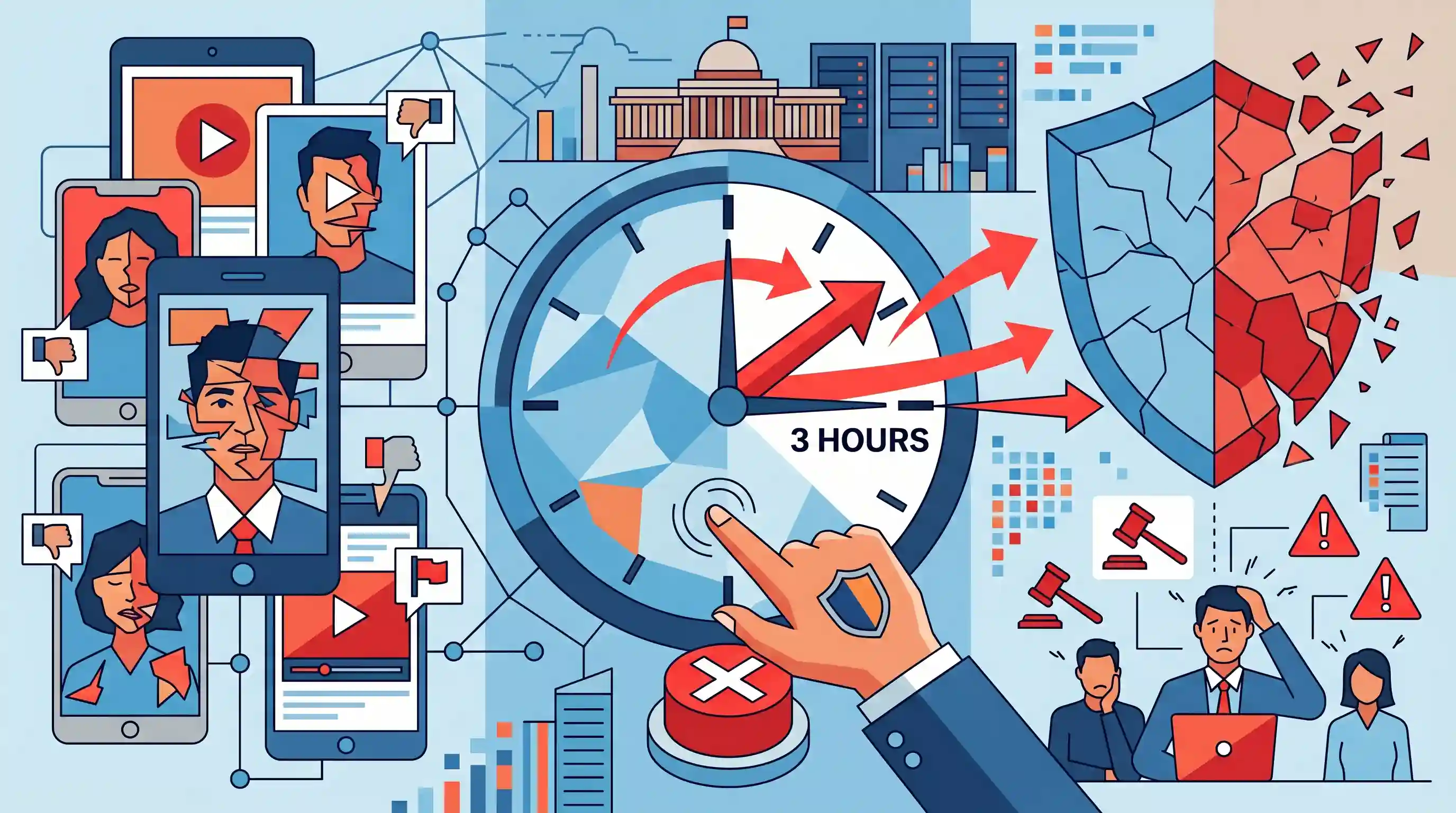
The Union Government has proposed amending the Information Technology (IT) Rules to mandate a strict three-hour deadline for social media platforms and internet intermediaries to take down flagged AI-generated content, including deepfakes. This significantly shortened compliance window addresses the rapid spread of synthetic media that threatens individual privacy, electoral integrity, and public order. Platforms failing to meet this deadline risk losing their 'safe harbour' immunity under Section 79 of the Information Technology Act, which currently protects them from legal liability for user-generated content.
Key Points
- The government is proposing a stringent three-hour deadline for social media platforms to remove flagged AI-generated content and deepfakes.
- This regulatory move aims to curb the rapid viral spread of malicious synthetic media that poses threats to privacy, public order, and democratic processes.
- The measure involves amending the existing IT Rules to specifically address the challenges brought about by generative AI.
- Failure to comply with the takedown timeline could result in internet platforms losing their 'safe harbour' protection under Section 79 of the IT Act, exposing them to legal liabilities.
Important Terms
Information Technology Act, 2000

India's primary law for electronic governance and cyber activities. It provides the legal framework for cybersecurity, electronic records, and digital signatures while governing intermediary liability.
UPSC context
GS Paper III: Cyber Security/Internal Security. Essential for understanding India's legal response to digital crimes and platform regulation.
IT Rules (Intermediary Guidelines & Digital Media Ethics Code)
Delegated legislation under the IT Act that mandates 'due diligence' for digital platforms. Recent amendments (2026) introduced strict 3-hour takedown windows for deepfakes and AI-generated content.
UPSC context
GS Paper II: Government Policies. Tests knowledge of regulatory frameworks for social media and digital ethics.
Safe Harbour
Legal immunity granted to intermediaries under Section 79 of the IT Act. It protects platforms from liability for third-party content provided they follow government-mandated due diligence.
UPSC context
GS Paper III: Cyber Security. Crucial for understanding the balance between platform responsibility and freedom of expression.
Ministry of Electronics and Information Technology (MeitY)
The nodal central ministry responsible for IT policy, electronics manufacturing, and internet governance in India. It notifies the IT Rules and coordinates AI safety initiatives.
UPSC context
GS Paper II: Statutory/Regulatory bodies. Relevant for questions on digital governance and institutional frameworks.
Synthetically Generated Information (SGI)
A formal legal term for AI-generated media (audio/video) that appears authentic. The IT Rules now require such content to be labeled to prevent misinformation.
UPSC context
GS Paper III: Science & Technology (AI). Key term for discussing the regulation of deepfakes and generative AI.
Intermediary
An entity that stores, transmits, or provides access to electronic records on behalf of others. Includes social media platforms, search engines, and internet service providers.
UPSC context
GS Paper II/III: Technology regulation. Defines the subjects of digital accountability and legal compliance in India.
Prelims Trap
Section 79 of the IT Act provides unconditional safe harbour immunity to internet intermediaries.
Immunity is strictly conditional. Platforms automatically lose protection if they fail to observe due diligence or ignore government-mandated takedown timelines for unlawful content.
Static Concepts Connected
What is the "Safe Harbour" principle under Section 79 of the IT Act?
- Conditional immunity: Protects internet intermediaries from direct legal liability for third-party, user-generated content hosted on their platforms.
- Due diligence requirement: Platforms must act merely as conduits, without initiating or modifying the content, and strictly observe government guidelines.
- Revocation of protection: Immunity is lost if intermediaries fail to expeditiously remove unlawful content upon receiving actual knowledge via court or government orders.
How do Generative Adversarial Networks (GANs) function to create deepfakes?
- Dual architecture: Utilizes two competing neural networks—a Generator and a Discriminator—working in opposition to continuously improve AI output.
- The Generator: Produces artificial data, such as fabricated audio or video, attempting to flawlessly mimic real-world datasets.
- The Discriminator: Evaluates the generated media against real data, forcing the Generator to relentlessly refine the fakes until they are indistinguishable from reality.
Cross-Topic Patterns
Deepfakes + Election Corrupt Practices
The intersection of AI deepfakes during campaigns links to Section 123 of the Representation of the People Act (corrupt practices) and the Election Commission's MCC guidelines on misinformation.
Right to Privacy vs. Tech Regulation
The 3-hour rapid takedown mandate reinforces the Puttaswamy judgement's Right to Privacy protections, specifically combating non-consensual synthetic media to protect individual dignity.

Expect a 2026 Prelims multi-statement question merging GANs technology (Science) with the conditional nature of Section 79 (Polity/Law).
Linked PYQs · 2
Linked PYQs · 2
- 2024MainsGS3
Social media and encrypting messaging services pose a serious security challenge. What measures have been adopted at various levels to address the security implications of social media? Also suggest any other remedies to address the problem.
- 2016MainsGS3
Use of Internet and social media by non-state actors for subversive activities is a major security concern. How have these been misused in the recent past? Suggest effective guidelines to curb the above threat.
