Constitutional Role of Governors and State Legislation Assent
Source:The Hindu ↗
Why It Matters
The ongoing friction between State Governments and Governors over pending bills is a recurring polity issue. This development touches upon the core constitutional mechanisms of checks and balances, the discretionary powers of the Governor (Article 200), and the limits of the Supreme Court's extraordinary jurisdiction (Article 142).
Summary
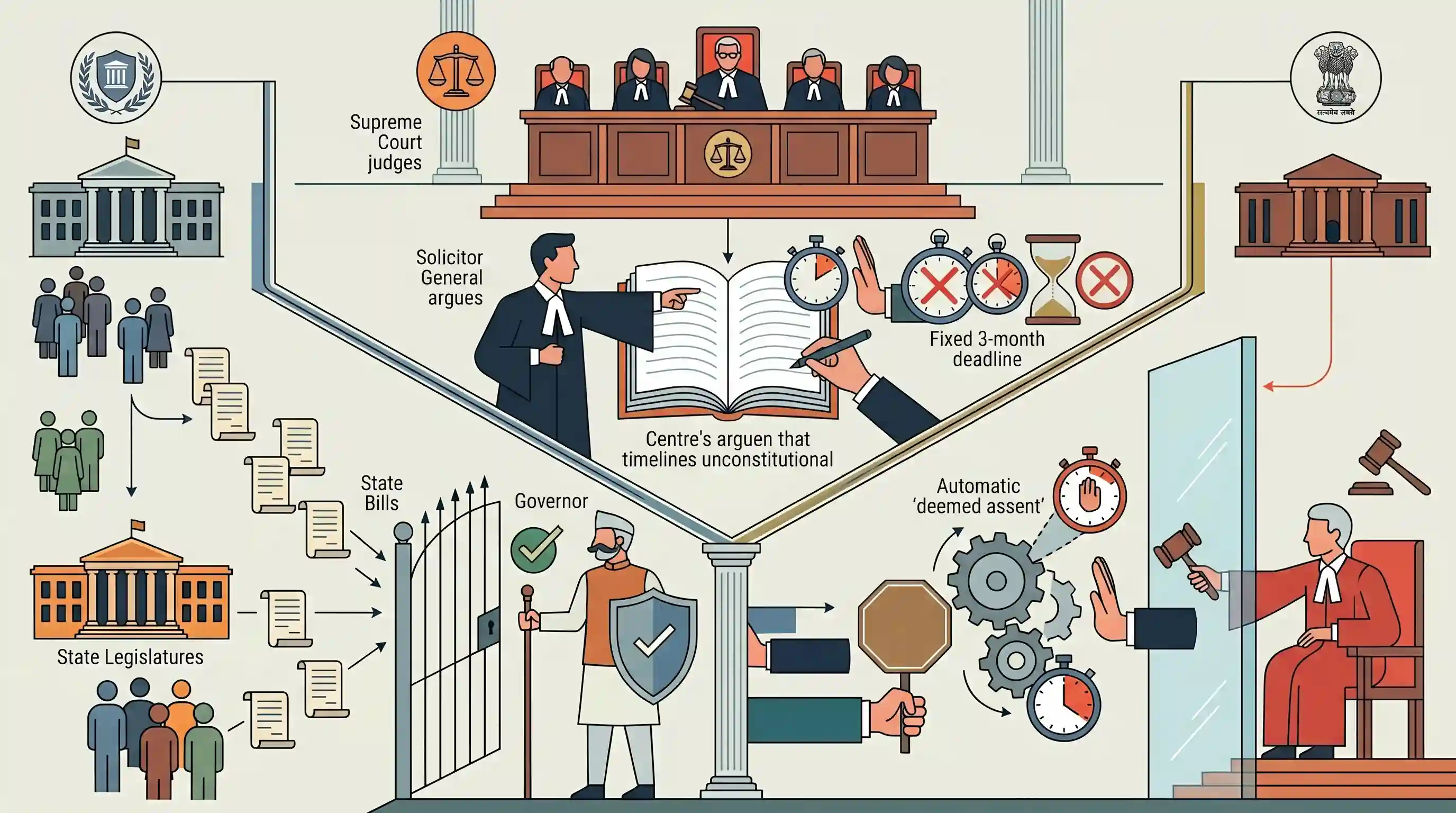
During a Presidential Reference hearing, the Centre told the Supreme Court that fixing a timeline for Governors or the President to clear State Bills is unconstitutional. Responding to the SC's earlier judgment that set a three-month deadline, the Solicitor General argued that Articles 200 and 201 do not contain time constraints, and reading one into them would amount to rewriting the Constitution. He further noted that Governors act as crucial checks on hasty state legislation and that the Court cannot use Article 142 to grant 'deemed assent' without breaching the separation of powers.
Key Points
- The Union government argued in the Supreme Court that imposing a timeline for Governors to give assent to state bills amounts to amending the Constitution, as Articles 200 and 201 have no specified deadlines.
- Solicitor General Tushar Mehta contended that Governors are not 'aliens' but serve as a vital constitutional check against hasty legislation by state governments.
- The Centre also asserted that the Supreme Court cannot invoke its extraordinary powers under Article 142 to grant 'deemed assent' to bills, emphasizing the separation of powers.
- These submissions were made during a Presidential Reference hearing, pushing back against the SC's April 8 judgment that had set a three-month deadline for the Governor and President to decide on bills.
Important Terms
Article 200

Constitutional provision outlining the Governor’s options when a State Bill is presented: grant assent, withhold assent, return it for reconsideration, or reserve it for the President’s consideration.
UPSC context
GS Paper II (Polity); central to Executive-Legislature relations and the debate over 'indefinite delays' by Governors.
Article 201
Prescribes the procedure for State Bills reserved by the Governor for the President's consideration, allowing the President to grant assent, withhold it, or return the Bill for reconsideration.
UPSC context
GS Paper II; crucial for understanding federal balance and the Union's oversight of state legislation.
Article 142
Grants the Supreme Court plenary power to pass any decree or order necessary for doing 'complete justice' in any matter pending before it.
UPSC context
GS Paper II; tests knowledge of judicial activism versus judicial overreach and constitutional boundaries.
Presidential Reference
Also known as Article 143, it empowers the President to seek the Supreme Court's opinion on questions of law or fact of public importance.
UPSC context
GS Paper II; relates to the Advisory Jurisdiction of the Supreme Court and Executive-Judiciary cooperation.
Separation of Powers
A constitutional doctrine ensuring that the Legislature, Executive, and Judiciary remain within their own spheres to prevent the concentration of power and maintain checks and balances.
UPSC context
GS Paper II; a 'Basic Structure' element frequently tested in the context of judicial intervention in executive functions.
Deemed Assent
A legal fiction where a Bill is considered passed or assented to automatically after a certain period, even without formal signature, to prevent legislative paralysis.
UPSC context
GS Paper II; specifically relevant to recent landmark judgments on the limits of judicial power over the Governor's office.
Prelims Trap
"Article 200 mandates a maximum 3-month timeline for Governors to return or decide on State Bills."
The Constitution only states the Governor should return the bill "as soon as possible." The 3-month deadline is a recent SC judicial construct, not constitutional text.
Static Concepts Connected
What options does a Governor have under Article 200 regarding State Bills?
- Grant or Withhold: The Governor can formally give assent to the bill, or withhold assent, which legally brings the bill to an end.
- Return: Can return non-money bills with a message. If the legislature passes the bill again (with or without amendments), the Governor's assent becomes mandatory.
- Reserve: Reservation for the President is mandatory if the bill endangers High Court powers; it is discretionary for other constitutional conflicts.
What are the features of the Supreme Court's Advisory Jurisdiction (Article 143)?
- Presidential Reference: The President can refer to the Supreme Court any question of law or fact of public importance that has arisen or is likely to arise.
- Non-binding Nature: The Supreme Court's opinion is advisory. It carries high persuasive weight but is not legally binding on the President or the government.
- Discretion to Answer: The Supreme Court may decline to offer an opinion under Article 143(1), but it must answer disputes regarding pre-Constitution treaties under Article 143(2).
Cross-Topic Patterns
Art 142 vs Separation of Powers
The SC using Art 142 for 'deemed assent' clashes directly with constitutional checks, a classic GS2 Mains theme highlighting the fine line between judicial review and judicial overreach.
Federalism & Sarkaria Commission
Center-State friction over withholding assent links directly to Sarkaria and Punchhi Commission recommendations, which advised heavily restricting the Governor's discretionary power to reserve bills.

Expect a 2026 Prelims question mixing Articles 200/201 with Art 142 limits, specifically testing the absence of assent timelines.
Linked PYQs · 3
Linked PYQs · 3
- 2022MainsGS2
Discuss the essential conditions for exercise of the legislative powers by the Governor. Discuss the legality of re-promulgation of ordinances by the Governor without placing them before the Legislature.
- 2020MainsGS2
Judicial Legislation is antithetical to the doctrine of separation of powers as envisaged in the Indian Constitution. In this context justify the filing of large number of public interest petitions praying for issuing guidelines to executive authorities.
- 2025PrelimsGS1
Consider the following statements : I. The Constitution of India explicitly mentions that in certain spheres the Governor of a State acts in his/her own discretion. II. The President of India can, of his/her own, reserve a bill passed by a State Legislature for his/her consideration without it being forwarded by the Governor of the State concerned. Which of the statements given above is/are correct?
