Constitutional Friction and Federal Governance Issues in Tamil Nadu
Source:The Hindu ↗
Why It Matters
This article brings together several critical constitutional issues frequently tested in UPSC exams, including the discretionary powers of the Governor regarding State Bills, the functioning of federalism, the operational independence of the Election Commission, and the fundamental constitutional value of secularism.
Summary
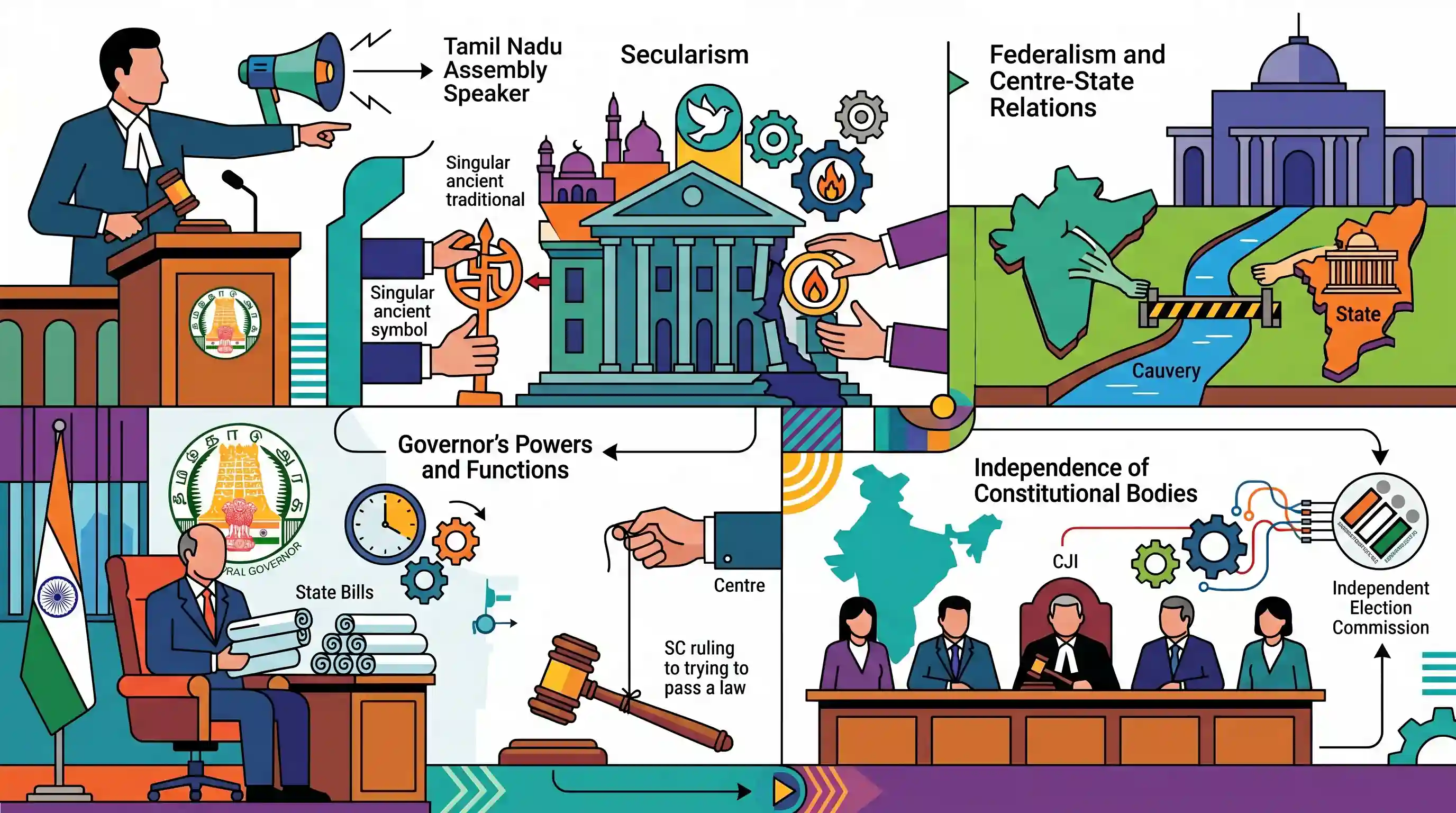
The Tamil Nadu Assembly Speaker launched a sharp critique against the State Governor and the RSS, alleging attempts to undermine the secular framework of the Indian Constitution in favor of a system based on Sanatana Dharma. The remarks highlighted significant constitutional frictions, notably the ongoing conflict over Governors delaying assent to State Bills and the Centre's potential challenge to a Supreme Court ruling on this matter. The Speaker also flagged vital issues impacting federalism and institutional integrity, such as the handling of the Cauvery water dispute and the recent restructuring of the selection panel for the Chief Election Commissioner, which excluded the Chief Justice of India.
Key Points
- Tamil Nadu Assembly Speaker M. Appavu criticized the State Governor and RSS, accusing them of acting contrary to secular and constitutional principles.
- Concerns were raised over the Union government's intent to file a revision petition against a Supreme Court directive requiring Governors to grant timely assent to Bills passed by State Assemblies.
- The Speaker highlighted federal frictions, including the establishment of the Cauvery Water Management Authority instead of a full-fledged Cauvery Board.
- Questions were raised regarding the independence of the Election Commission following the legislative change that replaced the Chief Justice of India with a Union Minister in the selection committee for the Chief Election Commissioner.
Important Terms
Article 200 (Governor's Assent)

Under Article 200, the Governor can grant assent, withhold it, or reserve a Bill for the President. Recent Supreme Court rulings mandate Governors act 'as soon as possible.'
UPSC context
GS II: Executive-Legislature relations. Tests discretionary powers and legislative deadlocks.
Secularism
A basic structure of the Constitution ensuring the State maintains an equal distance from all religions, often contrasted with 'Sanatana Dharma' in recent ideological debates.
UPSC context
GS II: Indian Constitution. Vital for questions on communalism and constitutional morality.
Cauvery Water Management Authority (CWMA)
Established under Article 262 and the 1956 Act, this statutory body regulates water sharing between Tamil Nadu, Karnataka, Kerala, and Puducherry to resolve long-standing disputes.
UPSC context
GS II: Federalism. Focuses on inter-state water dispute mechanisms.
Chief Election Commissioner (CEC) Selection Panel
The 2023 Act replaces the CJI with a Union Cabinet Minister in the committee selecting the CEC and ECs, sparking debates over the body's autonomy.
UPSC context
GS II: Constitutional Bodies. Tests independence and separation of powers.
Federalism
A system of government where power is shared between the Union and States. Conflicts over Bills and water rights highlight tensions in 'Cooperative Federalism.'
UPSC context
GS II: Centre-State Relations. Core theme for administrative and legislative balance.
Sanatana Dharma
An ancient Sanskrit term for 'eternal law' or Hinduism. In current political discourse, it is often debated alongside constitutional principles of social justice and secularism.
UPSC context
GS I/II: Social issues & Philosophy. Relevant to socio-political movements in India.
Prelims Trap
"The Constitution explicitly imposes a strict 6-month time limit on Governors to grant or withhold assent to a State Bill."
Article 200 only states a Governor must return non-Money Bills "as soon as possible". It does not prescribe a strict mathematical time limit, a loophole often exploited in reality and tested in Prelims.
Static Concepts Connected
What are a Governor's powers regarding State Bills under Article 200?
- Grant or Withhold: The Governor may declare assent to the Bill or legally withhold assent outright.
- Return for Reconsideration: Can return a non-Money Bill "as soon as possible" for the Assembly to reconsider. If passed again, the Governor must give assent.
- Reserve for President: Can reserve the Bill for the President's consideration (this is mandatory if the bill endangers the position of the State High Court).
How does the Constitution handle Inter-State River Water Disputes?
- Article 262: Empowers Parliament to enact laws for the adjudication of any dispute or complaint regarding the waters of inter-state rivers and valleys.
- Judicial Exclusion: Parliament may by law provide that neither the Supreme Court nor any other court shall exercise jurisdiction in respect of any such water dispute.
- Inter-State Water Disputes Act: Enacted under Article 262, it allows the Centre to set up ad hoc tribunals to resolve disputes (e.g., Cauvery Water Disputes Tribunal).
Cross-Topic Patterns
ECI Autonomy & Basic Structure Doctrine
The removal of the CJI from the CEC selection panel parallels debates surrounding the NJAC, highlighting recurring tension between executive dominance and the Basic Structure doctrine regarding institutional independence.
Governor's Discretion vs Elected Mandates
Friction over pending bills in TN, Kerala, and Punjab links Article 200 debates to the broader Centre-State relations syllabus, specifically the Sarkaria and Punchhi Commission recommendations on gubernatorial discretion.

Article 200's 'as soon as possible' caveat and the recent ECI appointment act are prime candidates for a multi-statement 2026 Prelims Q.
Linked PYQs · 5
Linked PYQs · 5
- 2022MainsGS2
Discuss the essential conditions for exercise of the legislative powers by the Governor. Discuss the legality of re-promulgation of ordinances by the Governor without placing them before the Legislature.
- 2024MainsGS2
Discuss India as a secular state and compare with the secular principles of the US constitution.
- 2024MainsGS2
What changes has the Union Government recently introduced in the domain of Centre-State relations ? Suggest measures to be adopted to build the trust between the Centre and the States and for strengthening federalism.
- 2024MainsGS2
Examine the need for electoral reforms as suggested by various committees with particular reference to "one nation one election" principle.
- 2022MainsGS2
Discuss the role of the Election Commission of India in the light of the evolution of the Model Code of Conduct.
