Governor Lacks Power To Act As Super Chief Minister Says Tamil Nadu
Source:The Hindu ↗
Why It Matters
This legal battle touches upon critical faultlines in India's federal structure, redefining the bounds of a Governor's discretionary powers under Article 200 over state legislation and examining whether state governments have locus standi under Article 32 to challenge central or gubernatorial actions.
Summary
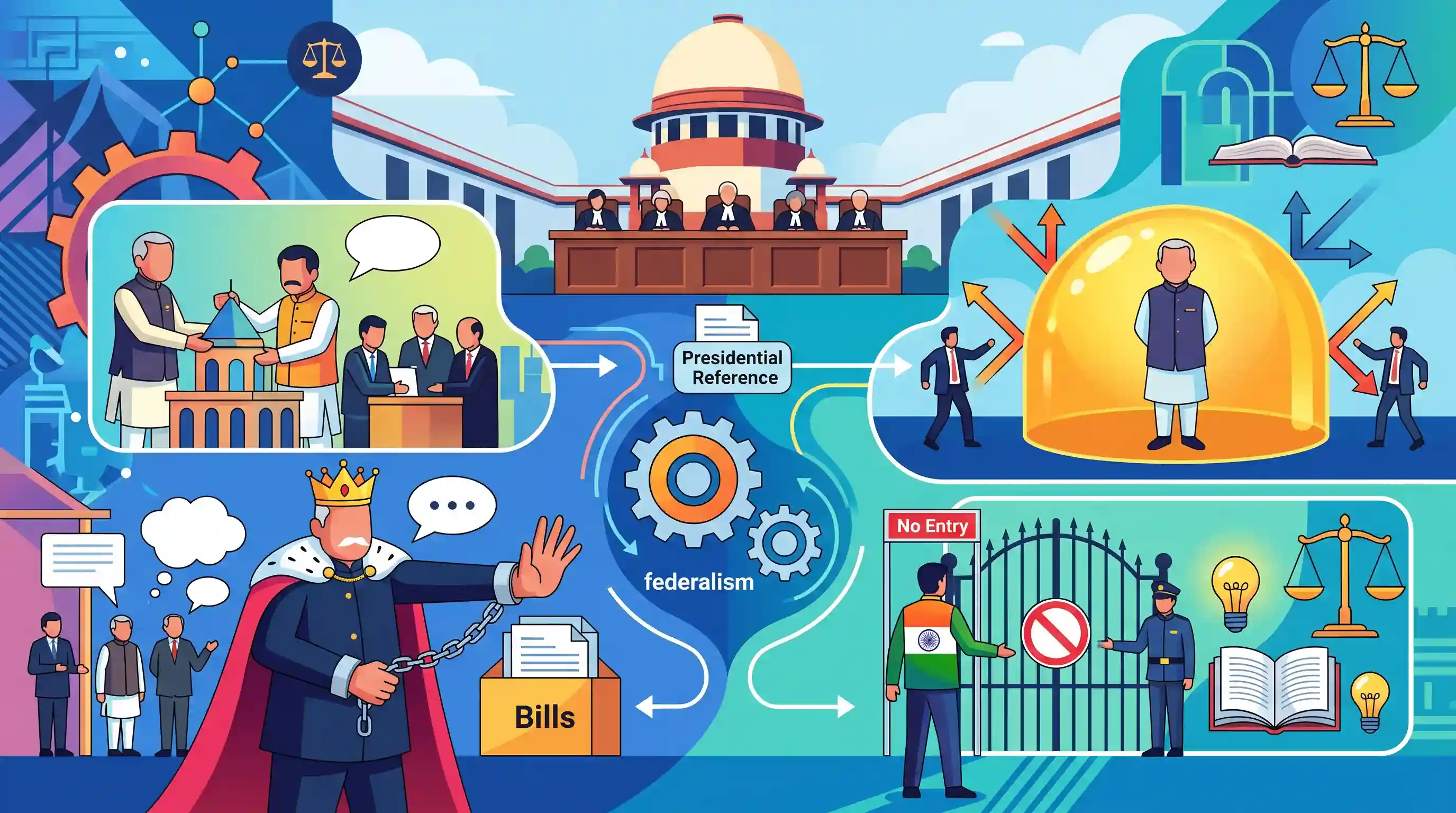
During a Supreme Court hearing on a Presidential Reference concerning gubernatorial powers, Tamil Nadu argued that a Governor's role is merely to facilitate democratic governance, not to act as a 'super Chief Minister' by withholding assent to Bills under Article 200. Conversely, the Centre argued that State governments cannot approach the Supreme Court under Article 32 since states do not possess fundamental rights, and further defended the Governor's absolute constitutional immunity under Article 361.
Key Points
- Tamil Nadu argued before the Supreme Court that a Governor is a 'facilitator' and cannot act as a 'super Chief Minister' or a legislator.
- The State contended that a Governor's discretion under Article 200 to withhold assent to state bills is constrained by the advice of the elected Cabinet.
- Solicitor General Tushar Mehta argued that a State government cannot invoke Article 32 for writ jurisdiction as states are not holders of fundamental rights.
- The Centre also invoked Article 361 to assert the complete constitutional immunity of the Governor from legal proceedings.
Important Terms
Article 200

Deals with the Governor's powers regarding State Bills: granting assent, withholding it, or reserving the Bill for the President's consideration. It mandates returning Bills for reconsideration "as soon as possible."
UPSC context
Crucial for GS Paper II (Polity) regarding Governor's legislative powers and constitutional deadlocks in Centre-State relations.
Article 32
Empowers the Supreme Court to issue writs for the enforcement of Fundamental Rights. In this case, the Centre argues States cannot invoke it as they lack Fundamental Rights.
UPSC context
Key for GS Paper II (Judiciary) and Preliminary exam regarding the scope of Writ Jurisdiction and Locus Standi.
Article 143
Establishes the Supreme Court's advisory jurisdiction, allowing the President to seek the Court's opinion on significant questions of law or public importance.
UPSC context
Important for GS Paper II (Judiciary/President) regarding the advisory role of the SC and resolving constitutional ambiguities.
Article 361
Provides constitutional immunity to the President and Governors, stating they are not answerable to any court for their official duties and are immune from criminal proceedings while in office.
UPSC context
Relevant for GS Paper II (Polity/Executive) regarding the privileges and immunities of constitutional heads and the principle of accountability.
Presidential Reference
A formal procedure where the President seeks the Supreme Court's advisory opinion under Article 143 on a specific legal or constitutional issue of public importance.
UPSC context
Tests understanding of the consultative relationship between the Executive and Judiciary in GS Paper II.
Discretionary Powers
Powers exercised by the Governor independently of the Council of Ministers' advice. The extent of these powers in withholding Bill assent is a core constitutional dispute.
UPSC context
Frequent topic in GS Paper II (Polity) regarding federalism and the office of the Governor.
Prelims Trap
State governments can approach the Supreme Court under Article 32 to resolve Centre-State disputes.
Article 32 is strictly for enforcing Fundamental Rights of 'persons'. Centre-State federal disputes fall exclusively under the Supreme Court's original jurisdiction via Article 131.
Static Concepts Connected
What are the Governor's options regarding Bills under Article 200?
- Grant or Withhold: Assent can be granted or withheld, though the Supreme Court has clarified that withholding indefinitely violates constitutional limits.
- Return for Reconsideration: Can return non-Money Bills with a message for reconsideration. If passed again by the legislature, the Governor must give assent.
- Reserve for President: Can reserve Bills for the President; this is mandatory if the Bill endangers the position of the state High Court.
What is the scope of a Governor's constitutional immunity under Article 361?
- Official Acts: Governors are not answerable to any court for the exercise and performance of their official powers and duties.
- Criminal Immunity: They enjoy absolute immunity from any criminal proceedings, arrest, or imprisonment during their term in office.
- Civil Suits: Civil suits against them for acts done in a personal capacity require a mandatory two-month prior written notice.
Cross-Topic Patterns
Article 32 vs Article 131 jurisdiction
Litigation by States against the Centre over federal overreach increasingly blurs the boundary between Fundamental Rights enforcement (Article 32) and original federal dispute jurisdiction (Article 131).
Judicial review of Governor's discretion
Successive SC judgments like Shamsher Singh and Nabam Rebia have consistently narrowed gubernatorial discretion, firmly establishing that Governors must act on the 'aid and advice' of the Cabinet.

Expect a 2026 Prelims question contrasting Articles 32 and 131, specifically testing if a State qualifies to hold Fundamental Rights.
Linked PYQs · 3
Linked PYQs · 3
- 2022MainsGS2
Discuss the essential conditions for exercise of the legislative powers by the Governor. Discuss the legality of re-promulgation of ordinances by the Governor without placing them before the Legislature.
- 2014PrelimsGS1
The power of the Supreme Court of India to decide disputes between the Centre and the States falls under its
- 2024MainsGS2
What changes has the Union Government recently introduced in the domain of Centre-State relations ? Suggest measures to be adopted to build the trust between the Centre and the States and for strengthening federalism.
