Conventional media protection policies and digital disruption measures
Source:The Hindu ↗
Why It Matters
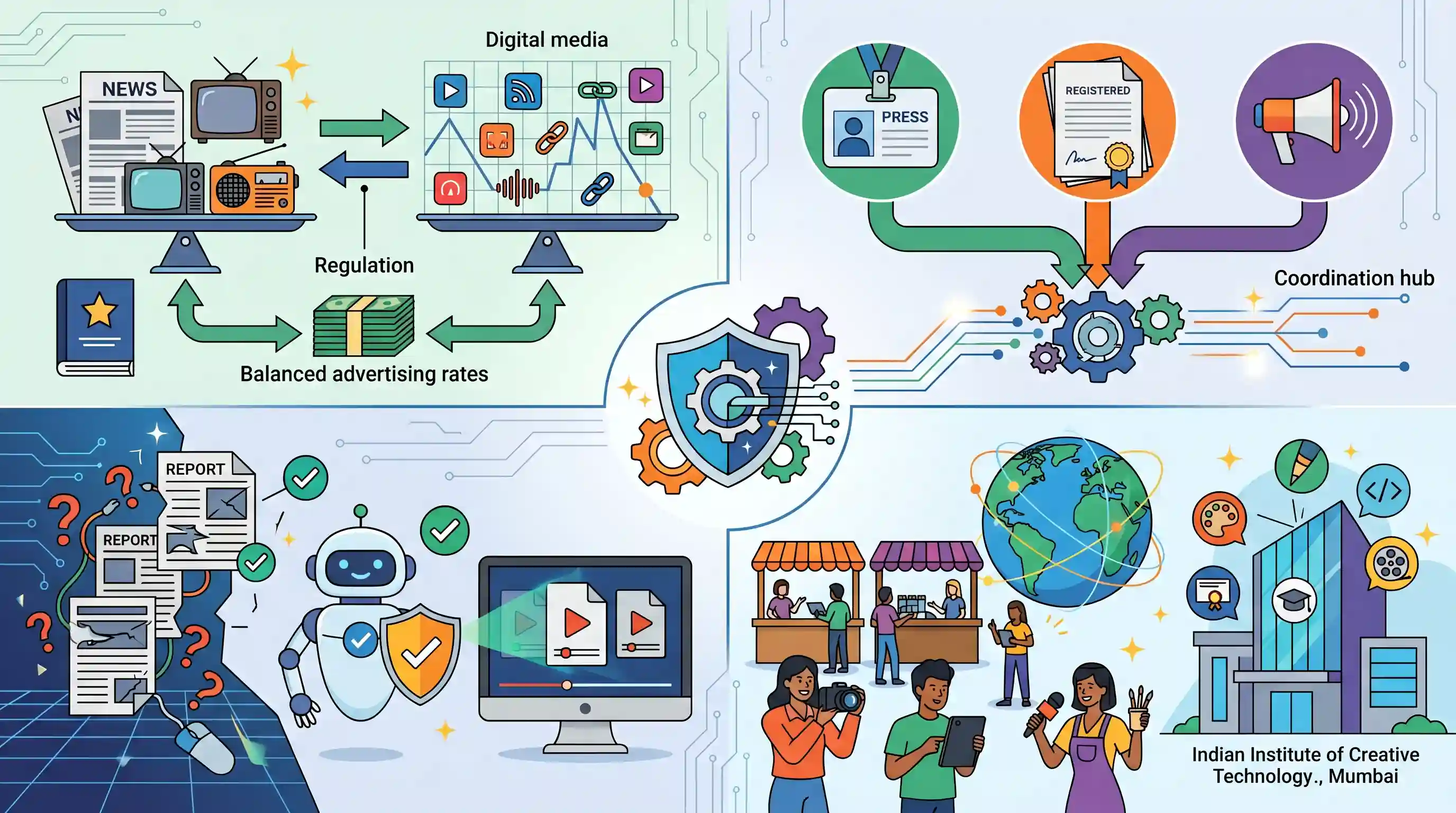
Media is the fourth pillar of democracy, and balancing the playing field between conventional and digital platforms is a pressing policy challenge. Initiatives to integrate government communication bodies, regulate TRPs, and combat fake news using AI/chatbots demonstrate crucial governance reforms relevant to UPSC GS2 (Governance/Policies) and GS3 (Internal Security/Digital Economy).
Summary
The Union Information and Broadcasting Ministry has announced a slew of measures to protect conventional media platforms from digital disruption through regulatory reforms and rationalizing advertisement rates. Crucially, the government plans to integrate key media bodies—the PIB, RNI, and Central Bureau of Communication—to ensure better coordination and convergence of regulatory functions. To counter fake news and misinformation, the government is developing a chatbot for the PIB's Fact Check Unit and rolling out software for social media video verification. Simultaneously, the 'creator economy' is being bolstered through global outreach programs like WAVES Bazaar and the establishment of the Indian Institute of Creative Technology in Mumbai.
Key Points
- The Information and Broadcasting Ministry plans to introduce reforms and rationalise government advertisement rates to protect conventional media (radio, TV, print, DTH) from digital disruption.
- New guidelines for Television Rating Points (TRP) agencies are being drafted to address existing distortions.
- Key government media bodies including the Registrar of Newspapers for India, the PIB, and the Central Bureau of Communication will be integrated to streamline outreach and regulation.
- To combat fake news, a chatbot is being developed for the PIB's Fact Check Unit alongside software to verify the authenticity of social media videos.
- The government is actively promoting the 'creator economy' through initiatives like WAVES Bazaar and the newly operational Indian Institute of Creative Technology in Mumbai.
Important Terms
Press Information Bureau (PIB)

The nodal agency of the Government of India responsible for disseminating official information regarding policies, programmes, and initiatives to print and electronic media.
UPSC context
GS Paper II (Governance); primary source for authentic current affairs and official policy data.
Registrar of Newspapers for India (RNI)
A statutory body under the Ministry of Information and Broadcasting that regulates newspaper registration and maintains records of circulation and ownership in India.
UPSC context
GS Paper II (Regulatory Bodies); tests knowledge of media regulation and statutory administrative frameworks.
Central Bureau of Communication (CBC)
The Government of India's primary agency for public outreach and advertising, formed by merging DAVP, the Directorate of Field Publicity, and Song & Drama Division.
UPSC context
GS Paper II (Governance); relevant for administrative convergence and integrated government communication strategies.
PIB Fact Check Unit
A specialized wing under the Press Information Bureau tasked with identifying and debunking fake news and misinformation specifically related to Union Government affairs.
UPSC context
GS Paper III (Internal Security/Cyber); addresses challenges of digital misinformation and state regulatory responses.
WAVES Bazaar
A global e-marketplace designed to connect Indian creators with international markets, facilitating business-to-business (B2B) networking and content showcasing ahead of the WAVES summit.
UPSC context
GS Paper III (Economic Development); supports the creator economy and India's global soft power initiatives.
Indian Institute of Creative Technology (IICT)
A premier National Centre of Excellence in Mumbai focused on education, R&D, and innovation in the Animation, Visual Effects, Gaming, and Comics (AVGC) sector.
UPSC context
GS Paper III (Science & Tech); highlights skill development and formalization of the creative technology industry.
Prelims Trap
"The PIB Fact Check Unit's determinations are legally binding on social media platforms, requiring mandatory takedowns of fake news."
The 2023 IT Rules amendment making the FCU's fake news tags binding on intermediaries (forcing takedowns to keep safe harbour) was struck down by the Bombay High Court in 2024.
Static Concepts Connected
What are key provisions of the Press and Registration of Periodicals (PRP) Act, 2023?
- Institutional Shift: Replaces the colonial-era 1867 Act, shifting authority from the Registrar of Newspapers for India (RNI) to the newly designated Press Registrar General (PRG).
- Decriminalization: Decriminalizes most violations, replacing imprisonment with financial penalties, and simplifies the registration process through a centralized online portal.
- Foreign Periodicals: Exact facsimiles of foreign periodicals can now be printed in India, subject to prior approval from the Central Government.
What is the AVGC-XR sector and its institutional framework?
- Definition: Stands for Animation, Visual Effects, Gaming, Comics, and Extended Reality—a key pillar of India's emerging creator economy.
- Nodal Ministry: The Ministry of Information and Broadcasting (not MeitY) is the nodal ministry driving AVGC sector policies and formalization.
- IICT: The government has established the Indian Institute of Creative Technology (IICT) in Mumbai as a National Centre of Excellence to build human capital for the sector.
Cross-Topic Patterns
Deepfakes and IT Rules 2021
PIB's video verification software intersects with ongoing debates over Section 79 'safe harbour' protections for social media intermediaries failing to proactively curb deepfakes and state-flagged misinformation.
Creator Economy as Service Exports
WAVES Bazaar targets global investors, signaling a policy shift treating digital content creation (AVGC-XR) as a high-growth service export sector akin to the IT/BPO boom of the 2000s.

Expect a Prelims question merging the new PRP Act 2023, the mandate of the PIB Fact Check Unit, and IT Rules intermediary limits.
Linked PYQs · 5
Linked PYQs · 5
- 2024MainsGS3
Social media and encrypting messaging services pose a serious security challenge. What measures have been adopted at various levels to address the security implications of social media? Also suggest any other remedies to address the problem.
- 2023MainsGS3
What are the internal security challenges being faced by India? Give out the role of Central Intelligence and Investigative Agencies tasked to counter such threats.
- 2013MainsGS3
What are social networking sites and what security implications do these sites present ?
- 2025MainsGS2
The National Commission for Protection of Child Rights has to address the challenges faced by children in the digital era. Examine the existing policies and suggest measures the Commission can initiate to tackle the issue.
- 2020MainsGS2
Recent amendments to the Right to Information Act will have profound impact on the autonomy and independence of the Information Commission". Discuss.
