Government advances Western Ghats eco-sensitive area notification
Source:Indian Express ↗
Why It Matters
Crucial for MPSC aspirants studying environmental governance, biodiversity hotspots, and committee recommendations related to the Western Ghats.
Summary
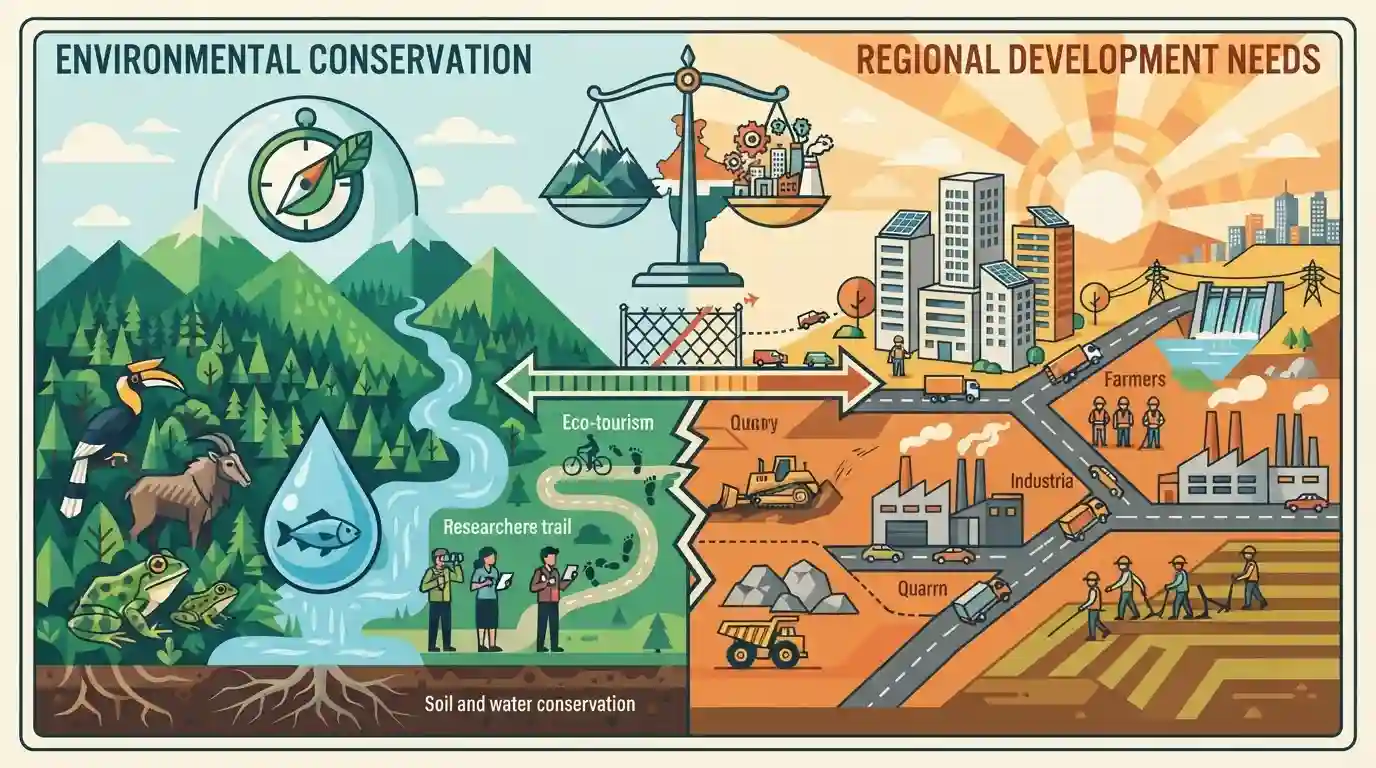
Recent developments concerning the Western Ghats Eco-Sensitive Area (ESA) notification highlight the ongoing debate between environmental conservation of a vital biodiversity hotspot and regional developmental needs across states like Maharashtra.
Key Points
- The government is moving forward with notifications regarding the Western Ghats Eco-Sensitive Area (ESA) to balance ecological protection and developmental aspirations.
- The Western Ghats span six states, including Maharashtra, and are a globally recognized biodiversity hotspot facing intense anthropogenic and developmental pressures.
- Two major committees, the Madhav Gadgil Committee and the K. Kasturirangan Committee, previously submitted reports outlining recommendations for the conservation and regulation of activities in the Western Ghats.
- The notification aims to regulate mining, quarrying, large construction, and thermal power projects in specified ecologically fragile zones while protecting local livelihoods.
Important Terms
Eco-Sensitive Area (ESA) Notification

A notification issued under the Environment (Protection) Act, 1986 by the MoEFCC to designate fragile zones around protected areas where specific commercial, mining, and industrial activities are restricted or prohibited to safeguard biodiversity.
UPSC context
Important for MPSC/UPSC Environment and Ecology (Paper III): tests understanding of biodiversity conservation frameworks, regulatory mechanisms, and developmental trade-offs.
Ministry of Environment, Forest and Climate Change (MoEFCC)
The nodal central ministry in India responsible for planning, promoting, and coordinating environmental and forestry policies, including wildlife conservation, pollution abatement, and notification of ecologically sensitive zones.
UPSC context
Essential for MPSC Governance and Polity / Environment: tests administrative setup, statutory bodies, and Union-level policy implementation.
Prelims Trap
The Madhav Gadgil Committee recommended designating roughly 37% of the Western Ghats as an Ecologically Sensitive Area.
Aspirants often confuse the two reports, assuming the Madhav Gadgil Committee recommended protecting only 37% of the Ghats, whereas it actually recommended the entire region as an ESA.
Static Concepts Connected
What are the key differences between the Gadgil and Kasturirangan committees on the Western Ghats?
- Gadgil Scope: Scope: Gadgil Committee (WGEEP) recommended designating the entire Western Ghats as an Ecologically Sensitive Area (ESA) under three zones.
- Kasturirangan Scope: Scope: Kasturirangan Committee recommended bringing only about 37% of the Western Ghats under the ESA category.
- Regulatory Approach: Approach: Gadgil favored strict blanket bans on mining across zones, whereas Kasturirangan adopted a more developmental-friendly, progressive regulatory approach.
Cross-Topic Patterns
Western Ghats ESA vs Federal Mineral Rights
The debate over the Western Ghats ESA mirrors the federal friction in Fifth Schedule areas where mineral rights and tribal livelihoods clash with central environmental mandates.
UNESCO Natural Sites & DPSP Mandates
UNESCO World Heritage natural site status adds international conservation obligations over state-level development plans under Article 48A and 51A(g).

Compare Gadgil vs Kasturirangan committee thresholds and state-wise span in a multi-statement MPSC environment question.
Linked PYQs · 2
Linked PYQs · 2
- 2017MPSC_PRELIMSGS1
Which of the following mountains are considered as one of the top biodiversity hot spots ?
- 2024MPSC_PRELIMSGS1
Match the following pairs : | List-I | List-II | |---|---| | (a) Dr. Nitin Karmalkar Committee | (i) For implementation of National Education Policy - 2020 in Maharashtra | | (b) Nitin Karir Committee | (ii) To enquire the incident which happened during the distribution of Maharashtra Bhushan Award | | (c) Sunil Pawar Committee | (iii) To study why the rates of onion collapse. | | (d) Dr. K. Kasturirangan Committee | (iv) To make the syllabus for pre-primary to degree according to National Education Policy - 2020 | Code: (a) (b) (c) (d)
