Western Ghats Eco-Sensitive Area ecological conservation and policy
Source:Indian Express ↗
Why It Matters
Crucial for MPSC aspirants studying environment, geography of Maharashtra/India, biodiversity conservation policies, and sustainable development frameworks.
Summary
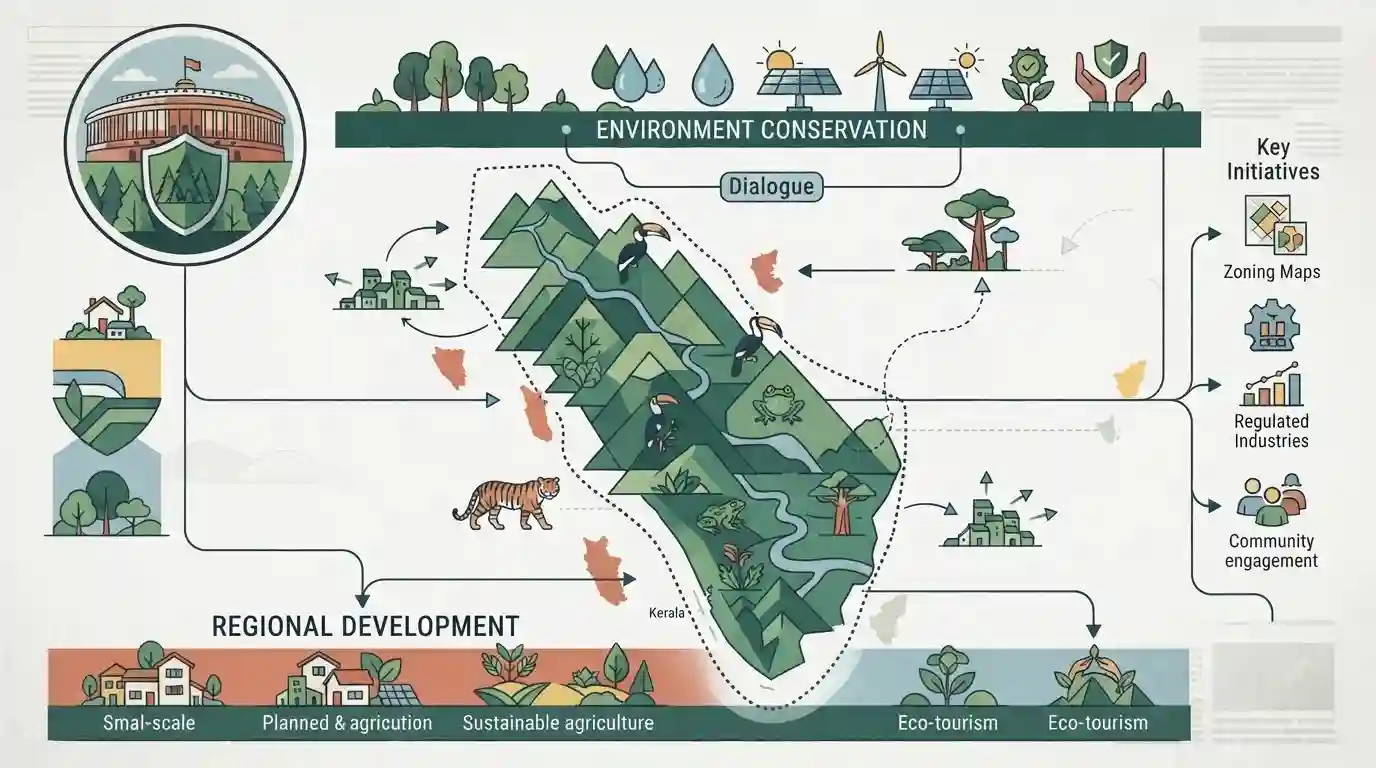
The article discusses the government's updates and initiatives regarding the Western Ghats Eco-Sensitive Area (ESA) notification, balancing environmental protection of a crucial biodiversity hotspot with regional development demands across states like Maharashtra.
Key Points
- The government has been working on finalizing the Eco-Sensitive Area (ESA) notification for the Western Ghats to balance ecological conservation and developmental needs.
- The Western Ghats span across six states, including Maharashtra, Goa, Karnataka, Kerala, Tamil Nadu, and Gujarat.
- Previous committees like the Madhav Gadgil Committee and Kasturirangan Committee laid the foundational recommendations for protecting this global biodiversity hotspot.
- The designation restricts certain high-impact activities like mining, large construction, and polluting industries in ecologically fragile zones while permitting sustainable local livelihoods.
Important Terms
Eco-Sensitive Area (ESA) notification

A formal government notification designating ecologically vital zones around protected areas where specific commercial and industrial activities are regulated or prohibited to prevent environmental degradation.
UPSC context
MPSC Environment and Ecology syllabus; tests knowledge of conservation laws, protected areas, and balancing development with ecological safety.
Ministry of Environment, Forest and Climate Change
The central government ministry responsible for planning, promoting, and implementing environmental and forestry policies, including the notification of Western Ghats ESAs.
UPSC context
MPSC Polity and Governance/Environment; tests administrative framework for national ecological policies and statutory notifications.
Gadgil Committee
The Western Ghats Ecology Expert Panel (WGEEP) led by Madhav Gadgil (2011), which recommended declaring the entire Western Ghats as an ecologically sensitive zone with severe restrictions on commercial activities.
UPSC context
MPSC Geography & Environment; frequently asked in prelims comparing committee recommendations for Western Ghats conservation.
Kasturirangan Committee
A high-level working group chaired by K. Kasturirangan (2013) that proposed restricting Eco-Sensitive Area status to only 37 percent of the Western Ghats to balance development with conservation.
UPSC context
MPSC Environment and Conservation; important for understanding sustainable development frameworks and state-level policy resistance.
Static Concepts Connected
What are the core differences between the Madhav Gadgil and K. Kasturirangan committees on the Western Ghats?
- Gadgil Scope: WGEEP recommended designating the entire Western Ghats as an ESA, dividing it into three Ecologically Sensitive Zones (ESZ 1, 2, and 3).
- Kasturirangan Scope: HLWG recommended bringing only about 37% (approx. 60,000 sq km) of the Western Ghats under the ESA framework, using a remote-mapping approach.
- Governance Model: Gadgil advocated a bottom-up approach through local bodies, whereas Kasturirangan favored a top-down model restricting red-category industries.
Cross-Topic Patterns
Western Ghats ESA vs. Forest Rights Act
The debate over ESA notifications in the Western Ghats directly intersects with Schedule V tribal rights and Gram Sabha consent in forest-fringe districts of Maharashtra.
Renewable Energy vs. Ecologically Sensitive Zones
Biodiversity conservation frameworks like the Kasturirangan report overlap with renewable energy land requirements, particularly pumped storage hydro projects in the Sahyadri ranges.

Expect a matching or statement-based question comparing the Gadgil and Kasturirangan committee recommendations on Western Ghats ESA percentage.
Linked PYQs · 3
Linked PYQs · 3
- 2017MPSC_PRELIMSGS1
Which of the following mountains are considered as one of the top biodiversity hot spots ?
- 2022MPSC_PRELIMSGS1
In India, which of the following has become a hot-spot with reference to threats to biodiversity ?
- 2022MPSC_PRELIMSGS1
Biosphere reserves are demarcated into ________.
