Western Ghats Eco Sensitive Area Notification And Conservation
Source:Indian Express ↗
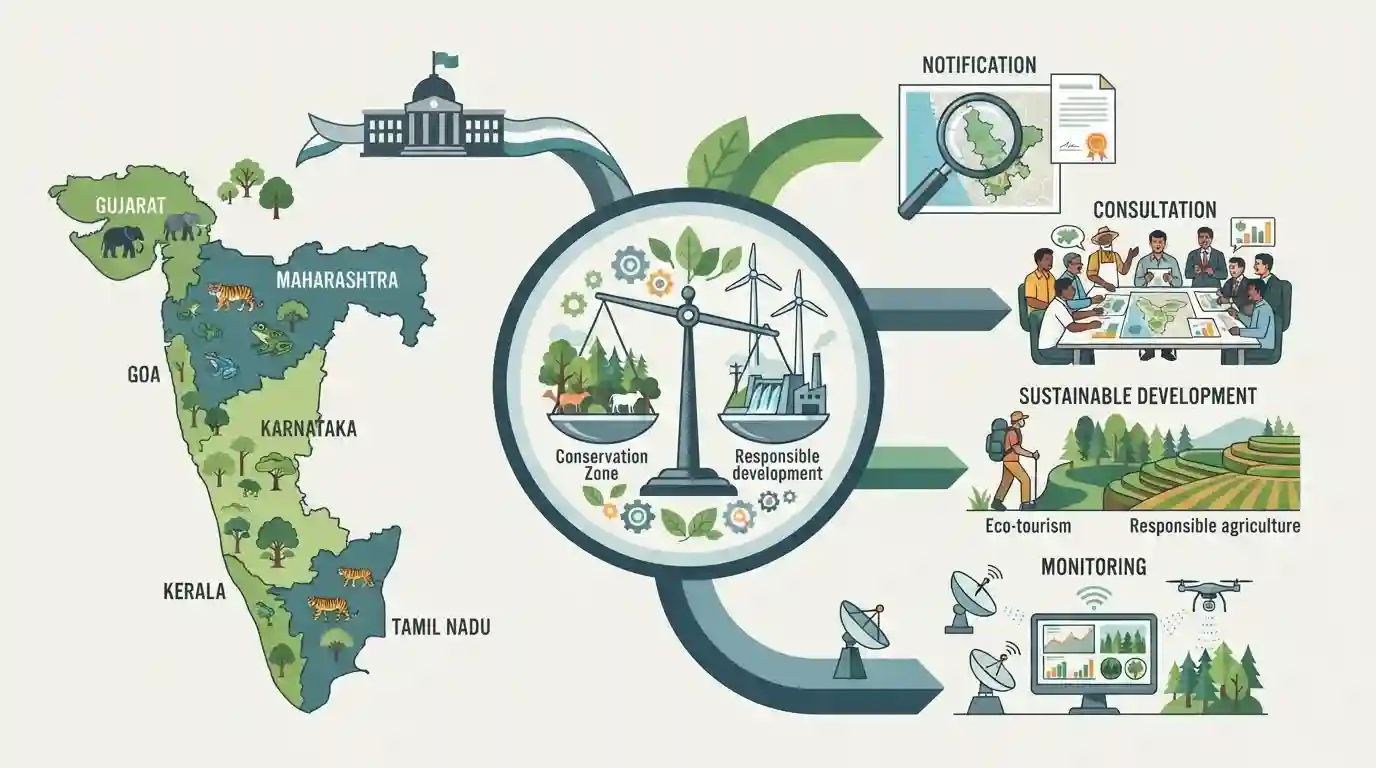
Why It Matters
Crucial for MPSC aspirants tracking environmental governance, biodiversity hotspots, and regional developmental debates in states like Maharashtra.
Summary
An update on the government's stance and actions regarding the Western Ghats Eco-Sensitive Area (ESA) notification, balancing ecological conservation with developmental needs across the six states of the Western Ghats region.
Key Points
- The government is moving forward with notifications regarding the Western Ghats Eco-Sensitive Area (ESA).
- The Western Ghats span across six states: Gujarat, Maharashtra, Goa, Karnataka, Kerala, and Tamil Nadu.
- Recommendations are based on environmental protection panels like the Kasturirangan and Gadgil committees to balance development and conservation.
Important Terms
Eco-Sensitive Area notification

A government designation around protected areas aimed at regulating commercial activities, mining, and large-scale infrastructure to protect fragile biodiversity and ecosystems from degradation.
UPSC context
MPSC/UPSC GS Paper III (Environment & Ecology): Tests understanding of environmental governance, developmental trade-offs, and biodiversity conservation policies.
Gadgil Committee Report
An expert panel chaired by Madhav Gadgil (2011) that recommended classifying the entire Western Ghats as ecologically sensitive, calling for a total ban on destructive industrial activities.
UPSC context
MPSC GS Paper III: Tests knowledge of historical committee recommendations on ecological conservation versus sustainable development.
Kasturirangan Committee Report
A high-level working group chaired by K. Kasturirangan (2013) that proposed designating 37 percent of the Western Ghats as an Eco-Sensitive Area, balancing conservation with socio-economic needs.
UPSC context
MPSC GS Paper III: Frequently tested in environment and governance sections regarding policy frameworks for hill region protection.
Ministry of Environment, Forest and Climate Change
The nodal ministry at the central level responsible for planning, promoting, and coordinating environmental and forestry policies, including the notification of ESAs across India.
UPSC context
MPSC/UPSC GS Paper II & III: Tests institutional structures, central government ministries, and administrative jurisdiction over environmental legislation.
Static Concepts Connected
What are the key differences between the Gadgil Committee (WGEEP) and Kasturirangan Committee reports on the Western Ghats?
- Gadgil Report: Recommended declaring the entire Western Ghats as an Ecologically Sensitive Area (ESA) with graded zones and a ban on mining/thermal plants.
- Kasturirangan Report: Recommended bringing only 37% of the Western Ghats under ESA and permitted existing developmental activities with a ban only on red-category industries.
- Geographical Scope: Spans 6 states: Gujarat, Maharashtra, Goa, Karnataka, Kerala, and Tamil Nadu, designated as a UNESCO World Heritage Site.
Cross-Topic Patterns
Western Ghats ESA vs. Fifth Schedule Mining
The Western Ghats ESA notifications directly intersect with mineral concessions in scheduled areas under the Fifth Schedule, balancing tribal livelihood, mining bans, and ecological conservation.

Expect a statement-based MPSC question comparing the Gadgil and Kasturirangan committee recommendations on developmental curbs in the Western Ghats.
Linked PYQs · 1
Linked PYQs · 1
- 2017MPSC_PRELIMSGS1
Which of the following mountains are considered as one of the top biodiversity hot spots ?
