Western Ghats Eco Sensitive Area Draft Notification
Source:Indian Express ↗
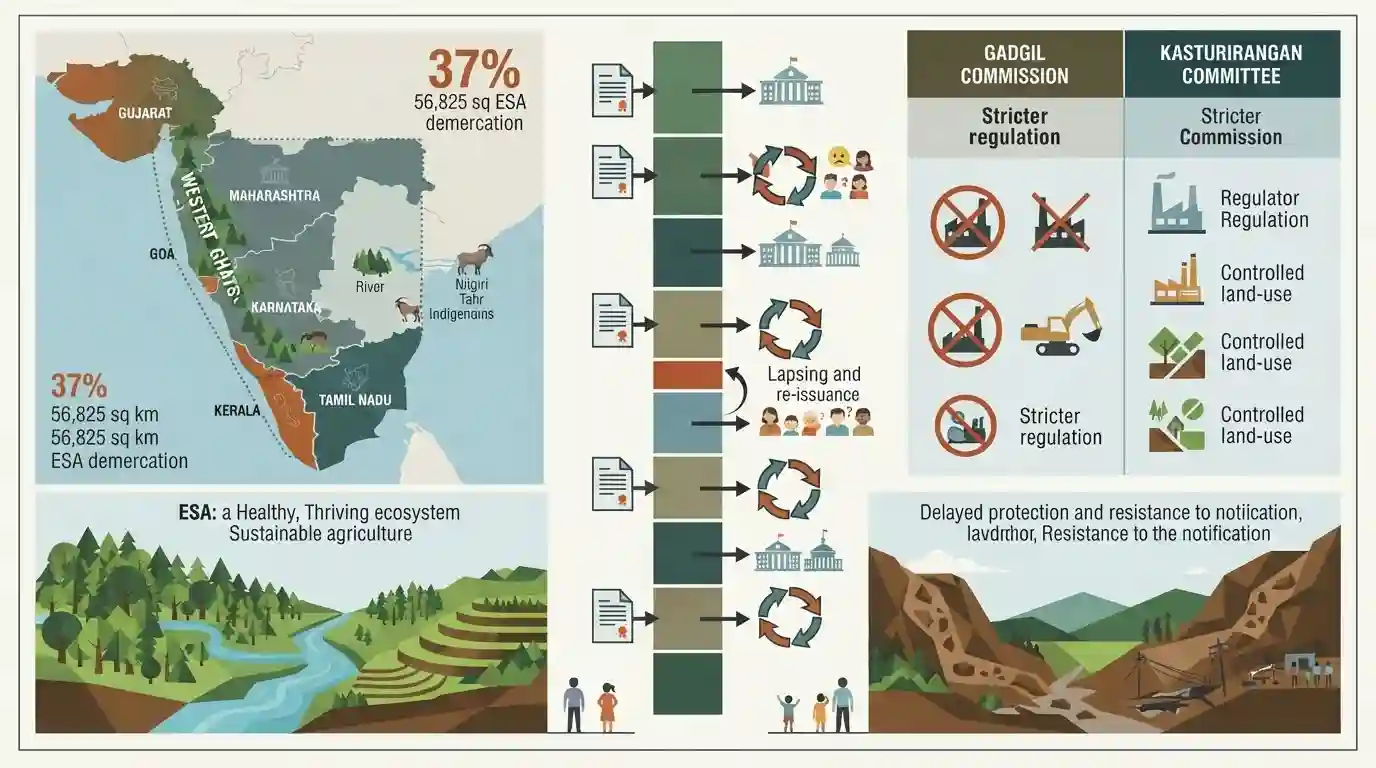
Why It Matters
The Western Ghats ESA notification is a classic case study of the 'Environment vs. Development' debate. It is vital for UPSC aspirants to understand the differences between the Gadgil and Kasturirangan committee reports, the statutory backing of ESAs under the Environment (Protection) Act, 1986, and how ecological degradation directly contributes to the increasing frequency and severity of landslides in the Western Ghats.
Summary
The Union Ministry of Environment, Forest and Climate Change (MoEFCC) has re-issued the draft notification proposing to declare 56,825 sq km of the Western Ghats as an Eco-Sensitive Area (ESA). Covering six states—Gujarat, Maharashtra, Goa, Karnataka, Kerala, and Tamil Nadu—the notification seeks to ban environmentally damaging activities like mining, thermal power plants, and highly polluting industries. The demarcation follows the Kasturirangan Committee's recommendations, which suggested designating 37% of the Western Ghats as an ESA, softening the stricter regulations proposed by the preceding Gadgil Commission. The draft has been stuck in a continuous loop of lapsing and re-issuance for a decade due to resistance from state governments concerned about restrictions on developmental activities and local livelihoods. The recent spate of deadly landslides in the region underscores the critical consequences of this delayed environmental protection policy.
Key Points
- The MoEFCC has re-issued a draft notification to declare 56,825 sq km of the Western Ghats across six states as an Eco-Sensitive Area (ESA). This marks the sixth such issuance in a decade.
- The proposed ESA would impose a complete ban on mining, quarrying, thermal power plants, and 'Red' category (highly polluting) industries to protect the region's fragile ecology.
- The ESA boundaries are based on the Kasturirangan Committee report (2013), which recommended protecting 37% of the Western Ghats, acting as a diluted compromise to the earlier Gadgil Commission report (2011) that proposed covering the entire region.
- Finalization of the notification has been repeatedly delayed due to strong opposition from states (especially Kerala and Karnataka) over concerns regarding the exclusion of human settlements, plantations, and the potential negative impact on local livelihoods and economic development.
- The urgency of finalizing the ESA notification has been renewed following recurrent devastating landslides in the region, highlighting the critical need to balance ecological conservation with sustainable development.
Important Terms
Environment (Protection) Act, 1986

India's umbrella environmental legislation enacted under Article 253, empowering the Central Government to protect the environment, prevent pollution, and notify ecologically sensitive areas.
UPSC context
GS Paper III (Environment). Tests legal frameworks for environmental protection, state regulatory powers, and landmark ecological legislation.
Western Ghats Eco-Sensitive Area (ESA) Draft Notification
A proposed central directive declaring over 56,000 square kilometers of the ecologically fragile Western Ghats as restricted zones to ban hazardous developmental activities.
UPSC context
GS Paper III (Conservation). Tests understanding of biodiversity hotspots, federal environmental governance, and disaster vulnerability.
Gadgil Commission (Western Ghats Ecology Expert Panel)
A 2011 panel that recommended designating the entire Western Ghats as an Eco-Sensitive Area, proposing a strict, bottom-up regulatory framework across three graded ecological zones.
UPSC context
GS Paper III (Conservation). Tests environmental committee recommendations, regional ecological assessments, and bottom-up planning.
Kasturirangan Committee (High-Level Working Group)
A 2013 committee that recommended declaring 37% of the Western Ghats as an Eco-Sensitive Area, distinguishing between natural and cultural landscapes to balance development and conservation.
UPSC context
GS Paper III (Conservation). Tests comparative policy analysis, sustainable development tradeoffs, and committee-based ecological governance.
Ministry of Environment, Forest and Climate Change (MoEFCC)
The nodal agency of the Indian Government responsible for planning, promoting, coordinating, and overseeing the implementation of India's environmental, forestry, and wildlife policies and laws.
UPSC context
GS Paper II (Executive). Tests institutional mandates, policy formulation, and administrative oversight of central environmental ministries.
Prelims Trap
"The term 'Eco-Sensitive Zone' is explicitly defined and mentioned in the Environment (Protection) Act, 1986."
The government declares ESZs using powers under Section 3 of the EPA 1986, but the specific term "Eco-Sensitive Zone" or "Eco-Sensitive Area" is nowhere mentioned in the text of the Act itself.
Static Concepts Connected
What are the core differences between the Gadgil and Kasturirangan Committee reports?
- Coverage Area: Gadgil recommended 100% of the Ghats as ecologically sensitive; Kasturirangan reduced this to 37% (the natural landscape), excluding cultural landscapes (settlements, plantations).
- Methodology: Gadgil proposed a bottom-up model empowering local Gram Sabhas. Kasturirangan used a top-down technocratic approach relying heavily on satellite imagery and remote sensing.
- Governance: Gadgil advocated for a statutory Western Ghats Ecology Authority (WGEA) under EPA 1986. Kasturirangan did not propose a new overarching statutory body.
What are the key geographical and ecological features of the Western Ghats?
- Geological Origin: They are block mountains formed by the down-warping of a part of the Arabian Sea landmass. They are older than the Himalayas.
- State Coverage: The range spans roughly 1,600 km across six states: Gujarat, Maharashtra, Goa, Karnataka, Kerala, and Tamil Nadu.
- Biodiversity: Recognized as a UNESCO World Heritage Site and one of the eight "hottest hotspots" of biological diversity globally, characterized by extremely high endemism.
Cross-Topic Patterns
Eco-Federalism and State resistance
The decade-long delay in ESA notification due to opposition from states like Kerala and Karnataka highlights the friction between national ecological mandates and state-level economic or livelihood priorities.
Disaster Management and Land Use
Rising frequency of deadly landslides in the Western Ghats correlates directly with unregulated quarrying, commercial mining, and plantation expansions in highly sensitive zones that lack statutory ESA protection.

Expect a Prelims 2026 statement question contrasting Gadgil's bottom-up Gram Sabha approach with Kasturirangan's top-down remote sensing.
Linked PYQs · 4
Linked PYQs · 4
- 2014PrelimsGS1
With reference to 'Eco-Sensitive Zones', which of the following statements is/are correct? 1. Eco-Sensitive Zones are the areas that are declared under the Wildlife (Protection) Act, 1972. 2. The purpose of the declaration of Eco-Sensitive Zones is to prohibit all kinds of human activities in those zones except agriculture. Select the correct answer using the code given below.
- 2021MainsGS1
Differentiate the causes of landslides in the Himalayan region and Western Ghats.
- 2019MainsGS3
Disaster preparedness is the first step in any disaster management process. Explain how hazard zonation mapping will help disaster mitigation in the case of landslides.
- 2019PrelimsGS1
Consider the following statements : The Environment Protection Act, 1986 empowers the Government of India to 1. state the requirement of public participation in the process of environmental protection, and the procedure and manner in which it is sought 2. lay down the standards for emission or discharge of environmental pollutants from various sources Which of the statements given above is/are correct?
